Sandwiched Horses
Sandwiched Horses (反宫马, traditional 反宮馬), also called the Sandwiched Horse Defense, is a xiangqi opening formation in which a cannon stands at a palace corner between two inward horses.[1] Black uses it chiefly against the Central Cannon, and Red can build the same formation from other openings.[1] The corner cannon can delay the development of Red's left horse and give Black time to organize a counterattack.[1][2]
The defense was already played in interwar competition and studied in mid-century opening manuals.[3][4] Hu Ronghua (胡荣华) developed it through tournament play and published a systematic account in 1983, expanded the following year as Sandwiched Horse Treatise (《反宫马专集》).[1][5] Black can prepare counterplay by activating a chariot or the seventh-file horse while Red is still organizing the central attack.[2][6]
The standard Sandwiched Horses formation.
Loading xiangqi example…
Formation
A standard move order is 1. C2=5 h2+3 2. H2+3 c8=6 3. R1=2 h8+7.[1] Black's horses occupy the same inward squares as in Screen Horses, with the cannon at the forward corner of the palace on Black's sixth file.[1] Left and right are given from the side playing the move. Hong and Li describe the third-file horse as the usual guard of the central pawn and the seventh-file horse as a piece Black can develop actively with p7+1.[2] Their account identifies weaker central cover and later chariot development than in Screen Horses as costs of the extra cannon move.[2] If Black develops the second horse to the edge with h8+9, the same earlier cannon move can lead to Single Horse.[7]
The corner cannon's immediate threat is c6+5. When Red develops the left horse inward in the position below, Black advances the cannon and uses Red's Central Cannon as a screen to threaten that horse.[1][8][9] Red can move the second cannon first, as in Five–Six Cannons, to prepare safer horse development.[7] In the 2018 league game Zhang Guofeng (张国凤) brought out the horse anyway and captured the central pawn when Zhao Guanfang (赵冠芳) advanced her cannon. Zhao took the Central Cannon with the third-file horse. After Zhang traded off the attacking cannon, Zhao brought her remaining cannon to file 5. The game was drawn.[8][9]
Zhang Guofeng–Zhao Guanfang, 2018 league final. Opening excerpt.
Loading xiangqi example…
Names and imagery
Png also records the romanized name Fan Gong Ma.[1] The name jiā pào píngfēng (夹炮屏风, traditional 夾炮屏風) describes a cannon held inside the two-horse screen.[1] Png records its use in 1920s Yangzhou and notes H. T. Lau's English rendering Side Cannon Screen.[1] The other name, bàn bì hé shān (半壁河山), means “half the realm,” an expression used in Chinese for a country whose territory has been diminished or divided.[10] Jin Qichang (金启昌) gives it as an alternate name for the defense.[11] Hong and Li connect it to a particular deployment. Black brings the left chariot over to join the forces on the right, so the two players attack on opposite wings.[2]
Xiangqi master Sun Haoyu (孙浩宇) compared the formation to a jiǎn (锏, traditional 鐧), a straight mace carried in reserve. For Sun, the analogy captures how the palace-corner cannon keeps several moves available until Black sees how Red develops.[12] Sun invokes Qin Qiong (秦琼), also known as Qin Shubao (秦叔宝).[12][13] In the novel Romance of the Sui and Tang (《隋唐演义》), Qin's gilt maces are family heirlooms. When away from them, he demonstrates his skill before Luo with a borrowed silver pair.[13]
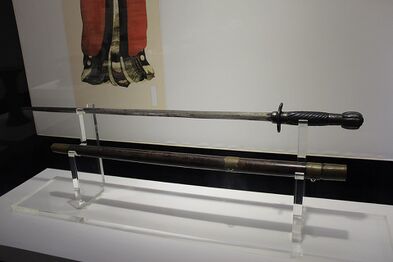
Qin also appears alongside Yuchi Gong (尉迟恭) in woodblock prints made to guard doorways.[14] The story preserved in the museum's catalog has the two generals watch over Emperor Taizong at night until he has portraits of them put up in their place.[14] The surviving Northern Song weapon below shows the form of a historical jiǎn, with a straight, four-ridged body and a wooden scabbard attributed to the Qing dynasty.[15]
-
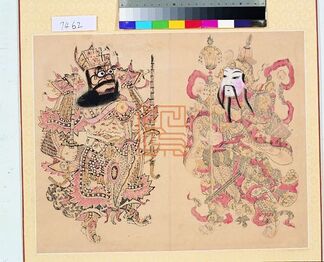 Qin Shubao (right) and Yuchi Gong in a late Qing or early Republican woodblock print, National Museum of History, Taipei.[14]
-


History
Dongping's game archive dates a right ranked-chariot encounter between Zhang Dekui (张德魁) and Wan Qiyou (万启有) to 1929.[17] The historians Chu Shi and Xu Ji describe one Sandwiched Horses study in Zhou Deyu's (周德裕) Forty-Eight Opening Methods (《开局四十八法》), a set of teaching notes from his classes in Hong Kong.[3] They also report that Zhou used the defense against Huang Songxuan (黄松轩) in Guangzhou in 1934 and lost.[3] Five years later in Hong Kong, Dong Wenyuan (董文渊) used it to beat Zhou at the Wenyuan chess venue (文园棋坛).[3][18] Zhou's overriver chariot and two cannons applied pressure in the center. The onlooker Li Zijian (黎子健) singled out Zhou's move of the advanced cannon to the middle as a mistake. Dong immediately advanced his right cannon. Zhou retreated the right horse toward the palace, and the historians identify that sequence as the turning point.[3]
Zhou Deyu–Dong Wenyuan, Hong Kong, 1939. Dong won.
Loading xiangqi example…
The defense appeared in a succession of Hong Kong studies, including two attacking examples in the first volume of Li Zhihai's (李志海) Cannon and Horse Contend (《炮马争雄》) in 1951, and a 1954 volume of Opening Methods (《布局津梁》) devoted to Single Horse and Sandwiched Horses.[4] In Shanghai, surviving printing matrices dated 1951 for Zhu Jianqiu's (朱剑秋) Latest Opening Methods (《最新开局法》) list four variations of an early central attack against the defense in the section for a one-move advantage.[19]
Hu's early tournament notes describe a practical problem. In the 1960s he advanced the seventh pawn early because he had yet to find a satisfactory way to meet the advance of Red's third pawn.[20] In their 1965 championship game, Liu Dianzhong (刘殿中) pushed the central pawn early and Hu raised the right chariot before developing his second horse.[20][21] Liu aimed his second cannon at the third file to counter the chariot. Hu later described the chariot move as progress over passive reinforcement and preferred earlier development of the inward horse in that position.[20][21] By 1974, Hu wrote that he could vary his seventh-pawn timing because he had found ways to meet Red's Five–Eight Cannons with an advanced third pawn.[22]
Liu Dianzhong–Hu Ronghua, national championship, 1965. Opening excerpt.
Loading xiangqi example…
The Hong Kong Amateur Xiangqi Association and Singapore's Beidou Xiangqi Research Society jointly published Hu's eleven-chapter study in August 1983 as 夹炮屏风.[5] The green first-edition cover carries the older “cannon inside the screen” title and the subtitle “Research on the Sandwiched Horses opening” (反宮馬佈局研究).[5] Hu added material for the September 1984 Shanghai edition.[5] In their 2019 study, Hong and Li credited his research and use in competition with the defense's revival and described its wider adoption during the 1980s.[23] In 1988 Hu won his fourth consecutive Wuyang Cup (五羊杯) with the defense in the rapid playoff.[24]
Central Cannon systems
An early P3+1 gives Red's right horse room and makes it harder for Black's seventh-file horse to advance. It also places a pawn on the rank along which Red might want to transfer a chariot.[2] Black can forestall this with an early p7+1 or advance the third pawn and seek play on the other wing.[6][25] The left ranked chariot gives Black another way to bring a major piece out when the horse pawn is restrained.[26]
Central-pawn rush
An early central advance tries to induce Black to spend moves on advisors and elephants. If Red can then offer the central pawn, an advancing chariot can take control of Black's pawn rank while the central cannon and horses press the center.[27] Hu showed how Black can challenge the rush by completing the inward horse development and returning the corner cannon to the central file. In his example the two sides contest the center while Black moves the other cannon outward to open the way for a chariot.[28][6]
A reply to the central-pawn rush from chapter IX of Hu Ronghua’s treatise.
Loading xiangqi example…
Overriver chariot, ranked chariot and riverbank cannon
With R2+6, Red sends a chariot to Black's pawn rank to restrain the seventh-file horse, particularly its jump to the river.[29] Black can offer to exchange chariots and bring the left chariot forward to defend that horse.[29] Yan and Zhang analyze a Black reply that raises the left chariot in place to support the threatened horse. In their example Black can offer a chariot exchange from there to seize the initiative.[30]
Overriver chariot against Sandwiched Horses, from chapter XI of Hu Ronghua’s treatise.
Loading xiangqi example…
Red can raise the right chariot with R1+1 and bring it to a palace-side file to support a central attack.[31] Against Liu Dahua (柳大华) in 1990, Hu advanced the third pawn to release his right horse against the center. On move nine Hu brought the left chariot to the river. Yan preferred bringing the palace-corner cannon to file 5.[31]
Liu Dahua–Hu Ronghua, 1990 Wuyang Cup. Opening excerpt with Yan Wenqing’s commentary.
Loading xiangqi example…
With C8+2, Red takes a slower approach. Yan and Zhang give two replies, a move of Black's right cannon to the edge to free the chariot and development of the left elephant to strengthen the center.[32] The example combines both ideas. After Red sends the right chariot over the river, the authors favor advancing Black's right chariot to restrict the riverbank cannon.[32]
Riverbank cannon and two Black replies, from game 102 of Yan and Zhang’s opening study.
Loading xiangqi example…
Five–Six Cannons
Red places the second cannon on file 6 with C8=6, keeping the central cannon and opening the eighth file for the left chariot.[33][34] The cannon also makes it easier to develop the left horse inward.[7] Black can open the right chariot's file by shifting the right cannon to the edge. In the seventh-pawn variation, Red combines a riverbank horse and overriver chariot against Black's left horse, while Black uses the active right chariot and can retreat the corner cannon before turning it against the invading chariot.[35][25]
Five–Six Cannons with the inward horse, from game 118 of Yan and Zhang’s opening study.
Loading xiangqi example…
With the left horse on the edge, developments by the two elephants lead to different plans for Black.[34][2] In the right-elephant setup, Hu describes a ranked chariot that can cross to the right, where Black can seek to exchange Red's nearby chariot and exploit the distance of the other.[34][2] With the left elephant, the left chariot has a route to help defend the horse, and the right chariot and cannon may work together to block the eighth file.[25][34] In a delayed-chariot line analyzed by Huang, the Red edge horse can retreat inward with an attack on that cannon.[25]
Jia Titao (贾题韬) explains how the edge pawns can also become important. In Li Laiqun (李来群)–Hu Ronghua, Hu offered an edge-pawn exchange to open his chariot's line. Li kept the pawns in tension and drew back the central cannon, ready to swing it toward the edge. Hu shifted his right cannon to the edge, opening the way for the exchange of chariots on the other wing.[36]
In the 2022 global pairs tournament, Zhao Xinxin (赵鑫鑫) and Shi Fenglan (时凤兰) played Five–Six Cannons against Hong Zhi (洪智) and Dang Guolei (党国蕾) in a drawn rapid game of the domestic mixed-pairs final.[37]
Li Laiqun–Hu Ronghua, Guangzhou, 1983. Opening excerpt with notes by Jia Titao.
Loading xiangqi example…
Five–Seven Cannons
With C8=7, Red directs the second cannon at the seventh file and clears the left chariot's way out.[38][39] The edge horse keeps that cannon file open in the mutual third-pawn system.[38][7] Black's early chariot can still shape the play. In the 1988 Wuyang Cup playoff against Lü Qin (吕钦), Hu opened the left chariot before Red set up Five–Seven Cannons. He then took the chariot to the river and across to the second file. Hu won the playoff after winning a horse in the middlegame.[24][40]
Lü Qin–Hu Ronghua, 1988 Wuyang Cup playoff. Opening excerpt.
Loading xiangqi example…
The mutual third-pawn setup can lead to a blockade by Black's right cannon. After 4. P3+1 p3+1 5. H8+9 e7+5 6. C8=7 r1=2 7. R9=8 c2+4, Black's cannon restricts Red's left flank and pressures the central pawn.[7][41] Red can wait with a riverbank chariot, or confront the blockade by offering two pawns with 8. P7+1 p3+1 9. P3+1.[25][41] In the pawn-offer line the riverbank chariot and seventh-file cannon can attack the advanced pawn and contest the left wing.[42] Black can try to exchange chariots by moving the cannon to the third file, advance the third pawn further, or take on the opposite flank and shift the third pawn sideways to protect the cannon as Yan Wenqing did in 1993.[42][39][43]
Xu Yinchuan (许银川) used the double pawn offer to beat Yan in the final round of the 1993 national championship, his first national individual title. The replay shows Xu bringing his right chariot across after both pawn offers.[43][44]
Xu Yinchuan–Yan Wenqing, national championship, 1993. Xu won.
Loading xiangqi example…
Five–Eight Cannons
Red advances the second cannon four ranks with C8+4 to attack from Black's pawn rank, where it may threaten pawns and help open a path for the left horse.[30][45] Hu's comparison of older Five–Eight lines with his later analysis stresses the support needed by Black's riverbank horse. An unsupported horse can run too far ahead of the chariots, while a well-placed horse and an active cannon can provide counterplay before both chariots are developed.[46] In Liu Dahua's account of Zhou Xiaoping (周小平)–Xu Yinchuan in 2008, the early edge cannon opened the way for Xu's right chariot to invade after Red took the central pawn.[47]
Tang Dan (唐丹) tried Five–Eight against Wang Linna (王琳娜) in the rapid tiebreak of the 2011 Qianjiang Cup. Tang moved the advanced cannon to the center and sought play for the material she offered. Wang went on to exchange both chariots and win.[48]
Tang Dan–Wang Linna, 2011 Qianjiang Cup rapid tiebreak. Opening excerpt.
Loading xiangqi example…
Other move orders
The shape can also be used by Red. Jin's Palcorner Cannon study starts 1. C2=4 c2=5 2. H8+7 h2+3 3. H2+3. Red forms Sandwiched Horses while Black has the Central Cannon, a route classified as A53.[49][50] Liu Dahua used the same formation from a Horse Opening against Xu Tianhong (徐天红) in 1995. The later inward horse followed the sequence 1. H2+3 p7+1 2. C8=6 h8+7 3. H8+7, a route whose first moves are cataloged under A43.[51][50]
Red adopts Sandwiched Horses from Palcorner Cannon, from chapter I of Jin Qichang’s study.
Loading xiangqi example…
In the 2019 National Mind Sports Games playoff, Huang Zhufeng (黄竹风) opened with a seventh-pawn advance. Meng Chen (孟辰) shifted his cannon to the palace corner, and Huang set up the Central Cannon on his second move. Black then completed the two-horse formation.[52] The game is a Central Cannon–Sandwiched Horses matchup reached through the E04 Pawn Opening route. ECCO retains that code for the reflected first move and reply.[53][52] Huang won the title after gaining material in the middlegame.[54]
Huang Zhufeng–Meng Chen, 2019 National Mind Sports Games playoff. Opening excerpt.
Loading xiangqi example…
Classification and recorded play
ECCO 2004's three Sandwiched Horses groups begin with Red's Central Cannon. Individual codes specify starting moves, allowed intervening moves and exclusions.[41][55] B30 covers routes such as Liu–Hu in 1965, in which Black plays an extra move beyond the listed pawn advances and elephant moves before completing the left horse. B31 covers the remaining continuations within its listed move allowances and exclusions.[41][20]
B32 is the early left-horse attack. The Chinese ECCO table prints 1... h8+7, which places Black's horse on the square the cannon would have to cross to play 2... c8=6.[41][56] Png's English translation gives 1. C2=5 h2+3 2. P7+1 c8=6 3. H8+7.[57] The ECCO publisher's game archive and the 2022 World Championship scorebook both label games with this move order B32. In Chen Lichun (陈丽淳)–Wu Xia (伍霞) in 2007 and Chao Yi-yifan (赵奕帆)–Sasaki Yuki (佐佐木雄希) in 2022, Black completed the formation with 3... h8+7 and both games continued 4. H7+6 e3+5.[58][59]
| ECCO codes | Distinguishing choices | Games in the Masters archive |
|---|---|---|
| B30–B36 | Delayed Black left horse, remaining continuations, rapid Red left horse, chariot and riverbank cannon systems, and Five–Eight Cannons.[41] | 3,275[60] |
| B40–B45 | Five–Six Cannons. Delayed chariot, inward horse with Black chariot, cannon and pawn alternatives, or edge horse.[41] | 1,866[60] |
| B50–B56 | Five–Seven Cannons. Black's chariot choices, mutual third-pawn moves, the right cannon crossing the river and Red's double pawn offer.[41] | 1,421[60] |
ECCO's own sample contained 504 of these classified games among 4,959 Central Cannon starts through 2004.[41][55] In the deduplicated Dongping Masters archive, 6,562 of 69,613 Central Cannon starts (9.4%) carry one of these tags, out of 141,548 archived games.[60] Within the archive's dated games, 427 of 2,071 Central Cannon starts in the 1980s (20.6%) carry these tags. For the partial 2020–2026 period the count is 999 of 11,674 (8.6%).[60]

The archive also has 998 games tagged A53. The A43 and E04 examples show two of the other routes by which a game can reach the same formation.[60][50][53]
See also
References
- ↑ a b c d e f g h i j Jim Png Hau Cheng, Lexicon of Xiangqi (Chinese Chess) Terms in English, 2017, ISBN 9789574347070, pp. 474–475, “Sandwiched Horse Defense” and “Sandwiched Horses”. Bibliographic record.
- ↑ a b c d e f g h Hong Leixin (洪磊鑫) and Li Peng (李鹏), 反宫马之半壁河山, Qingdao Press, 2019, ISBN 9787555280569, introduction and chapter I, game 1.
- ↑ a b c d e Chu Shi (褚石) and Xu Ji (徐骥), 广州棋坛六十年史, vol. V, Hong Kong Shanghai Book Company, pp. 39–40, game 5036, and pp. 70–75, ch. 14. Text transcription.
- ↑ a b Yan Mujiang (言穆江) and Chen Yiqiu (陈弈秋), 香港象棋谱点评, entries V and VII, pp. 2–4.
- ↑ a b c d Yan Mujiang and Chen Yiqiu, 重温历程, entry XIX, “夹炮屏风”, with photographs of the books.
- ↑ a b c Yan Wenqing (阎文清) and Zhang Qiang (张强), 布局定式与战理, part IV, games 112, 114 and 126, opening annotations.
- ↑ a b c d e Tang Yashun (唐亚顺), 儿童象棋阶梯教室:实战篇, Chemical Industry Press, digital edition 2024, ISBN 9787122328748, lesson 22 and lesson 23.
- ↑ a b General Administration of Sport chess administration center, report on the 2017–2018 Women's Xiangqi League final, Zhang Guofeng–Zhao Guanfang game.
- ↑ a b Dongping Master Games, Zhang Guofeng–Zhao Guanfang, 27 April 2018, moves 1–9.
- ↑ Taiwan Ministry of Education, Revised Mandarin Chinese Dictionary, 半壁江山, including the variant 半壁河山.
- ↑ Jin Qichang (金启昌), 中炮对反宫马, Beijing Sport University Press, 2010, ISBN 9787564405472, publisher's synopsis and chapter contents.
- ↑ a b Sun Haoyu (孙浩宇), “神兵利器谁与争锋?趣谈象棋的十八般兵器上”, §9, “锏——反宫马”.
- ↑ a b Chu Renhuo (褚人获), 隋唐演义, ch. 8, Qin Shubao and his inherited pair, and ch. 14, demonstration before Luo.
- ↑ a b c National Museum of History (國立歷史博物館), Taipei, 門神,秦叔寶,尉遲恭, inv. 07462, collection description and CC BY image.
- ↑ a b Fujian Provincial Cultural Heritage Bureau, “八闽文物·以器载道 | 唐宋时期铜器”, 21 December 2023, entry “北宋靖康元年李纲锏”.
- ↑ Gary Lee Todd, “Sword/Truncheon, Northern Song, Heirloom”, 24 March 2017, CC0 image record.
- ↑ Dongping Master Games, Zhang Dekui–Wan Qiyou (dated 1929), opening score.
- ↑ Dongping Master Games, Zhou Deyu–Dong Wenyuan, 29 September 1939, game score.
- ↑ Wu Ruopeng (吴若鹏), “剑胆琴心,秋实春华——朱剑秋的遗著《最新开局法》惊现人间”, PDF pp. 12–16, reproduced contents and dates of the matrices.
- ↑ a b c d Hu Ronghua (胡荣华), 反宫马专集, Shanghai Culture Publishing House, 1984, practical game 3, Liu Dianzhong–Hu Ronghua, notes to plies 6, 8, 9 and 16.
- ↑ a b Liu Dianzhong (刘殿中), 刘殿中象棋对局精选, Enterprise Management Press, 2019, ISBN 9787516419601, notes to his game with Hu Ronghua, 15 November 1965.
- ↑ Hu, 反宫马专集, practical game 11, Zhao Qingge–Hu Ronghua, 19 July 1974, notes to plies 8–12 and 17–22.
- ↑ Hong and Li, 反宫马之半壁河山, preface, on Hu's research, the 1980s and reassessment of old lines.
- ↑ a b Zhang Jiachang (张家昌), Xinhua, “胡荣华再夺‘五羊杯’”, People's Daily, 17 January 1988, p. 3.
- ↑ a b c d e Huang Shaolong (黄少龙), 象棋开局初步, People's Sports Publishing House, 1992, ISBN 7-5009-0745-1, pp. 112–119 and 156–158. Chinese edition scan.
- ↑ Yan and Zhang, 布局定式与战理, part IV, game 111 and game 123.
- ↑ Hu, 反宫马专集, chapter I, game 1, especially plies 8 and 13.
- ↑ Hu, 反宫马专集, chapter IX, game 1, plies 7–20.
- ↑ a b Hu, 反宫马专集, chapter XI, game 1, plies 9, 12–15 and 24.
- ↑ a b Yan and Zhang, 布局定式与战理, part IV, game 100, plies 9–16, and game 101, plies 10–12.
- ↑ a b Yan Wenqing, annotated Liu Dahua–Hu Ronghua, 10th Wuyang Cup, 6 January 1990, plies 12–25.
- ↑ a b Yan and Zhang, 布局定式与战理, part IV, game 102, plies 9–19.
- ↑ Png, Lexicon, pp. 234–236, “Five Six Cannons” and “Five Six Cannons versus Sandwiched Horse Defense with Left Elephant Variation”. Bibliographic record.
- ↑ a b c d Hu, 反宫马专集, chapter IV, game 1 and chapter V, game 1.
- ↑ Yan and Zhang, 布局定式与战理, part IV, game 118, plies 7–24.
- ↑ Jia Titao (贾题韬), annotated game 21, Li Laiqun–Hu Ronghua, Guangzhou, 20 January 1983, notes to plies 10, 18 and 20.
- ↑ Ge Huizhong (葛会忠), “全球象棋双人赛赵鑫鑫/时凤兰夺冠”, China Sports Daily, 22 November 2022, p. 3.
- ↑ a b Png, Lexicon, pp. 229–230, “Five Seven Cannons” and “Five Seven Cannons versus Sandwiched Horse Defense with Left Elephant Variation”. Bibliographic record.
- ↑ a b Hu, 反宫马专集, chapter III, game 1 and chapter V, game 2.
- ↑ 胡荣华棋路, Lü Qin–Hu Ronghua, 16 January 1988, compared with the Dongping score.
- ↑ a b c d e f g h i 象棋百科全书网, ECCO 2004, December 2004, Class B, especially groups B3–B5, with defining moves, exclusions and sample counts.
- ↑ a b Yan and Zhang, 布局定式与战理, part IV, game 109, the position after ply 19 and both Black responses.
- ↑ a b “许银川一战登顶!五七炮双弃兵对反宫马的精彩对局”, notes to plies 14 and 19 onward. Dongping score.
- ↑ “荣登‘六冠王’ 许银川直言难超胡荣华”, 7 December 2009, interview and title chronology.
- ↑ Yan and Zhang, 布局定式与战理, part IV, game 103, plies 9–19.
- ↑ Hu, 反宫马专集, chapter I, game 2 and chapter III, game 2.
- ↑ Liu Dahua (柳大华), “周小平先负许银川”, 棋艺, 2009 (2), moves 4–8 and notes.
- ↑ Qianjiang Cup final report, September 2011, women's rapid game. Dongping score.
- ↑ Jin Qichang, 仕角炮新编, chapter I, game 1, opening and variations at ply 5.
- ↑ a b c 象棋百科全书网, ECCO 2004, Class A, A43 and A53.
- ↑ Zhang Qiang, annotated Liu Dahua–Xu Tianhong, Wuyang Cup, Guangzhou, 21 December 1995, moves 1–3 and note at ply 3.
- ↑ a b National Mind Sports Games final report, 13 November 2019, and Huang–Meng score.
- ↑ a b 象棋百科全书网, ECCO 2004, E04 and FAQ §6, on left–right reflection.
- ↑ General Administration of Sport, “浙江象棋时隔12年再现高光点”, 2019, report of the professional men's singles final.
- ↑ a b 象棋百科全书网, ECCO 2004, introduction and classification method.
- ↑ Asian Xiangqi Federation, 象棋比赛规例, 4th revision supplement, 2017, ch. 1, §2, rules 4–6.
- ↑ Jim Png Hau Cheng, ECCO Opening Classification Translated, B32, “Central Cannon with Quick Left Proper Horse vs. Sandwiched Horse Defense”.
- ↑ 象棋百科全书网, Chen Lichun–Wu Xia, 21 April 2007, B32 and moves 1–4.
- ↑ World Xiangqi Federation, 17th World Xiangqi Championships individual game records, 24 October 2022, men's game R02T04, B32 and moves 1–4. Results with romanized names.
- ↑ a b c d e f Dongping Master Games, as retained by the LiXiangQi Masters opening book, snapshot 17 November 2026. Archive counts and method.
