Xiangqi in art: Difference between revisions
Publish illustrated Xiangqi in art with sourced works and two playable compositions |
Display the four photographs of Castiglione’s folding board in larger pairs |
||
| Line 49: | Line 49: | ||
The painter had to compose sixteen pictures as well as one.<ref name="flowers" /> Each section of the board can stand as a scene on its own, while banks, rocks and flowering plants join across the seams.<ref name="flowers" /> The court official Liang Shizheng (梁詩正) inscribed a poem comparing the painter’s arrangement to writing that reads in reverse.<ref name="flowers" /><ref name="jade" /> In ''Another Kind of Chess Game'', Jeffrey Shaw gave a visitor sixteen buttons and projected a digital model of the board onto a table.<ref name="shaw">[https://www.isea-symposium-archives.org/art-events/another-kind-of-chess-game-by-jeffrey-shaw/ Jeffrey Shaw, Another Kind of Chess Game, artist’s statement, ISEA archives]. Installation description.</ref> Each button turns one section, so a strip of flowers can lie between two stretches of playing grid, an arrangement the historical object inspired in the digital work.<ref name="shaw" /> | The painter had to compose sixteen pictures as well as one.<ref name="flowers" /> Each section of the board can stand as a scene on its own, while banks, rocks and flowering plants join across the seams.<ref name="flowers" /> The court official Liang Shizheng (梁詩正) inscribed a poem comparing the painter’s arrangement to writing that reads in reverse.<ref name="flowers" /><ref name="jade" /> In ''Another Kind of Chess Game'', Jeffrey Shaw gave a visitor sixteen buttons and projected a digital model of the board onto a table.<ref name="shaw">[https://www.isea-symposium-archives.org/art-events/another-kind-of-chess-game-by-jeffrey-shaw/ Jeffrey Shaw, Another Kind of Chess Game, artist’s statement, ISEA archives]. Installation description.</ref> Each button turns one section, so a strip of flowers can lie between two stretches of playing grid, an arrangement the historical object inspired in the digital work.<ref name="shaw" /> | ||
<gallery widths=" | <gallery perrow="2" widths="265" heights="200"> | ||
File:Qing jade xiangqi pieces - National Palace Museum.jpg|alt=Four rows of circles with gold characters on dark green jade and red characters on white jade.|The white and green jade armies. National Palace Museum, Taipei.<ref name="jade" /> | File:Qing jade xiangqi pieces - National Palace Museum.jpg|alt=Four rows of circles with gold characters on dark green jade and red characters on white jade.|The white and green jade armies. National Palace Museum, Taipei.<ref name="jade" /> | ||
File:Gilt face of the Qing flower chessboard.jpg|alt=Jade pieces stand in two armies on the gold-coloured grid of a folding board.|The playing face, ruled on gilt paper. The sections meet along the lines of the board. National Palace Museum, Taipei.<ref name="jade" /> | File:Gilt face of the Qing flower chessboard.jpg|alt=Jade pieces stand in two armies on the gold-coloured grid of a folding board.|The playing face, ruled on gilt paper. The sections meet along the lines of the board. National Palace Museum, Taipei.<ref name="jade" /> | ||
Latest revision as of 21:12, 22 November 2026

Xiangqi in art ranges from pictures of people playing Chinese chess to works in which the playing equipment itself carries the picture.[1][3] A Southern Song scroll makes a single general the sign of a future emperor.[4][5] On the reverse of a Qing folding board, the court painter Giuseppe Castiglione made sixteen panels of silk into one flowering landscape.[6] In a Suzhou print of a quarrel, a man raises the board over his head while the pieces scatter across the floor.[1]
A position can also be the work of art.[7] In the early twentieth century Xie Xiaxun (謝俠遜) arranged pieces to spell Chinese characters, each of which stood for an episode in recent history and posed a chess problem.[8][9][10] A woodcut lets a reader replay a medieval endgame, while in Vietnamese cờ người thirty-two people take the pieces’ places and perform the moves before an audience.[11][12]
Reading the board
Two details help identify xiangqi even when the characters on the pieces are too small to read.[2] On a xiangqi board the nine files and ten ranks meet at ninety points, with a river interrupting the lines across the middle.[2] At each end, diagonals mark off a nine-point palace where the general and the two advisors move.[13] Both crossed palaces are visible in a grid cut into a boulder at Taiwan’s Shisanjia Bogong Temple.[14] They also distinguish the two faces of a Qing travelling board in Taipei’s National Palace Museum.[15] On one face the silk is ruled for xiangqi, on the other for the nineteen-by-nineteen intersections of weiqi (圍棋, Go).[15] The whole board folds down like a small album.[15]
The furniture and the seated opponents can be much the same in pictures of different games.[16][17] The Palace Museum in Beijing identifies the game in the celebrated Double Screen handscroll attributed to Zhou Wenju (周文矩) as weiqi.[16] Chen Yuanjing’s (陳元靚) illustrated household encyclopedia Shilin guangji (事林廣記) includes both a xiangqi ending called Double Dragons Out to Sea and a weiqi encounter between Liu Zhongfu and an old woman.[11][18] A late Ming encyclopedia makes the distinction on a single page.[19] In its 1596 printing the upper register contains xiangqi and the lower weiqi, an arrangement that the historian Zhang Ru’an (張如安) explains as an economical use of the block.[19]
-
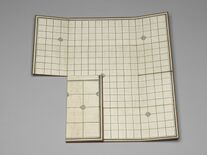 The two grids on the Qing folding board. National Palace Museum, Taipei.[15]
-
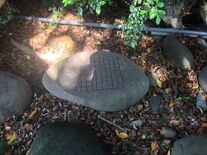 Empty board carved into a stone at Shisanjia Bogong Temple. Photograph by Outlookxp.[14]


A general wrapped in yellow silk

In the Tianjin Museum’s Auspicious Omens of Dynastic Revival (中興瑞應圖), Lady Wei stands at a table in a palace room with seven attendants around her.[4][5] A handful of round pieces lies on the table.[4] The woman’s extended hand places the viewer at the instant of the cast.[4] The palace drawn on the board gives that gesture its meaning.[5] In Cao Xun’s (曹勳) inscription, Lady Wei wraps a general in yellow silk and marks it with the title of her son Zhao Gou (趙構), Prince of Kang.[5] She prays that, if he is to take the throne, his piece alone will fall within the palace.[5] It does.[5] The prince became Emperor Gaozong, the first ruler of the Southern Song.[4][21]
The painting belongs to a sequence of twelve omens.[20][4] In the seventh, it is the rank written on the piece and the place where it falls that identify a future ruler.[5][13] Cao told the story of the 1127 crisis twice.[5] His account of the imperial family’s captivity places the casting on the journey north, while the text written for the picture sets it outside the fallen capital.[5] Yu Yunguo (虞雲國) dates the cycle to about 1171–1174 and argues for Gaozong’s part in its making.[4] Luo Chaohua (羅超華) agrees that the work followed his abdication but points out that no order from the emperor survives.[22] The Taipei museum’s scroll, attributed to Li Song (李嵩) but dated by its curators to the Ming, contains four episodes.[20] Lady Wei’s casting belongs to the Tianjin version illustrated here.[4]
In a tale preserved by Niu Sengru (牛僧孺), someone cuts open two unusually large oranges and finds a pair of old men at play inside each one.[23] The Southern Song poet Liu Kezhuang (劉克莊) could call xiangqi the game inside the orange.[24] Zhu Jinzhen (朱晉楨) drew on the same story for the title of his 1632 manual, Secrets Inside the Orange (橘中秘).[25][26] In Hanabusa Itchō’s drawing, published in the eighteenth-century Itchō gafu, two old men sit inside the rind beside a board dotted with Go stones.[27]
-
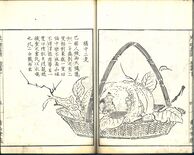 Hanabusa Itchō’s men inside an orange. The board in this Japanese illustration is a Go board. Kanazawa College of Art.[27]
-


Painting and carving the equipment
Faces of a counter
Each of the thirty-two counters in a Song bronze set exhibited by the China Sports Museum has a name on one face and a corresponding picture on the other.[28] A collector writing for the Jining Museum describes a soldier bought in Hangzhou with the character bing (兵) and a figure riding a beast on the same side.[29] He left the species of the mount an open question.[29] Archaeologists at Diaoyucheng in Chongqing recovered a horse, a cannon written with the stone radical (砲) and a soldier of matching size.[30] A smaller general, found separately, has a hole through it.[30] The archaeologist Zhao Zhenjiang suggested it could have been worn or strung for carrying.[30]

Colour can distinguish the two armies even when their titles agree.[32][33] On a set excavated at Jiangyou, both armies have a jiang (將, general) and five zu (卒, soldiers).[33] A complete Northern Song set excavated in Luoyang uses different-coloured ceramic bodies and incised lettering, with traces of red pigment still visible.[32] On a glazed cannon from the Xiheyan site in Beijing, the potter picked out the recessed character and the circle around it in yellow-brown against a green edge.[34] A single Qing ivory piece in the National Palace Museum measures just 1.7 centimetres across.[35] A wooden set in the Horniman Museum pairs mother-of-pearl inlay with blue and red characters and a board printed on paper.[36]
A Taiwanese museum’s Five Rings set still has its blue label with an orange trophy, its wooden pieces and its paper board.[37] Someone supplied its missing red horse by writing the character on white paper.[37] Designing an alternative for people who could not read the characters became a question for international players.[38] Yan Mujiang (言穆江) and Chen Yiqiu (陳弈秋) trace the pictorial designs of Singapore’s Mao Ruifa (毛瑞發) through their adoption in Bangkok in 1981 and the federation’s reversal in 1982.[38] The picture pieces retained a use in instruction while the character pieces kept their place in official play.[38]
A garden on the reverse
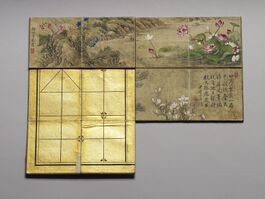
The Qing jade set in the National Palace Museum comes with two armies of sixteen.[3] On the white jade the cuts are filled with red, and on the green jade with gold.[3] The pieces fit into a box underneath a folding wooden board.[3] Open it with the gilt-paper face upwards and the lines, river and palaces are ready for a game.[3] Turn it over and there is a painting on silk signed by the court painter Lang Shining (郎世寧), the Italian Jesuit Giuseppe Castiglione.[3] Lotus, iris, peony and chrysanthemum bloom together beside the water, with two birds calling to one another.[6]
The painter had to compose sixteen pictures as well as one.[6] Each section of the board can stand as a scene on its own, while banks, rocks and flowering plants join across the seams.[6] The court official Liang Shizheng (梁詩正) inscribed a poem comparing the painter’s arrangement to writing that reads in reverse.[6][3] In Another Kind of Chess Game, Jeffrey Shaw gave a visitor sixteen buttons and projected a digital model of the board onto a table.[39] Each button turns one section, so a strip of flowers can lie between two stretches of playing grid, an arrangement the historical object inspired in the digital work.[39]
-
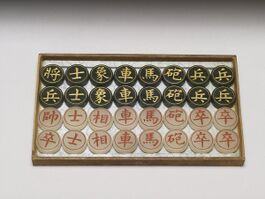 The white and green jade armies. National Palace Museum, Taipei.[3]
-
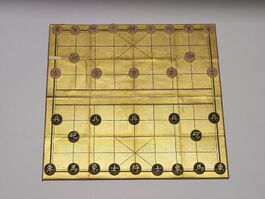 The playing face, ruled on gilt paper. The sections meet along the lines of the board. National Palace Museum, Taipei.[3]
-
-
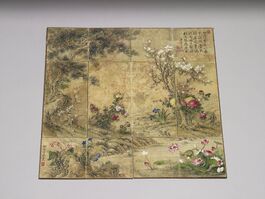 Castiglione’s flowers on the reverse. Each of the sixteen sections forms a smaller picture. National Palace Museum, Taipei.[6]


The written piece as decoration
On a Qing porcelain dish studied by Zhang Chaoying (張超英), two advisors and a sceptre make a wish.[40] The character for an advisor, shi (士), sounds like the word for an affair or undertaking (事).[40] Read the two discs aloud, then name the ruyi (如意) sceptre beside them, and the objects say shishi ruyi (事事如意), “may everything go as you wish”.[40] The motif repeats four times around the dish.[40] Zhang found a different joke on a little porcelain bird feeder.[40] The chariot and horse on the feeder call to mind the saying that provisions must go ahead of the army.[40] Zhang’s reading turns the bird’s food into the army’s provisions.[40]
The words written across a board’s river, Chu he, Han jie (楚河漢界, “Chu River, Han border”), lend themselves to the same kind of play.[7][41] In Xingyang, Song Changsheng (宋長生) fused the first pair of characters and the second pair into two signs, combining Han clerical lettering, bamboo-slip forms and the brushwork of the Qing calligrapher Jin Nong (金農).[41] The design also appeared on folding fans.[41] A local exhibition showed paper-cut artists working on xiangqi subjects, while a Nanjing university team looked to Wei and Jin stone inscriptions and the regular script of Yan Zhenqing (顏真卿) for lettering later used in online chess activities.[42][43]
The Chinese chess authorities’ 2025 competition asked for a consistent script across the pieces and a different script for the words on the river.[44] More than a hundred entries were submitted.[45] The first set in the edition of sixty went to the China Sports Museum, and at the presentation the judoka Yang Xiuli (楊秀麗) and grandmaster Xu Yinchuan (許銀川) brushed the opposing commanders’ names.[45] In 2026 the annual set bore lettering by the calligrapher and seal carver Pang Shutian (龐書田).[46] The associated exhibition invited work in media as different as seal carving, lacquer painting, printmaking and ceramics.[47]
Playing cards
On four-colour cards, the general, advisors, elephants, chariots, horses, cannons and soldiers can be held in the hand and dealt.[48][49] The National Museum of Taiwan History preserves a pack still bound with a strip of paper, its colours fading and flaking.[48] A player writing in Quanzhou recalled a four-handed game with 112 long, narrow cards, four of each rank in each of four colours.[49] The thirty-two cards of Vietnamese tam cúc follow the two sixteen-piece armies of cờ tướng, the Vietnamese name for xiangqi.[50][51] In the pack illustrated here a red ornamental ground distinguishes one side, and pictures make the ranks legible.[52][51] The elephant has a trunk and tusks, the horse is saddled, and the cannon has wheels.[52]


The same corners and borders could be put to work in several games at once.[54] Sixteen Taiwanese cards illustrating the heroes of Three Heroes and Five Gallants carry a zodiac sign in the upper right, a xiangqi rank in the upper left, a number below and a Western suit in the remaining corner.[54] Among the figures are the magistrate Bao and the swordsman Zhan Zhao.[54] On an uncut sheet of twenty-four children’s counters in the same museum, pairs of zodiac animals fill the centres and the four-colour ranks sit in the upper corners.[55] In Vietnam the illustrator Duy Văn drew on designs he had made for a book of folk spirits to create a new tam cúc deck.[50] His sources included the Hàng Trống and Đông Hồ print traditions.[50] In Đông Hồ printing, colours have their own blocks and the final black outline brings them together.[56]
Pictures that can be played

The Yuan woodcut of Double Dragons Out to Sea fits three things into a single block.[11] A dark cartouche names the study, a diagram fixes the exact distribution of the pieces, and a line of moves tells the reader how to set them in motion.[11] The original calls the winning side White.[11] The modern transcription presents that side as Red, playing from the bottom.[57] The woodcut’s seven half-moves end with a chariot racing up the second file, 4. R2+4.[11] In the modern transcription’s longer line Black interposes a chariot, 4... r7-1, and Red takes it with 5. R2=3 for mate.[57] The last two half-moves in the player belong to that continuation.[11][57]
Double Dragons Out to Sea
Loading xiangqi example…
Printers used the space around the grid to direct the reader’s eye.[19][58] A page of the 1597 Five Carts of Brocade (五車拔錦) identifies a Screen Horses opening in a heading above columns of moves.[59][19] In a surviving printing of Elegant Pastime (適情雅趣), the cartouche above position 209 gives the problem a Buddhist title.[58] The strip below offers a clue about the play.[58] White is to give up a chariot and a horse, and the soldier is to win.[58] In November 1926 the Shanghai publisher Zhonghua Shuju put piece names to work around the border of an advertisement.[60] Inside that frame it announced the four volumes of Xie Xiaxun’s first collection and their price of three yuan.[60]
-
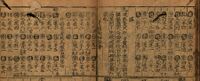 The Screen Horses score in the 1597 encyclopedia. Library of Congress.[59]
-
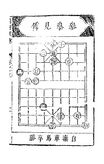 Position 209 of Elegant Pastime. The words below the board tell what White gives up. Peking University Library copy.[58]
-
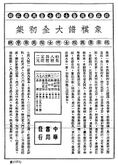 A border of pieces advertises Xie’s collection in the journal Xueheng, 1926. National Library of China.[60]


Characters and animals made of pieces
A more exacting form of picture-making asks that the pieces themselves draw a recognizable outline and still yield a solvable chess problem.[7] In a study associated with the Boxer Protocol of 1901, the young Xie Xiaxun placed eight dark pieces around the palace to represent the invading Eight-Nation Alliance.[61][8] With Pan Dingsi (潘定思) he made thirty character-shaped compositions to recall events from the Opium War to the Twenty-One Demands.[9][8] The Commercial Press issued their New Xiangqi Positions in Commemoration of National Humiliation in Shanghai in August 1916.[10] Xie’s family recalled a position in the shape of 卡, accompanied by lines mocking the six men who had promoted Yuan Shikai’s bid to become emperor.[8]
Fitting the writing to the chess posed a difficulty for Wang Jianxin (汪建新), who made three positions spelling “Chinese Dream” (中國夢).[62] He reworked the outline of the dream character until he was satisfied that people would recognize it.[62] His hardest character, “country”, used all thirty-two pieces.[62] Other players in Zigong examined the resulting lines of play.[62]
Yao Yougen’s (姚佑根) animal-shaped study appeared in the Yangcheng Evening News on 6 October 2007, with the solution a week later.[7] Jim Png reproduces both in his Lexicon of Xiangqi and describes the animal as a deer or antelope.[7] Seen before the first move, the pieces make a body across the lower ranks, a long neck rising from its left side and a pair of legs beneath it.[7] Advancing first one cannon and then the other begins to take the outline apart.[7] The player gives the first four moves of Png’s published line.[7]
Yao Yougen’s deer, 2007 · first four moves
Loading xiangqi example…
Players, spectators and artists
In the Suzhou print Manchus Quarrel During a Chess Game, the players’ anger has given the spectator a clear view of the board.[1] A bare-chested man swings it overhead while a second man restrains him from behind.[1] One figure bends towards the scattered counters, and another man throws out his arms behind the table.[1] The action runs across a sheet nearly 78 centimetres wide, with colour added by hand to the black woodblock lines.[1] For makers of popular prints in Suzhou, scenes of everyday life belonged alongside deities, stories and auspicious subjects in the pictures bought to put up at New Year.[63] The game also appears as the subject of a second Qianlong print, catalogued by the Umi-Mori Art Museum in Japan under the name Zhonggui Zheng (中桂正).[64] Its coloured woodblock image is almost square, just 31 by 30.3 centimetres.[64]
In Europe, John Ingram’s eighteenth-century etching and engraving after François Boucher bears the title The Game of Chinese Chess.[65] A seated player dominates the foreground, with the playing surface tucked into the group around him.[65] Eyles Irwin’s 1793 letter from Canton to the Royal Irish Academy offered a European reader a different view.[66] His plate gives the board the whole field, and the accompanying directions explain the river, the armies and how the cannon captures.[66] Chinese manufacture could also serve a European game.[67][68] National Museums NI identifies its Qing ivory horseman, with a removable sword and a shaft of nested balls, as an export knight.[67] A Chinese-made set at the Metropolitan Museum has crowned queens and bishops, yet its flag-topped mortar-shaped rooks reminded the curator of the xiangqi cannon.[68]
-
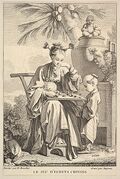 John Ingram after François Boucher, The Game of Chinese Chess, 1741–1763. Metropolitan Museum of Art.[65]
-
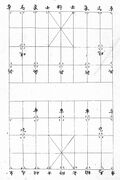 The plate accompanying Eyles Irwin’s letter from Canton, 1793.[66]


For Liang Xiuzhong (梁秀中), the game supplied one centre of attention among several.[69] In Under the Peach Tree (桃樹下), two boys play in the foreground and a girl in a pink checked dress watches.[69] A second girl uses a twig to tease a dozing boy.[69] A reader and a kite-flyer complete the group of seven.[69] Liang painted the picture in autumn 1982 and gave the children a tree in spring blossom.[69] The feelings of the onlooker are the whole subject of a short poem by the Qing poet Yuan Mei (袁枚).[70] He stands with his hands folded into his sleeves, sees the armies of Chu and Han confronting each other and swings between delight and exasperation as he watches.[70]
The landscape painter Xu Qinsong (許欽松) compared holding a plan in reserve during a game to leaving part of a painted landscape indistinct.[71] In composing a mountain he wanted gentle stretches against which a sudden precipice could register.[71] When printmakers Yang Feng (楊鋒), Wang Jiazeng (王家增) and Kong Guoqiao (孔國橋) exhibited together in 2018, Kong recalled their matches and said that each man’s way of playing had become recognizable to him in his prints.[72]
A place at the table
Hedda Morrison’s Playing Chinese Chess, made in Beijing between 1933 and 1946, places two young men on a kang, a heated platform.[17] Their long fur-lined gowns, caps and the carved wood around them help the Powerhouse curator identify a prosperous household in winter.[17] The curator also calls it one of Morrison’s more deliberately staged photographs.[17] In Liu Anming’s (劉安明) 1990 photograph Duìyì (對弈), a player squats on a folding chair, a cigarette in one hand and the other hand suspended above the board.[73] Of three spectators, one is almost hidden behind him.[73] Curator Wei Zhujun (魏竹君) observes that the photographer has left one place at the table open, directly in front of the viewer.[73]
A different audience fills the frame in Yoshinari Shōichi’s (吉成正一) 1975 photograph at Tainan’s Small City God Temple.[74] The opera company is performing the story of Xue Pinggui and Wang Baochuan onstage.[74] Below, members of its audience have their heads bowed over their own game of xiangqi.[74] Malcolm Rosholt’s photograph in Yinchuan records the game on a Ningxia street.[75] In 2007 teenagers photographed their San Francisco neighbourhood for a workshop.[76] One picture identifies Mr Feng and Mr Gun at play in Chinatown’s Fan Yun Gok Park, watched by a third man.[76]
-
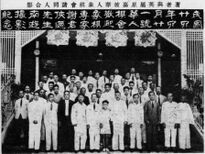 The Singapore association welcomed Xie Xiaxun in 1935. He reproduced this group portrait in his illustrated account of the tour, published in 1937.[77]
-
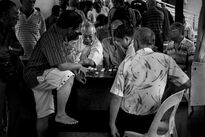 Varun Chatterji’s photograph brings the viewer to the edge of a game in Singapore’s Chinatown, 2012.[78]
-
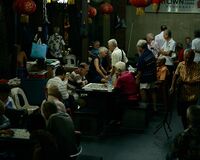 Players and spectators at a Chinatown pavilion after dark, photographed by Whgan07 in 2023.[79]


A 2016 SingPost series looked back to board games familiar in Singapore in the 1970s and 1980s, placing Chinese chess on the stamp for first local postage.[80] Varun Chatterji’s Singapore picture catches a man leaning in from the left, the players still visible through a gap, while Whgan07’s later colour photograph draws back to include the company gathered around several tables in a Chinatown pavilion.[78][79]
Sculpture and public art
Sculpted armies

When Ju Ming (朱銘) carved chessmen, he kept the decisive axe-cut lines of his larger sculptures.[83] A Taiwanese account describes the effect of holding these compact figures from his sets of 1985 and 1987.[83] An authorized edition of Xiangqi (Historical Figures) dated 1988 consists of thirty-two pieces with a wooden board.[84] Chen Cheng-hsiung (陳正雄) chose the Song and Jin as the rival armies in Blazing Battle (烽火大戰, 1988).[85] His bronze and stainless-steel figures stand on a lacquer board measuring 173 by 143 centimetres, with the work’s title spanning the space between the armies.[85]
For the exhibition Wangzhe tianxia (王者天下) Wu Rongci (吳榮賜) individualized the combatants of the Chu–Han struggle in ninety-six bronzes and four wood sculptures.[86] In her wooden set DUEL, Winnie Lim describes working backwards from writing, giving each name a corresponding person, animal or artefact from the conflict.[87] Beijing craftsman Zhang Guoliang (張國良) found a second use for the disc itself.[81] He had learned diabolo making from his father at ten, and made a set in which every chessman could be lifted off the board and spun on a string.[82][81]
For his 2015 Harmony in Difference (和而不同), Zhao Sining (趙斯寧) glued the pieces to two half-boards and placed a double-sided mirror between them.[88] On the xiangqi side he mounted cloud-patterned paper and edged the sandalwood counters in gold.[88] On the other he built up black and white oil paint in the squares of a Western chessboard.[88] The Hong Kong sculptor Chow Shun-keung (周順強) made Chess (棋, 2001) in twenty-one pieces of wood.[89] His starting point was the form of xiangqi pieces, which he associated with experiences as far apart as the desire for a utopia and encounters with social violence.[89]
The public board
In Beijing’s Purple Bamboo Park, Crossing the Sea on an Eastern Expedition (跨海征東) turns a named endgame into a place to walk.[90] The ground is the board and the pieces are carved figures.[90] Its title invokes the Tang emperor Taizong’s expedition across the sea.[90] The park’s description compares the expanse of water to the depth and variety of the continuations in the endgame.[90] In a Taipei courtyard the 2015 work Turning the Situation Around (扭轉乾坤) spans sixteen metres, using stone, wood and steel to set out a formation.[91] Its makers describe that array as planning for victory.[91]

In Singapore’s Esplanade Concourse, Justin Lee (李志) set his terracotta-warrior figures facing one another in Game of Life.[92] A river ran down the steps, and the grid became a series of fortifications.[92] Lee associated the hierarchies on either side with relations at work, in social life and online.[92] In Guangzhou, visitors can stop over a position carved into the tombstone of grandmaster Yang Guanlin (楊官璘).[93] Yang Jianming (楊健明) designed his father Yang Guanlin’s tombstone with reliefs of his books, trophies and an endgame.[94] Yang had worked out the solution late in life and left it unpublished.[94] His son wrote that he put it there for visitors to solve as a way of remembering him.[94][93]
Living pieces, stage and screen
Human xiangqi in Vietnam
In Vietnamese cờ người (“human chess”), the playing ground can be a temple courtyard or a level field.[95] Two people still choose the moves.[12] Thirty-two others, in costume, represent their pieces.[96] One account describes a man and a woman selected as the opposing generals, with a thirty-third official, the tổng cờ, directing proceedings.[96] In a version described by Vietnam Tourism, the two players call moves from raised platforms behind their armies.[97] Drum rolls signal the start, and a performer demonstrates martial movements on the way to the new position.[97] A captured piece leaves the field.[97]
André Salles photographed the setting for a human game near Hanoi at the residence of the mandarin Lê Hoan in 1898.[98] His plate takes in the wooden structures beside the water.[98] Léon Busy later turned the camera towards the performers themselves.[99][100] His autochrome of a group of women acting as pieces in Tonkin records the colours of their robes and headwear.[99] In a separate portrait a young woman playing a pawn stands in pink with one hand on her hip.[100] Both plates date to 1914–1918 and belong to Albert Kahn’s Archives de la Planète.[101][100]
-
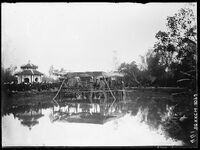 The site of the game at Lê Hoan’s residence, near Hanoi, June 1898. André Salles, Bibliothèque nationale de France.[98]
-
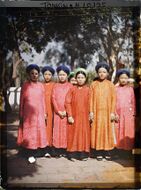 Women appearing as human chess pieces in Tonkin, 1914–1918. Léon Busy, Musée départemental Albert-Kahn.[99]
-
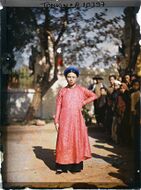 A performer playing a pawn, from a second autochrome by Busy. Musée départemental Albert-Kahn.[100]


At Cổ Loa, the festival used cờ bỏi, played with markers, from 1953 to 2005, before restoring human pieces in 2006.[102] At Hanoi’s Chùa Vua the festival runs from the sixth to the ninth day of the first lunar month.[103] The shrine honours Đế Thích, a deity represented in imperial robes and credited in a Vietnamese proverb with being able to give the odds of both chariots.[104] His chess skill is also the point of entry into a folktale.[105] Disguised as a beggar, he rescues a losing player and defeats the gifted gardener Trương Ba.[105] The playwright Lưu Quang Vũ took up the later exchange of bodies in the story.[106] When the gardener dies in error, Đế Thích brings him back in the body of a newly dead butcher.[106] The play follows what that gift costs the man and his family.[106] It has been staged by actors and adapted for the Thăng Long troupe’s land puppets.[107][106]
The game as drama
China’s Jiangsu Grand Theatre built its dance drama Chu River, Han Border (楚河漢界) around a game.[108] The production draws on the Records of the Grand Historian and tells the conflict from the perspectives of both Xiang Yu (項羽) and Liu Bang (劉邦), the opposing commanders whose territories are recalled by the inscription on the river.[108][41] In the comic dialogue Playing Chess (下棋), associated with Yang Zhenhua (楊振華) and his partnership with Jin Bingchang (金炳昶), a cry about the loss of a chariot became a catchphrase.[109][110] The sketch returned to a Shenyang teahouse stage in 2021.[110]
In A Cheng’s (阿城) 1984 novella The King of Chess (棋王), Wang Yisheng keeps the unlettered set his mother left him as dearly as his own life.[111] When Wang’s friend is prepared to give away his own father’s set to help arrange a place in a tournament, Wang wants no part of the bargain.[111] In Teng Wenji’s (滕文驥) 1988 film the story moves from Beijing and the journey out to a farm, then to the simultaneous exhibition.[112] The production engaged the player He Liansheng (何連生) as its chess consultant.[112] Hong Kong directors Yim Ho (嚴浩) and Tsui Hark (徐克) joined A Cheng’s story to Chang Hsi-kuo’s (張系國) Taiwanese novel of the same name.[113][114] Wang takes on nine xiangqi opponents blindfold, while the Taiwanese child whom television producers want to put on air plays five-in-a-row.[115][114] In the Hong Kong release of 1992, the narrator climbs up and opens a skylight to let the moves reach the crowd.[114] From outside, the opening appears cut into the enormous painted portrait of Mao.[114]
Related articles
References
- ↑ a b c d e f g Metropolitan Museum of Art, Manchus Quarrel During a Chess Game (滿族着棋爭圖). Object 2025.356, image, catalogue and technique.
- ↑ a b c Chinese Xiangqi Association, 象棋竞赛规则 (2020). Chapter 1, article 1, board, river, palaces and pieces.
- ↑ a b c d e f g h i j National Palace Museum, Taipei, Jade Chinese Chess Pieces (玉象棋). Object 故玉006246, description and inscriptions.
- ↑ a b c d e f g h i Yu Yunguo (虞雲國), “中兴圣主”与他的《中兴瑞应图赞》, 2019. Part I, paragraphs on the design and the caption of the Tianjin detail.
- ↑ a b c d e f g h i j Cao Xun (曹勳), 黃羅擲將, inscription for the seventh omen, and Beishou jianwen lu (北狩見聞錄), transcribed by Yu Yunguo. Seventh episode, two primary passages quoted and compared.
- ↑ a b c d e f g National Palace Museum, Portrayals from a Brush Divine, tricentennial exhibition. Chinese chess board painted with flowers of the four seasons, exhibition commentary.
- ↑ a b c d e f g h Jim Png Hau Cheng, Lexicon of Xiangqi (Chinese Chess) Terms in English, first printing, 2017, ISBN 9789574347070. “Chu River”, p. 123, and “Diagrammatic Endgame Compositions”, p. 159, fig. 172. Link to bibliographic record.
- ↑ a b c d Xie Xiaxun’s grandchildren, 怀念爱国棋王谢侠逊, China General Administration of Sport. Account of the 1916 collaboration with Pan Dingsi and the character 卡.
- ↑ a b Xie Xiaxun (謝俠遜), 海內外象棋新譜. Author’s preface on his earlier collection of positions commemorating national humiliation.
- ↑ a b Ye Guoqing (葉國慶), 我珍藏的谢侠逊象棋谱. Entry 1, 1916 Commercial Press issue.
- ↑ a b c d e f g h Chen Yuanjing (陳元靚), Shilin guangji (事林廣記), Yuan woodcut editions; facsimiles at Shuge. Zhishun printing, illustrated encyclopedia and section on the two full games and one ending.
- ↑ a b Vietnam Sports Authority, Cờ người truyền thống. Sections on the performing arts, costume, movement and sound.
- ↑ a b China Intangible Cultural Heritage Digital Museum, 象棋. National inventory entry VI-19, description.
- ↑ a b Outlookxp, stone xiangqi board at Shisanjia Bogong Temple (十三甲伯公廟), 2017. Photograph of the stone and its two crossed palaces.
- ↑ a b c d National Palace Museum, Taipei, Brocade-mounted board for weiqi and xiangqi (裱錦圍棋象棋棋盤). Object description, materials and original inventory.
- ↑ a b Palace Museum, Beijing, 五代 周文矩《重屏会棋图卷》. Caption to Zhou Wenju’s scroll, p. 28.
- ↑ a b c d Powerhouse, Hedda Morrison, Playing Chinese chess. Object description, production 1933–46, exhibition and publication notes.
- ↑ National Palace Museum, Taipei, 碁人弈事, chapter on illustrated game books. Catalogue entry for the Jian’an edition of Shilin guangji, 遇仙圖.
- ↑ a b c d Zhang Ru’an (張如安), 晚明通俗日用类书中的象棋史料, 2019. Section I, entries 1–2 on Wanshu cuibao and Wuche bajin.
- ↑ a b c National Palace Museum, Taipei, Auspicious Omens (瑞應圖). Curatorial description, 2009, episode list and surviving sections.
- ↑ Yu Hui (余輝), “Li Tang and landscape painting after Li Tang”, National Palace Museum Research Quarterly 30.4. Discussion of early Southern Song legitimating images and note 19.
- ↑ Luo Chaohua (羅超華), 《中兴瑞应图》的流传及其相关问题新考, Journal of Nanjing University of the Arts, 2022, no. 4. Introduction, discussion of patronage.
- ↑ Niu Sengru (牛僧孺), Xuanguai lu (玄怪錄). Juan 3, 巴邛人, episode of the two oranges.
- ↑ Liu Kezhuang (劉克莊), 象弈一首呈葉潛仲. Opening on the two camps, subsequent mention of the rematch.
- ↑ a b Zhu Jinzhen (朱晉楨), Secrets Inside the Orange (橘中秘), 1632. Preface and contents of the opening and endgame books.
- ↑ a b 棋類培訓基地, 博弈篇:中国象棋的发展历程, CCTV, 4 June 2007. Section on 橘中戲.
- ↑ a b Hanabusa Itchō (英一蝶), drawings, Suzuki Rinshō (鈴木鄰松), comp., Itchō gafu (一蝶畫譜), Kanazawa College of Art. Lower volume, leaves 4v–5r, 橘中.
- ↑ China Sports Museum, 在巴黎“遇见”中国体育五千年. Entry 铜中国象棋棋子.
- ↑ a b Jining Museum, 中国古代象棋具收藏与欣赏. Fig. 4 and the author’s description of the soldier.
- ↑ a b c Chongqing Daily, interview with archaeologist Zhao Zhenjiang, 宋代象棋是什么样?钓鱼城出土了4枚, 2024. Paragraphs on four copper pieces and the perforated general.
- ↑ Gary Lee Todd, photograph of Song-dynasty xiangqi pieces, Luoyang Museum (2008). File description, date and licensing.
- ↑ a b China Media Group, 在宋代象棋里“找不同”, Luoyang Museum feature, March 2025. 1997 excavation, body and incised lettering.
- ↑ a b Academy of Chinese Studies, 故宫内的非一般中国象棋. Jiangyou cache and Palace Museum objects.
- ↑ 北京古代棋子的考古发现 (Archaeological finds of early chess pieces in Beijing). Glazed cannon counter from the Palace Museum area.
- ↑ National Palace Museum, Taipei, Ivory chess piece (象牙象棋子). Object 故雕000187, dimensions and date.
- ↑ Horniman Museum and Gardens, Chinese chess board and pieces. Description and materials.
- ↑ a b Taiwan Ministry of Culture, Five Rings brand xiangqi set (五環牌象棋). Object description, paragraph 1.
- ↑ a b c Yan Mujiang (言穆江) and Chen Yiqiu (陳弈秋), 象棋图形棋子的文物依据和专家评述及近年动向, 2019. Sections on Mao Ruifa’s design and the 1981–1982 Asian Xiangqi Federation decisions.
- ↑ a b Jeffrey Shaw, Another Kind of Chess Game, artist’s statement, ISEA archives. Installation description.
- ↑ a b c d e f g Zhang Chaoying (張超英), 清代瓷器象棋纹饰研究 (Xiangqi motifs on Qing porcelain), Hangzhou chess culture symposium, 2022. Section 2, examples 1, 3 and 4; author's collection.
- ↑ a b c d Xingyang municipal government, 楚河˙汉界, design by Song Changsheng. Description of composite characters, styles and fans.
- ↑ Xingyang municipal government, 象棋文化展国庆献礼. Exhibition report, paragraph on papercutting.
- ↑ 南财这个团队致力做“象棋文化传播者”, interview with Wang Zhengyao and his team at Nanjing University of Finance and Economics. Paragraphs on inscriptional models and transfer to digital games.
- ↑ China Chess and Cards Administrative Center, 象棋文字书法作品征集通知, March 2025. Section 4, content, script and contrast of river and piece lettering.
- ↑ a b China Sports Daily, 弈棋书写中华雅韵, 27 May 2025. Account from Dai Temple, Tai’an.
- ↑ China Chess and Cards Administrative Center, 象棋文字书法作品文化活动在上海举办, September 2026. Exhibition and annual set, Shanghai Jiading.
- ↑ China Sports Museum, 弈心向远 艺韵流长, exhibition call for 2026. Section 5, entries and materials.
- ↑ a b c National Museum of Taiwan History, Four-colour cards (四色牌). Object description of the bound deck.
- ↑ a b Quanzhou Evening News, recollection of four-colour cards. Opening, the grandmother’s pack and its contents.
- ↑ a b c Văn Hóa & Phát Triển, Độc đáo bộ bài tam cúc. Modern Duy Văn deck, folk-print models and 32 cards.
- ↑ a b c Minsheng Weekly, 漫谈我国民间纸牌的牌面符号. Section 3, xiangqi and four-colour pack designs.
- ↑ a b c Outlookxp, Tam cúc, 2013. Photograph of the ranks of a traditional deck, both armies.
- ↑ Outlookxp, Taiwanese four-colour cards (台灣的四色牌), 2013. Photograph of cards in the four suits.
- ↑ a b c National Museum of Taiwan History, 彩色三俠五義紙牌. Description of sixteen illustrated cards and their four corner indices.
- ↑ National Museum of Taiwan History, 十二生肖方形尪仔標. Description of uncut 24-counter sheet.
- ↑ Vietnamese Cultural Heritage Department, Tranh dân gian Đông Hồ. Description of woodblocks for separate colours.
- ↑ a b c d Xiangqipu (象棋譜), 二龍出海勢, digital score for Shilin guangji. Position, solution and coordinate transcription, 19 February 2020.
- ↑ a b c d e Xu Zhi (徐芝), comp., Shiqing yaqu (適情雅趣), Dunhua Huaide Hall printing. Peking University Library, CADAL02095149, juan 3, position 209, scan 22.
- ↑ a b Xu Sanyou (徐三友), corrector, Five Carts of Brocade (五車拔錦), 1597 woodblock edition. Juan 12, 棋譜門, scan 10, Library of Congress Chinese Rare Book Collection.
- ↑ a b c Zhonghua Shuju, advertisement for Xiangqi pu daquan (象棋譜大全初集), Xueheng, no. 59, November 1926. Advertising leaf 1271, National Library of China facsimile.
- ↑ Wu Qiangsheng (伍強勝), 近现代象棋排局名家录, Hangzhou chess culture symposium, 2022. Section II.1, Xie Xiaxun, diagrams and the 1901 composition.
- ↑ a b c d Ouyang Min and Chen Liyuan, 仅用18天 完成象棋排局“中国梦”, Zigong Daily. Interview with composer Wang Jianxin, account of the design of 國.
- ↑ China Academy of Art, 民艺中国——桃花坞与杨柳青年画展, 2020. Exhibition introduction on the Suzhou and Tianjin print traditions.
- ↑ a b Umi-Mori Art Museum, exhibition checklist of Chinese woodblock prints. Exhibit 203, p. 13, Zhonggui Zheng (中桂正).
- ↑ a b c Metropolitan Museum of Art, John Ingram after François Boucher, The Game of Chinese Chess. Object information and image; 1741–63.
- ↑ a b c Eyles Irwin, An Account of the Game of Chess, as played by the Chinese, Transactions of the Royal Irish Academy 5. Letter dated Canton, 14 March 1793, Chinese text, board plate and directions.
- ↑ a b National Museums NI, Chinese carved ivory chessman. BELUM.C375.1926, curatorial note on detachable parts.
- ↑ a b Metropolitan Museum of Art, Chessmen (32), Chinese set with Europeans and Chinese. Curator’s discussion of the crowned heads, bishops and mortars.
- ↑ a b c d e National Dr. Sun Yat-sen Memorial Hall, Liang Xiuzhong (梁秀中), Under the Peach Tree (桃樹下). Collection commentary, D_4_784.
- ↑ a b Xu Jialiang (徐家亮), Zhongguo gudai qiyi (中國古代棋藝). Chapter 2, section 8, Qing spectator poem by Yuan Mei.
- ↑ a b Shi Shaozong (施紹宗), interview with Xu Qinsong (許欽松), Guangzhou Daily, 19 February 2009. Sections on the hidden and the manifest, and on placing a surprise.
- ↑ International Academic Printmaking Alliance, 杨锋 王家增 孔国桥·“与历史有关”, 2018. Artists Yang Feng and Kong Guoqiao at the exhibition opening.
- ↑ a b c Wei Zhujun (魏竹君), on Liu Anming’s 對弈, National Center of Photography and Images, Taiwan. NCP2016-017-0014, 1990, description.
- ↑ a b c Taiwan Ministry of Culture, photograph by Yoshinari Shōichi (吉成正一), Tainan, 1975. National Cultural Memory Bank, description, date and author.
- ↑ University of Bristol, Historical Photographs of China, Chinese chess players, Yinchuan, Ningxia. Malcolm Rosholt collection, Ro-n0096.
- ↑ a b San Francisco Chronicle, A Kid’s-Eye View of Chinatown, 2007. Photo Camp project and photograph of Mr Feng and Mr Gun.
- ↑ Xie Xiaxun (謝俠遜), Nanyang xiangqi zhuanji (南洋象棋專集), vol. 1 (Shanghai, Zhonghua Shuju, 1937). National Library of China copy. “Impressions of a southern tour” (南遊印象), plate 4, upper photograph and dated banner.
- ↑ a b Varun Chatterji, Chess at Chinatown, Singapore, 20 May 2012. Photograph and photographer’s account.
- ↑ a b Whgan07, A spirited game of chess in Chinatown, 2023. Photograph and photographer’s caption.
- ↑ The Straits Times, SingPost to issue stamp set of traditional board games, April 2016. Issue description and 1st Local value.
- ↑ a b c Cheng Xiaofang (程曉芳), 空竹象棋首次亮相京城, China Consumer News, 14 January 2011. Report from Beijing Xicheng, maker’s explanation.
- ↑ a b China Intangible Cultural Heritage Digital Museum, 張國良. Artist profile, representative works.
- ↑ a b National Culture and Arts Foundation, 信封裡的春聯與當代藝術禮品. Section 1, 朱銘的中國象棋.
- ↑ Christie’s, Ju Ming (朱銘), 象棋(歷史人物). 1988 edition, provenance and artist authorization.
- ↑ a b Tainan Art Museum, Collection Catalogue, Chen Cheng-hsiung (陳正雄), Blazing Battle (烽火大戰). Object caption and bilingual essay.
- ↑ Taoyuan City Department of Cultural Affairs, 王者天下-吳榮賜象棋雕刻大展. Exhibition account, totals and artistic programme.
- ↑ Winnie Lim, DUEL, 2020. Designer’s account, wooden pieces.
- ↑ a b c Zhao Sining (趙斯寧), 棋盘上的隐喻, 2015. Artist’s description of 和而不同, reproduced by Xinhua.
- ↑ a b Hong Kong Museum of Art, Hong Kong Art Biennial 2001, Chow Shun-keung, Chess (棋). Award-winning works, artist's entry.
- ↑ a b c d e Beijing Tourism, 跨海征东, Purple Bamboo Park. Illustrated park feature, explanation of the name and layout.
- ↑ a b Taiwan Ministry of National Defense, 扭轉乾坤, Public Art Archive. Work P002-29-15, site, dimensions, material, artists and year.
- ↑ a b c Justin Lee, Game of Life, Esplanade Concourse, artist’s statement. Installation description and social interpretation.
- ↑ a b Huang Baoyi (黃寶儀), 「魔叔」楊官璘, Ta Kung Pao, July 2009. Photograph and report from Guangzhou’s Zhonghua Cemetery.
- ↑ a b c Yang Jianming (楊健明), reminiscence in Zhou Zhenming, 一代象棋宗師楊官璘. Chapter 31, last paragraph of the son’s account.
- ↑ Vietnam National Authority of Tourism, Cờ người. Village festival account, preparation of the board and teams.
- ↑ a b State Committee for Overseas Vietnamese Affairs, Trò chơi cờ người. Description of board, two generals and the marshal.
- ↑ a b c Vietnam Tourism, Human chess in Vietnam. Description of the players on platforms, opening drum rolls and the taking of pieces.
- ↑ a b c André Salles, Jeu d’échecs vivants, chez le mandarin Le-Hoan, near Hanoi, June 1898. Bibliothèque nationale de France, Société de Géographie, SG XXCM-1029, photographic print, glass negative and original envelope.
- ↑ a b c Léon Busy, Groupe de femmes figurant les pièces d’un jeu d’échecs vivant. Musée départemental Albert-Kahn, A10395, 1914–1918, autochrome.
- ↑ a b c d Léon Busy, Jeune femme figurant un pion dans un jeu d’échecs vivant. Musée départemental Albert-Kahn, A10397, 1914–1918, autochrome.
- ↑ Musée départemental Albert-Kahn, Les inspirations de Claire Glorieux. A10395, from the selection of 127 images in Albert Kahn’s Archives de la Planète.
- ↑ Hà Nội municipal cultural guide, Nghệ thuật chơi cờ người Cổ Loa. Festival history and selecting the human pieces.
- ↑ Vietnam Sports Authority, Thi đấu Cờ người tại Lễ hội Chùa Vua. 2019 report, opening and temple dedication.
- ↑ Lưu Đức Hải, Chùa Vua – Quán Đế Thích, Vietnam Chess Federation. Opening discussion of Đế Thích and Hanoi shrine.
- ↑ a b Chuyện ‘hồn Trương Ba da hàng thịt’, account of the Trương Ba tale. Encounter with the disguised Đế Thích.
- ↑ a b c d Hồ Gươm Theatre, Hồn Trương Ba, da hàng thịt, October 2026 production. Performance with Việt Nam Youth Theatre, account of the adaptation.
- ↑ Quân đội nhân dân, Hồn Trương Ba, da hàng thịt lên sân khấu múa rối. Account and interview with director Lê Chí Kiên.
- ↑ a b China Shanghai International Arts Festival, 楚河汉界, Jiangsu Grand Theatre. Commission programme and creative team.
- ↑ Mu Kai (穆凱), interview on the work of Yang Zhenhua, Liaoshen Evening News, January 2026. Section on the partnership with Jin Bingchang.
- ↑ a b Gao Shuang (高爽), 杨振华携弟子再现沈阳相声经典, Liaoning Daily, 20 July 2021. Report from the Shenyang teahouse performance of 下棋.
- ↑ a b A Cheng (阿城), The King of Chess (棋王), Shanghai Literature, no. 7, 1984. Chapter 3, conversation about the two sets of pieces.
- ↑ a b China Movie Channel, 棋王, production notes, 1988. Teng Wenji’s adaptation, structure and chess consultant.
- ↑ Zhuang Yiwen (莊宜文), study of adaptations of King of Chess and Farewell My Concubine. Abstract and section on Yim Ho and Tsui Hark’s two-source adaptation.
- ↑ a b c d Hong Kong Film Archive, City Portraits: Hong Kong Film and Literature. Essay on The King of Chess, discussion of the adaptation and the opening in the portrait of Mao.
- ↑ Long Shong film channel, King of Chess (棋王). Plot, mainland and Taiwan strands.


