Same Direction Cannons

Same Direction Cannons (Chinese: 顺手炮, shùnshǒupào, usually shortened to 顺炮, shùnpào) is a family of xiangqi openings in which Black answers Red's Central Cannon with the cannon on the same side of the board, normally 1. C2=5 c8=5.[2] It is among the oldest documented openings of the modern game: a surviving Yuan-dynasty edition of Shilin Guangji (事林广记, An Extensive Record of the Forest of Affairs), printed in 1330–1333, preserves a short Same Direction Cannons game.[3][4] Its later literature ranges from the attacking examples of the Ming manual Secrets Inside the Orange to specialist studies of delayed chariot development, inward horses and double ranked chariots.[1][5]
The opening begins with an apparent symmetry and quickly becomes a contest over time and freedom of movement.[6] Both cannons face the opposing central pawn, but the decision to take that pawn, advance a chariot or drive away a cannon can leave the rest of an army behind in development.[2][7] The old injunction “with Same Direction Cannons, first make the chariot active” expresses one enduring concern; modern delayed-chariot systems give it a more demanding interpretation, postponing a chariot move while cannon pressure restricts the opponent and preserves a choice of routes.[8][9][10]
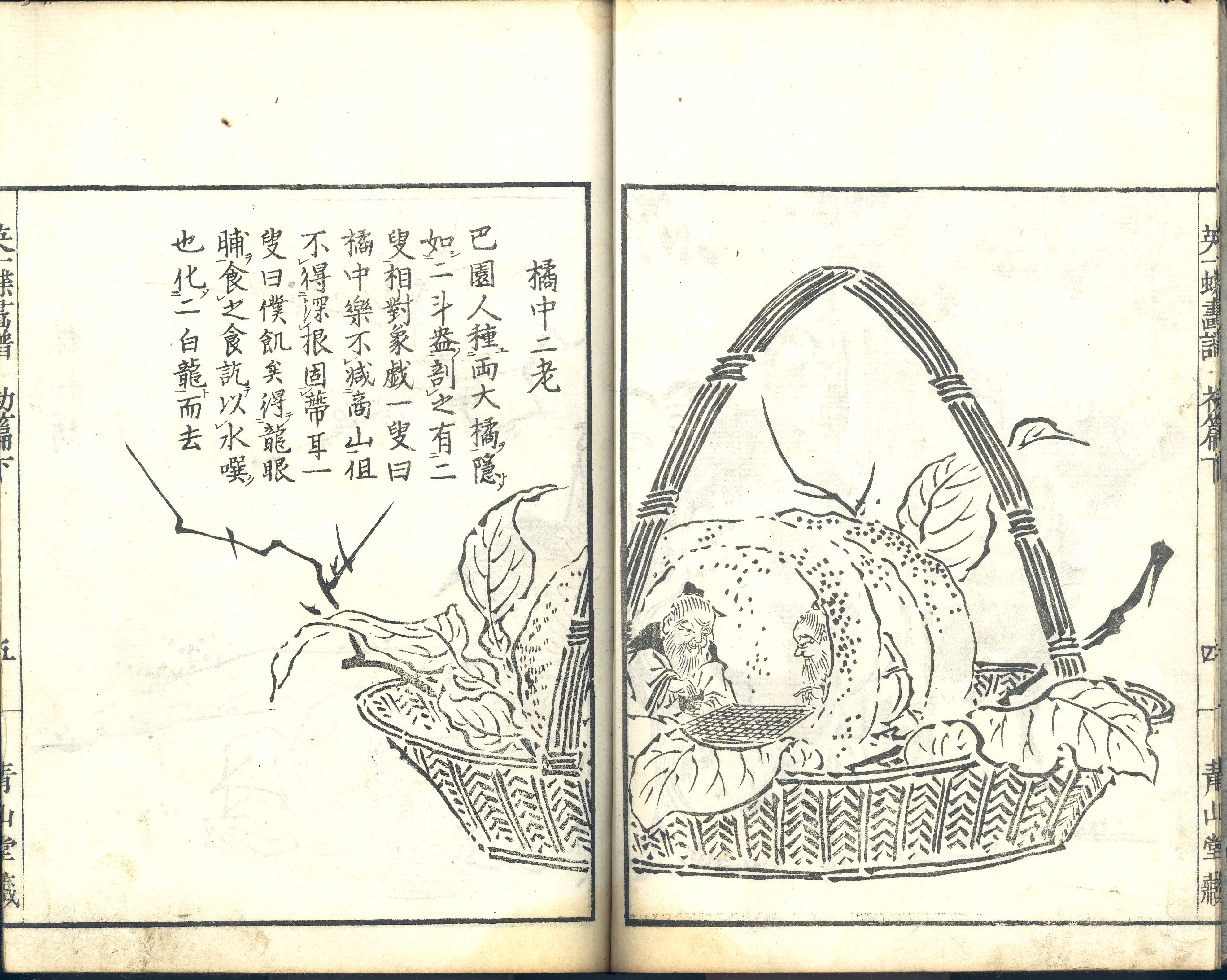
Its history is also a history of how xiangqi knowledge circulated: through household encyclopedias, manuals that promised to disclose guarded knowledge, Hong Kong reprints, tournament annotations, correspondence teaching and discussion among amateur analysts.[11][8][12][13][14] The orange of its most famous manual comes from a tale of a world hidden inside a fruit; the modern literature places that inherited imagery beside exact arguments about pawn breaks, cannon retreats and the order in which pieces should emerge.[15][16][17]
Same Direction Cannons remains an extensive field of study rather than a single forcing attack: Lin Ye's English repertoire treats four principal chariot-development families, while Chinese monographs subdivide them into numerous competing formations.[6][18] Modern assessments distinguish its practical and instructional value from Black's prospects against precise opposition; Yang Zuqiang's artificial-intelligence-assisted study, for example, considers Black's task demanding but the opening defensible and valuable for learning tactical play.[19]
Formation and terminology
After 1. C2=5 c8=5, both cannons have moved from the same physical wing onto the central file; the different file numbers reflect the players' opposite viewpoints.[2] In Opposite-direction Cannons, Black instead uses the cannon from the other wing, replying 1... c2=5.[2] The reflected Same Direction sequence, 1. C8=5 c2=5, is equally valid and occurs, for example, in Yang Guanlin's (杨官璘) published account of his 1953 game with Luo Tianyang (罗天扬).[20]
Same Direction Cannons after 1. C2=5 c8=5.
Loading xiangqi example…
The major family names describe how the chariots enter play, not a requirement that they remain on a particular line throughout the game.[2] A filed chariot (直车) turns onto the file vacated by a horse, as in H2+3 followed by R1=2; a ranked chariot (横车) first advances one point, as in R1+1, and then travels across that rank.[2] Deferred chariot development (缓开车) postpones the choice while other pieces develop or restrict the opponent.[9]
| Family | Typical distinguishing development | Main questions |
|---|---|---|
| Red filed chariot against Black ranked chariot (直车对横车) | 2. H2+3 h8+7 3. R1=2 r9+1 | Can Red's earlier activity restrain Black's ranked chariot, and can Black obtain counterplay against Red's advanced pawns?[6] |
| Red filed chariot against Black deferred chariot (直车对缓开车) | Black develops horses and often advances the other cannon before committing a chariot. | Can Black's cannon pressure interfere with Red's horses while preserving a useful chariot route?[10] |
| Red ranked chariot against Black filed chariot (横车对直车) | Red uses R1+1 and R1=6; Black uses h8+7 and r9=8. | How far should either chariot advance before the remaining pieces can support it?[21] |
| Red deferred chariot against Black filed chariot (缓开车对直车) | Red develops horses and advances one or both horse-file pawns before moving a chariot. | Does Red's control of useful squares justify giving Black the first active chariot?[6][22] |
A proper horse (正马) develops inward toward the centre; an edge horse (边马) develops toward the edge, where it has fewer immediate central options but can clear a route for a cannon or chariot.[2][23] The double-headed snake (两头蛇) means the advances of both Red horse-file pawns, P3+1 and P7+1; it is a pawn formation within several branches, not another first-move opening.[5] Black's double ranked chariots (双横车) and double rib chariots (双肋车) describe related but distinct arrangements: the former emphasizes how both chariots develop, the latter their occupation of the files alongside the central file.[6][24]
Move order can carry a game into the family from elsewhere: Huang Shaolong (黄少龙) discusses 1. P7+1 c2=3 2. C2=5 c8=5 as a pawn-opening route into Same Direction Cannons.[25] The extra pawn and cannon moves matter, so a familiar formation does not by itself justify copying a continuation from a different sequence.[17][25]
Historical development
The medieval record

Shilin Guangji, compiled by Chen Yuanjing (陈元靓), belongs to the tradition of practical encyclopedias that collected knowledge from many fields rather than treating chess in isolation.[26] Its Song-period original has not survived; the Yuan witnesses are therefore evidence for the transmission of an already developed game, rather than a dated account of the invention of Same Direction Cannons.[26][3] The National Palace Museum's surviving Jian'an Chunzhuang edition is itself a small printed object, approximately 17.3 by 10.5 centimetres, dated to the Zhishun era, 1330–1333.[27]
The opening material includes one Same Direction and one Opposite Direction Cannons record, alongside an endgame.[3] In the Same Direction example, Red's active chariot repeatedly changes files while Black's horse advances through the centre; the recorded line ends after Black's ninth move with a verdict of a chariot won and a winning game for Black.[4] The following playback uses the modernized notation printed in Cheng Mingsong's (程明松) anthology; the historical text's notation and its use of white and black pieces differ from modern WXF conventions.[4]
The nine-move Same Direction Cannons record in Shilin Guangji, in modernized notation.
Loading xiangqi example…
Medieval and Ming transmission
Elegant Pastime (适情雅趣), compiled by Xu Zhi (徐芝) and associated with Chen Xueli (陈学礼), appeared in 1570 and placed whole-game opening material after its large collection of endgames.[8] Its preface describes acquiring older chess writings, including Jinpeng Mijue (金鹏秘诀, Secrets of the Golden Roc), and choosing to circulate their knowledge rather than keep it private.[8] The maxim about making the chariot active in Same Direction Cannons is already present in this earlier textual tradition.[8]
The history extends beyond the familiar named chess manuals: Zhang Ru'an's (张如安) study of late-Ming household encyclopedias identifies a 1596 Wanshu Cuibao (万书萃宝) text containing both a horse-sacrifice attack and a line in which the sacrifice is declined.[11] The same research finds Screen Horses material in Ming sources, making a simple sequence of “Ming cannon attack, then Qing invention of the horse defence” untenable.[11]
The orange and its world
Zhu Jinzhen's (朱晋桢) Secrets Inside the Orange (橘中秘), whose first preface dates to 1632, gave cannon-against-cannon play an enduring literary and instructional setting.[1] Its opening examples are accompanied by maxims about development, initiative and sacrifice; its editorial rules also explain that some inferior defensive moves are retained to make the teaching clear.[1] The attacking lines must therefore be read as particular demonstrations, with alternatives, rather than proofs that the initial position forces a win.[1][28]

The title's imaginative background is the story “The Man of Baqiong” (巴邛人) in Niu Sengru's (牛僧孺) Xuanguai lu (玄怪录).[15][16] A householder opens two unusually large oranges and discovers two elderly men inside each, absorbed in a game described as xiangxi (象戏); their world includes supernatural wagers and pleasures independent of the person who has found them.[15] Later Chinese accounts explicitly connect this tale with the expression “play inside the orange” (橘中戏) and the title of Zhu's manual.[16] The story establishes the literary association, not the identity of the Tang-period game with the fully developed modern opening.[15][3]
The manual's first whole-game example turns that promise of hidden knowledge into a concrete attacking lesson.[1] Red develops a ranked chariot, penetrates deeply with it, and leaves a horse available to Black's other cannon; after 6... c2+7, the recorded continuation coordinates the two chariots and cannons, ending with 13. C8=5 checkmate.[1][28] This is the thirteen-move horse sacrifice (弃马十三着).[28]
The thirteen-move horse sacrifice in Secrets Inside the Orange; the displayed starting point is before Black accepts.
Loading xiangqi example…
Yan Wenqing (阎文清) and Zhang Qiang (张强), in their analysis of opening traps, give Black alternatives including 6... a6+5 instead of accepting the horse, and earlier departures from the displayed line.[28] The sacrifice's value as a teaching example lies in the resulting coordination and mating sequence; the defender's earlier choices remain part of its theory.[28] Yan Mujiang (言穆江) was still presenting the old sacrifice in a lecture on classical manuals in Singapore in 2025.[30]
Plum Blossom, counterexamples and inherited names
Wang Zaiyue's (王再越) Plum Blossom Manual (王氏梅花谱) includes five Same Direction games with a filed chariot against a ranked chariot and five with the development reversed, alongside its celebrated Screen Horses material.[31] Its Same Direction examples include the use of a riverbank cannon against a deeply advanced chariot.[31] Research on the broader Plum Blossom tradition distinguishes Wang's book from other works with similar floral titles, including Meihua Quan (梅花泉); they are not interchangeable names for a single text.[32]
Later writers also argued with inherited opening demonstrations: Ba Jiren's (巴吉人) Anti-Plum Blossom Manual (反梅花谱) includes a filed-against-ranked Same Direction line in which an inward horse and an advanced cannon answer Red's deep chariot.[33] Wang Jialiang's (王嘉良) modern self-study manual revisits such positions by comparing a Black chariot at the river with one that has crossed it: changing that single placement changes the force of Red's invasion.[13]
Another transmitted manual, Since Emerging from the Cave, Unmatched (自出洞来无敌手), organizes its original thirty-five games into seven groups associated with the seven characters of its title; its Same Direction material is part of a wider collection of openings.[34] The title phrase also appears in Yao Kuan's (姚宽) Xixi Congyu (西溪丛语), in an account of a mysterious Daoist chess player whose apparent burial ends with an empty coffin and a poem.[35] The poem pairs the boast of invincibility with an injunction to show forbearance when one can; the text does not identify its game as a Same Direction Cannons contest.[35]
Tournament theory in the twentieth century
Published games show that the older chariot systems remained living competitive choices: the 1958 national-championship game Li Yiting (李义庭)–Liu Yici (刘忆慈) began with an early ranked chariot, and its annotations explain the subsequent attack through the coordination of a central pawn and horse.[36] In the following year's championship, Li used Same Direction Cannons against Yang Guanlin when Li needed to win and Yang could secure his objective with a draw; Zhou Zhenming's (周镇明) biography describes Yang's use of riverbank chariots and a rearranged central defence.[37]
Hu Ronghua's (胡荣华) 1966 victory over Li Yiting became a landmark in the development of Red's inward-horse, third-pawn system.[38] Li Xixing's (李西兴) annotated collection preserves the game and the history of its recovery in a 1974 mimeographed record.[39] Hu had already used inward-horse Same Direction play in his 1965 draw with Yang Guanlin.[40] Cheng Zhi's (承志) biographical narrative connects Hu's interest with an unnamed Shanghai amateur's play, presenting the development as a process of observation and experimentation.[41]
Delayed-chariot systems developed through several players and centres.[9] Liu Jinqi (刘锦祺) and Li Zhigang (李志刚) trace northeastern experiments to the 1960s, a Shanghai–Shenyang–Harbin invitational to 1973, and national use by Zhao Qingge (赵庆阁), Meng Liguo (孟立国) and Guo Changshun (郭长顺) in 1974.[9] A later profile of Guo singles out his victory over Yang Guanlin in Guangzhou on 10 December 1974, after improving on an earlier defeat, as an important demonstration of the system.[42]
Ding Xuguang's (丁旭光) biography records Hu's 1981 Same Direction defeat by Qian Hongfa (钱洪发), while Jia Titao's (贾题韬) analysis of Li Laiqun (李来群)–Hu Ronghua in 1984 places another long struggle in the context of Hu's need to win.[43][44]
The Baoren events of 1991 and 1993 gave the opening its own championship setting and generated dedicated tournament literature.[45] Reporting on Hu Ming (胡明) in September 1991 describes her preparation with Liu Dianzhong (刘殿中) and her victory over Taiwan's Ma Zhongwei (马仲威) in that month's Same Direction competition.[46] The opening's history in this period includes women's championship practice and exchanges across the wider Chinese-speaking chess world, as well as the frequently reproduced games of male national champions.[46][12]
Strategic questions
Activity, commitment and the second wing
The classical preference for active chariots concerns coordination, not simply the number of squares one chariot has travelled.[1][47] An isolated advanced chariot can become a target while its owner spends further moves defending or relocating it; Yan and Zhang show how a pawn offer and horse development can exploit precisely this imbalance.[47] Fu Baosheng (傅宝胜) likewise distinguishes purposeful riverbank deployment from grabbing a pawn while the other wing remains undeveloped.[48]
The second chariot is often the practical measure of a position's freedom.[49][10] Wang Jialiang and Li Delin (李德林) explain an edge-pawn advance as both a restraint on an opposing edge horse and a way to release one's own blocked wing; the same pawn may later become the object of a counter-sacrifice that reopens a file.[49] In Yan and Zhang's delayed-chariot examples, advancing both horse-file pawns without arranging chariot support can instead leave an impressive-looking formation overextended.[10]
Defensive development is also position-dependent: Fang Changqin (方长勤) and Zhang Yanan (张雅楠) show an inward-horse line in which a routine advisor move yields the initiative, while an active reply maintains counterplay.[50]
Cannon retreats and apparent gains of time
A cannon retreat can be a planned change of function rather than a concession.[7] Wu Guilin's (吴贵临) Xiangqi Military Methods: Same Direction Cannons explains that chasing a cannon toward a square it already wants to occupy does not necessarily gain useful time; the retreat can prepare pressure against a pawn or another wing.[7] Huang Shaolong's elementary opening treatment similarly places the cannon's restraining role before an attempt to harass the advanced enemy chariot.[51]
This is especially important when Black retreats the central cannon to the back rank and advances a horse-file pawn.[6] The cannon, pawn and ranked chariot then cooperate against Red's horses and pawn centre, so Red must judge the whole arrangement rather than count the cannon's repeated moves in isolation.[6] Huang's question-and-answer manual gives a complementary example of a Red chariot on the pawn rank: it obstructs a deep incursion against a horse while preparing a lateral cannon move, combining defence with a developing threat.[52]
Material and compensation
The exposed central pawn is a recurring temptation, but its value depends on the time required to capture it and escape the developing attack.[2][53] Shang Wei's (尚威) trap collection distinguishes a sound pursuit of a misplaced cannon from a sequence that merely lets the opponent mobilize with threats.[53] The thirteen-move sacrifice is the classical extreme of this theme; modern studies apply the same question to pawn offers, horse offers and exchanges of a chariot for two lesser pieces.[28][54]
Yang Dian's (杨典) study of opening sacrifices stresses the continuation that makes the offer work: a pawn sacrifice which opens lines must be followed by the necessary development or central action.[54] In his discussion of Guo Furen (郭福人)–Ke Shanlin (柯善林), the central-pawn advance belongs to the concrete attack; taking the material offer away from that sequence would remove its point.[54]
Red filed chariot against Black ranked chariot
After 1. C2=5 c8=5 2. H2+3 h8+7 3. R1=2 r9+1, Black can bring the ranked chariot toward a rib file while Red chooses the other horse's route and which pawn to advance.[6] Huang Shaolong distinguishes older edge-horse arrangements from inward-horse systems: the edge horse can facilitate rapid piece deployment, whereas the proper horse participates more directly in the central struggle.[55]
Inward horse and the third pawn
The inward-horse, third-pawn system combines H8+7 and P3+1, often meeting Black's ...p3+1 with a chariot advance that puts pressure on that pawn.[6] In the following representative line, 6. R2+5 c5-1 7. R2=7 r4+1 8. H3+4 h2+3, Red's active chariot and horse are balanced against Black's central-cannon retreat and the development of the other horse.[6]
Inward horse and third pawn: a representative line from Lin Ye, pp. 31–32.
Loading xiangqi example…
This is a recurring decision point rather than a fixed attack: Black can use the back-rank cannon to support counterplay while Red must find useful work for the remaining chariot and cannon.[6][56] In Lü Qin's (吕钦) 1990 annotations, an automatic elephant development later in the opening is criticized because moving the central cannon sideways would have contested Red's initiative more effectively.[56]
Advancing the seventh pawn instead changes which horse can move freely and which file the chariot can control.[57] He Zuofeng's (何左峰) account describes the rehabilitation of a once-criticized seventh-pawn line through a riverbank chariot blockade; the point is the accompanying piece arrangement, not the pawn move considered alone.[57]
Double-headed snake and double ranked chariots
With both P3+1 and P7+1, Red obtains space for the horses, while Black can develop both chariots across the second rank.[5][6] Liu Binru (刘彬如) and Yu Zhiyi (余志弈) explain the resulting contest around the inward horse and Black's pressure on its file; Red's E7+9 can clear the route R9=7, connecting the otherwise inactive chariot with the fight.[5]
An active Red horse can restrict a deep Black rib-chariot advance; Zhao Qingge and Yang Dian also show a horse retreat preparing a renewed advance after the chariot changes files.[58] Red can instead clear the other chariot's route with E7+9, but that elephant move leaves the edge vulnerable: Lin gives Black's repeated advance of the first-file pawn as a way to open the outside chariot's file.[6] The following line displays the trade-off after 7. E7+9 p1+1 8. A6+5 p1+1 9. P9+1 r1+4.[6]
Double-headed snake against double ranked chariots: Lin Ye’s edge-pawn continuation.
Loading xiangqi example…
The same balance appears in later tournament annotation.[59][60] In Sun Yongzheng's (孙勇征) game against Vietnam's Uông Dương Bắc (汪洋北), the 2013 cup-games collection explains how E7+9 helps release the chariot but exposes the edge to Black's pawn play.[59] The 2016 national-championship collection, discussing Teng Fei (滕飞)–Zhao Wei (赵玮), prefers Black's edge-pawn counterplay to a chariot move that assists Red's development, and examines a later central-cannon shift that avoids a tactical sacrifice.[60]
Black's rear chariot also has a defensive job: Zhu Baowei (朱宝位) and Liu Haiting (刘海亭) show it supporting the horse before the central cannon retreats, so Red cannot simply attack an undefended horse by shifting the central cannon.[18] A well-timed pawn offer and chariot exchange can then force Red's edge elephant back inward and release Black's other horse.[18] These details explain why nearly identical double-ranked positions can require different move orders.[18][17]
The double-rib arrangement sharpens the same contest.[24] Fan Xiangjun (范向军) and fellow analysts describe a line in which Black's third-pawn sacrifice and pressure from the two rib files attack Red's development, including variations with a chariot exchanged for two pieces.[24] Their separate studies of double ranked chariots revisit central captures and the timing of a cannon advance, showing how apparently natural continuations can expose loosely connected pieces.[14][61] Liang Wenbin's (梁文斌) survey of the 2001 team championship likewise identifies a cannon advance as a stronger continuation than an immediate pawn move in a specific double-headed-snake position.[62]
The system also allows practical attempts to avoid a quiet game: Wang Yang's (汪洋) annotation of Jiang Chuan (蒋川)–Zhao Jincheng (赵金成), played in Shenzhen on 24 November 2016, explains Black's choice of an unusual pawn break when the team score made a win necessary.[63] His analysis nevertheless gives Red an equalizing alternative later in the game, so the result does not establish a forced opening advantage for Black.[63]
Five–Six Cannons and alternative development
Red's C8=6 creates Five–Six Cannons (五六炮), clearing a route for the left chariot while the sixth-file cannon affects Black's freedom to cross the board.[6][21] Wang Jialiang and Zhang Zhiqiang (张志强) treat the formation as a coordination problem for both sides: Black may connect the chariots or reorganize the horses rather than respond only to the apparent central threat.[64] Ge Weipu's (葛维蒲) analysis gives ...c2+4 as a concrete way to obstruct Red's development in one principal arrangement.[21]
Other cannon placements require the same attention to timing: Yang Dian's opening-trap collection examines Five–Seven Cannons against an edge horse and shows why exchanging the central cannons can release the opponent's formation.[65] The name of a cannon formation identifies its structure; the tactical justification for entering it still depends on the positions of the horses, chariots and pawns.[65][64]
The Heavenly Horse (天马行空) variation develops Red's other horse through the centre after an early seventh-pawn advance.[66][67] Cannon Duels examines Black's central horse manoeuvres against it, while Li Zhongjian (李中健) and Liu Haiting distinguish continuations according to whether Black's horse proceeds toward the central file or the other rib.[66][67] Fang Shiqing (方士庆) and Li Peng (李鹏) use these positions to compare rapid chariot activity with the slower construction of a flexible horse formation.[68]
Red filed chariot against deferred Black chariots
Black's delayed development usually combines proper horses, a seventh-pawn advance and pressure from the other cannon before choosing a chariot route.[6][9] The characteristic cannon incursion ...c2+4 attacks Red's third pawn and interferes with the right horse, while Red's seventh-pawn advance prepares the left horse to seek play elsewhere.[42][6] Black may subsequently develop the right or left ranked chariot, so the order of horse and cannon moves preserves real options.[69]
Red's inward horse
After 1. C2=5 c8=5 2. H2+3 h8+7 3. R1=2 p7+1 4. P7+1 c2+4 5. H8+7 h2+3, Red can play 6. H7+6; Black's 6... c2=7 makes the cannon's pressure on the other wing explicit.[6]
Deferred Black chariots: Red’s inward horse and Black’s cannon incursion.
Loading xiangqi example…
The central horse is active, but it has not solved the development of Red's other chariot.[70] Sun Zhiwei (孙志伟) and Liu Haiting examine the vulnerabilities left behind when that horse leaves home, and the way a cannon shift and chariot invasion can exploit them.[70] Yang Dian and Han Zhigang (韩志刚) compare different Red cannon replies to the incursion rather than treating the horse advance as an automatic gain of initiative.[71]
A Black cannon on the edge creates another branch.[10] In Yan and Zhang's analysis, ...c2=1 frees the right chariot and restricts Red's left wing; the chariot's subsequent route determines whether the two pieces cooperate or become vulnerable to a blockade.[10] The 2012 national-championship annotations of Wei Qiang (蔚强)–Zhao Jincheng show why a slow pawn move can squander this activity, and why Red may prefer an elephant development that restrains Black's pawn play to a routine advisor move.[72]
Red's outward horse and the other chariot
Red can instead play H7+8, moving the left horse outward and preparing the chariot to enter along the seventh file.[6] In Lin's representative sequence, 6. H7+8 r9+1 7. R9+1 r9=4 8. A4+5 precedes R9=7; the advisor move helps determine whether Black's chariot can invade the home camp with effect.[6]
Deferred Black chariots: Red’s outward horse, advisor preparation and seventh-file chariot.
Loading xiangqi example…
The competition between an immediate chariot activation and the intervening advisor move became a recurring subject of practical analysis.[73][74] Yang Dian's account of Guo Furen–Ke Shanlin explains the central attack after the preparatory advisor move; Xie Jinjie's (谢今杰) and Huo Xianyong's (霍羡勇) study examines the sharper incursion that can follow an immediate chariot shift.[73][74] Liao Erping (廖二平), writing about a youth game, describes precisely this coaching disagreement between immediate activity and a student's quieter preparation.[75]
Red's other cannon may wait, advance or retreat according to Black's chariot arrangement.[69] Yan and Zhang distinguish C8+1 from C8+2, and examine a riverbank chariot before the other chariot's lateral development; their point is that a waiting move changes what Black can safely commit to.[69] A 2005 game between Yan Wenqing and Xu Yinchuan (许银川), annotated by Liang Wenbin, illustrates Black's flexibility in developing the two chariots and later rerouting a horse, rather than following one compulsory plan.[76]
The system's practical attractions include an immediate contest over material and activity.[77] The Fifty Years of Same Direction Cannons feature selects Xu Tianhong (徐天红)–Li Laiqun from January 1992 as a notable example: Black's cannon takes a pawn while Red exchanges the active chariot, develops the other one and seeks an attack.[77] Yang Guanlin's annotations of games from the first Asian Cup also show the defensive consequences of passive preparation in the outward-horse branch, alongside the risks of Red's own premature pawn hunting.[78]
Edge horses and transpositions
An edge horse can be a deliberate way to clear a cannon's path.[23] Wang Bin's (王斌) annotations of Tang Dan (唐丹)–Zhang Tingting (张婷婷), played at the 2008 individual championship, explain that purpose before showing how a later overextension of the horse loses the initiative.[23] A report on Jiang Chuan's 2007 victory over Wang Bin similarly locates the decisive difficulty in a trapped edge horse, rather than declaring the entire opening lost from its initial formation.[79]
Xie Jing's (谢靖) account of his 2000 game with Li Xuan (李轩) distinguishes an older ranked-chariot reply from a more active cannon incursion, and describes a subsequent chariot exchange as equalizing before the later fight was decided.[80] The pawn-opening route also remains relevant: a Qiyi analysis of a 2019 amateur game criticizes repeated pawn activity and a passive advisor move because the other wing's pieces had not joined the struggle.[81]
Red ranked chariot against Black filed chariot
The classical ranked-chariot attack normally brings Red's right chariot to the sixth file, where it can threaten the palace or help the other wing.[21] Black's filed chariot has a crucial choice of depth: the riverbank placement ...r8+4 supports operations across both wings without immediately committing to a deep incursion.[21]
Red ranked chariot against Black’s riverbank filed chariot: Ge Weipu, game 103.
Loading xiangqi example…
Ge Weipu's representative line combines that riverbank chariot with proper horses and an advisor, followed by an elephant development when Red's ranked chariot advances.[21] Yang Dian and Wang Jing (王静) explain how moving the central cannon off its file can release an elephant and improve Black's central defence; the original cannon placement need not be preserved after it has served its purpose.[82]
This differs materially from the old thirteen-move attack, in which Black's chariot has already crossed the river.[28][13] Wang Jialiang's comparison of the two chariot placements makes the defensive resources part of the explanation, rather than treating a visually similar Red invasion as equally strong in both positions.[13]
Red's own treatment has also changed.[22] Yang Dian records a 1975 Shanghai development in which Red retreats the other cannon before reorganizing against Black's inward horse, replacing an older approach with a more flexible deployment.[22] His analysis prefers a useful cannon shift to taking a pawn when the latter allows Black to coordinate.[22]
Fu Baosheng also examines the early central-pawn capture by Black: it can interfere with Red's intended ranked-chariot route, but the cannon's repeated moves give Red opportunities to develop with threats.[48] Whether the capture succeeds is a concrete question about the resulting position, not a general exception to the importance of development.[48]
Red deferred chariot against Black filed chariot
Red can postpone chariot development with an early P3+1, restricting Black's seventh-pawn advance while bringing out both horses.[22] With both horse-file pawns advanced, Black may answer by developing one filed and one ranked chariot, producing a contest between Red's space and Black's earlier heavy-piece activity.[6]
Red defers the chariot and advances both horse-file pawns: Lin Ye, pp. 61–63.
Loading xiangqi example…
Lin's sample line reaches 5. P7+1 r1+1 6. C8=9 r8+4, where the edge cannon clears space for Red's remaining development and Black establishes the filed chariot at the river.[6] Red can also begin with a ranked chariot rather than the edge cannon; Lin's analysis gives both sides resources and does not treat Red's pawn space as sufficient for a decisive attack.[6]
Black has another important fifth-move choice, ...c2=1, clearing the other chariot's file before raising it.[6] Red can answer by advancing the left horse outward or by developing the left chariot directly; Black's riverbank chariot then helps contest the files that Red is trying to occupy.[6] Lin dates the increased popularity of this edge-cannon branch to the 1990s and analyzes continuations ranging from exchanges to deep chariot incursions.[6]
An annotated game: Lü Qin–Yu Youhua, 1990
Lü Qin's win over Yu Youhua (于幼华) at Taizhou in May 1990 developed from the inward-horse, third-pawn filed-against-ranked system.[56] His notes praise Black's early cannon retreat as a sound countermeasure, but criticize a later routine elephant move and give a lateral cannon move as a stronger alternative.[56] The game then illustrates how the opening's space and piece activity can be converted into a sustained attack rather than an immediate forced combination.[56]
Lü Qin–Yu Youhua, Taizhou, May 1990. Complete recorded game; Lü Qin won.
Loading xiangqi example…
Lü's discussion of the horse retreat 24. H6-4 emphasizes the timing and preparation of the attack, describing the manoeuvre through the image of reining in a horse and holding a bow ready.[56] He explicitly invokes a phrase from the Art of War (孙子兵法), whose chapter on shi (势) compares accumulated force with a drawn crossbow and the moment of action with releasing its mechanism.[56][83] The comparison explains the value he attaches to a preparatory retreat before renewing the attack.[56]
Another military expression appears in Liu Dianzhong's analysis of Yang Guanlin–Hu Ronghua at the second Wuyang Cup: “besiege Wei to rescue Zhao” (围魏救赵).[84] The idiom means relieving pressure by attacking the adversary's vulnerable rear, rather than confronting the threatened point directly.[85] Its historical narrative, recorded in Sima Qian's (司马迁) Records of the Grand Historian, tells how Sun Bin advised threatening Wei's capital when Wei's main army was besieging Handan, compelling it to withdraw.[86] In Liu's chess annotation, a pawn advance drives the opposing chariot and relieves pressure elsewhere: the cultural phrase names the relationship between the two fronts.[84]
Practice, teaching and publication

Champions, specialists and learners
Same Direction Cannons has served both as a specialist weapon and as an early foundation for a wider repertoire.[88][89] A 2010 profile of Jiang Chuan reports Zhang Qiang's recollection that Jiang initially relied almost exclusively on it with Black, before broadening his opening knowledge after joining the Beijing team.[88] Reporting on Xie Yejian (谢业枧) used the nickname “Same Direction Cannons Prince” (顺炮王子), reflecting a recognizable association between a player and the opening.[89] Conversely, Wang Yiren (王毅人) and Zhao Xia's (兆夏) selected grandmaster games place Hu Ronghua's filed-against-ranked and delayed-chariot examples within a much wider range of openings; a player's association with the system need not imply an exclusive repertoire.[90]
International and women's play continued to generate examples.[91][78] The first Asian Cup collection includes Liu Dahua (柳大华)–Fan Qingyong (范清涌), with double-headed-snake and double-ranked formations, and Hu Ronghua's Black delayed-chariot game against Thailand's Xie Gaizhou (谢盖洲).[78] At the 2008 World Mind Sports Games, Zhang Guofeng (张国凤) and Vietnam's Ngô Lan Hương (吴兰香) drew a game in the double-headed-snake versus double-ranked system.[91]
The opening also lends its name to public competitions: a Tianjin “Same Direction Cannons King” rapid event during the 2009 Spring Festival included adult and youth sections, linking competitive chess with holiday recreation.[92] At the introductory level, the Chinese Xiangqi Association's 2023 grading standard, published in January 2024, placed recognition and five-to-seven-move play of Same Direction and Opposite Direction Cannons in its thirteenth-grade requirements.[93]
What a defined game archive shows
In the DPXQ Master Games collection as incorporated into LiXiangQi's deduplicated database and inspected on 16 November 2026, 7,163 of 141,548 eligible standard-start games begin with the immediate Same Direction reply, including its reflected form.[94] That is 5.06% of all games in this sample and 10.29% of its 69,613 games beginning with a central cannon.[94] The dated records range from 1917 to 2026; “Master Games” identifies the source collection, not a verified grandmaster title for every participant.[94]

| Recorded period | Central Cannon games | Immediate Same Direction replies | Share of Central Cannon starts |
|---|---|---|---|
| 1990–1999 | 4,828 | 675 | 13.98%[94] |
| 2000–2009 | 15,989 | 2,213 | 13.84%[94] |
| 2010–2019 | 33,495 | 2,884 | 8.61%[94] |
| 2020–2026 | 11,674 | 767 | 6.57%[94] |
The measured share is lower in the two later cohorts, but these are archive proportions, not a census of all competitive xiangqi or an explanation of why players chose another defence.[94] The counting rule deliberately excludes games that reach the opening after a pawn or other first move, such as the transpositions discussed above.[94][25]
Modern study nevertheless continues to refine its positions.[95][19] Liang Wenbin and Zhang Zhiqiang's Twenty-first-century Chinese Xiangqi Openings follows a delayed-chariot variation through a new central-cannon move in a 2005 game and a later defensive improvement in Hu Ronghua–Lu Weitao (陆伟韬), drawn in 2011.[95] Yang Zuqiang's 2022 study explicitly incorporates artificial-intelligence analysis while retaining the opening as material for understanding attack and defence.[19]
The modern literature grew through both professional instruction and inexpensive circulation.[96][12] Xu Xu's (徐续) account of Chen Songshun (陈松顺) describes the collaborative production of the three volumes of Chinese Xiangqi Manuals (中国象棋谱) in the late 1950s and early 1960s.[96] Yan Mujiang and Chen Yiqiu's (陈弈秋) survey of Hong Kong chess books identifies a Weiqing edition, Same Direction Cannons Chariot Openings (顺炮对车布局法), reproducing Yang Guanlin's fifteen filed-against-ranked and fourteen ranked-against-filed lines from the second volume.[12] Their separate study of Singapore publications and Li Zhihai's (李志海) oral history preserves discussion of Li's 1958 game with Wang Jialiang, including an attack based on giving up a cannon for defensive pieces.[97]
Wang Jialiang's newspaper and magazine work helped sustain a channel between competitive play and readers: a 2005 interview describes his work on a weekly chess column and his role in establishing Northern Chess Art (北方棋艺) in 1979.[98] The magazine tradition also accommodated substantial amateur analysis: Fan Xiangjun's double-ranked-chariot studies appeared as collaborative investigations, and one installment explicitly invited strong local players to contribute.[61]
Zhang Lei (张雷), who posted online as “Pujing” (普京), developed Spring and Autumn of Same Direction Cannons (顺炮春秋) through repeated drafts and discussion with online chess friends, combining annotated games with historical material.[99] In a 2005 newspaper interview with Yanshan Buyi (燕山布衣), he described the difficulty of finding a publisher and the privately printed copies circulated for comment that July.[99] He had selected one hundred principal games and two hundred reference games, aiming to explain the opening through the players and circumstances that shaped its development.[99]
Several works serve distinct purposes within this literature.[2][6][9][18]
- Jim Png Hau Cheng's Lexicon of Xiangqi Terms in English supplies English terminology and entries for the principal Same Direction formations, with Chinese names that connect them to the older literature.[2]
- Lin Ye and Agostino Guberti's Modern Xiangqi Opening Repertoire: D00–D29 Same Direction Cannons develops selected lines in the four main chariot families; it is a repertoire treatment rather than an exhaustive catalogue of every ECCO code.[6]
- Zhu Baowei and Liu Haiting's Same Direction Cannons (顺手炮) organizes a much broader set of Chinese-language variations, including early chariot incursions, advisor-first play, edge horses and double-ranked formations.[18]
- Liu Jinqi and Li Zhigang's Same Direction Cannons with Deferred Chariots (顺炮缓开车) supplies 399 selected game scores and a historical preface, rather than explanatory annotations to every move.[9]
- Yan Wenqing and Zhang Qiang's treatments of established lines, deceptive moves and vulnerable formations explain why a continuation works, what it concedes and how a superficially similar position can require a different response.[10][28][47]
ECCO classification
The 2004 Encyclopaedia of Chinese Chess Openings classification assigns Same Direction Cannons the D0–D2 families, with twenty-two defined codes; some numbers in the D00–D29 range are unused.[100] The classifications distinguish move orders and formations more finely than the four broad development families above.[100]
| Code | Formation or distinguishing feature |
|---|---|
| D00 | Red deferred chariot against other formations.[100] |
| D01 | Red deferred chariot against Black ranked chariot.[100] |
| D02 | Red deferred chariot against Black filed chariot.[100] |
| D03 | Red ranked chariot against Black deferred chariot.[100] |
| D04 | Red ranked chariot against Black filed chariot, other variations.[100] |
| D05 | Red ranked chariot against Black filed chariot at the riverbank.[100] |
| D10 | Red filed chariot against Black deferred chariot, other variations.[100] |
| D11 | Black left ranked chariot.[100] |
| D12 | Black right ranked chariot.[100] |
| D13 | Red and Black exchange filed chariots.[100] |
| D14 | Black cannon crosses the river.[100] |
| D15 | Black edge cannon.[100] |
| D20 | Red filed chariot against Black ranked chariot, other variations.[100] |
| D21 | Red develops an advisor first.[100] |
| D22 | Red left edge horse.[100] |
| D23 | Red riverbank chariot.[100] |
| D24 | Red chariot crosses the river.[100] |
| D25 | Red advisor's-corner cannon.[100] |
| D26 | Red third-pawn advance, without the double-headed snake.[100] |
| D27 | Red seventh-pawn advance, without the double-headed snake.[100] |
| D28 | Red double-headed snake, other variations.[100] |
| D29 | Red double-headed snake against Black double ranked chariots.[100] |
References
- ↑ a b c d e f g h 朱晋桢. 橘中秘. Preface dated 1632; editorial rules, complete instructions and first whole-game horse-sacrifice line. Primary-text transcription. Illustrated page: Qing Jiangzuo Shulin printing reproduced in 故宫珍本丛刊, volume 468, facsimile and scan provenance.
- ↑ a b c d e f g h i j Jim Png Hau Cheng. A Lexicon of Xiangqi (Chinese Chess) Terms in English. Entries “Same Direction Cannons” and its principal variations, printed pp. 460–473. Bibliographic record.
- ↑ a b c d 季本涵. “长三角象棋活动史论纲”. 2019. PDF pp. 5–13, 34–37 and 42–43. World Xiangqi Federation repository.
- ↑ a b c 陈元靓, compiler. 事林广记, Yuan opening record; normalized score and edition introduction in 程明松, editor, 中国象棋谱大全, 蜀蓉棋艺出版社, 1997, 2003 printing, ISBN 7805485291, pp. 1–3. Edition descriptions and facsimile access; bibliographic record of the anthology's 2006 reprint.
- ↑ a b c d 刘彬如、余志弈. 现代顺炮新变. 人民体育出版社, June 1993. ISBN 7500908822. Preface, contents and pp. 1–5. Digital edition index.
- ↑ a b c d e f g h i j k l m n o p q r s t u v w x y z aa ab Lin Ye, with Agostino Guberti. Modern Xiangqi Opening Repertoire: D00–D29 Same Direction Cannons, edition 1.0.5. Introduction and printed pp. 9–68; especially pp. 31–32, 43, 45–46, 49–51 and 61–63. Author-associated bibliographic listing.
- ↑ a b c 吴贵临. 象棋兵法·顺炮篇, lesson 1. Digital transcription and annotations, discussion of cannon retreats and useful tempi.
- ↑ a b c d e 徐芝、陈学礼. 适情雅趣, 1570. Preface, 棋经论, opening verse and first whole-game example, reproduced in 程明松, editor, 中国象棋谱大全, 1997, 2003 printing, ISBN 7805485291, pp. 28–33. Bibliographic record of the anthology's 2006 reprint.
- ↑ a b c d e f g 刘锦祺、李志刚. 顺炮缓开车. 经济管理出版社, June 2011. ISBN 9787509614129. Preface and contents. Bibliographic record.
- ↑ a b c d e f g 阎文清、张强. 布局定式与战理. Same Direction Cannons, game 12, “红内肋马横车对黑边炮”. Digital transcription and annotations.
- ↑ a b c 张如安. “晚明通俗日用类书中的象棋史料”. Hangzhou xiangqi research collection, 2019, 10 pp.; discussion of 万书萃宝 and the opening verses. World Xiangqi Federation repository.
- ↑ a b c d 言穆江、陈弈秋. “香港象棋谱点评”. 2022. PDF pp. 10–11, 17–19, especially entry 43, 顺炮对车布局法. World Xiangqi Federation repository.
- ↑ a b c d 王嘉良等. 新概念象棋自学教程. 上海辞书出版社, March 2002. ISBN 7532608468. Preface and pp. 249–251, 258. Bibliographic record; edition date follows the book's colophon.
- ↑ a b 范向军等. “探究两头蛇对双横车新变”. 棋艺, 2005, no. 8. First analyzed variation and opening of the second; 参考网 republication.
- ↑ a b c d 牛僧孺. 玄怪录, volume 3, “巴邛人”. Tang dynasty. Primary-text transcription.
- ↑ a b c 中央电视台. “博弈篇:中国象棋的发展历程”. 4 June 2007. Section connecting 橘中戏 and the titles of Ming manuals with the Baqiong story.
- ↑ a b c 朱永康. 象棋布局行子次序. 成都时代出版社, 2021. ISBN 9787546427898. pp. 1–2. Digital chapter, comparison of ...h2+3 and ...c2+4.
- ↑ a b c d e f 朱宝位、刘海亭. 顺手炮. 安徽科学技术出版社, August 2014. ISBN 9787533763886. Contents and pp. 123–126, games 61–63. Bibliographic record.
- ↑ a b c 杨祖强. 跟人工智能学象棋开局:顺炮篇. 成都时代出版社, 2022. ISBN 9787546431673. pp. 2–5, conclusions on Black's prospects and instructional value. Publisher-supplied digital edition.
- ↑ 杨官璘. 弈林新编. 人民体育出版社, 1977. Chapter 8, game 10, 罗天扬–杨官璘, Shanghai, 4 September 1953. Digital transcription.
- ↑ a b c d e f 葛维蒲. 象棋布局细解. 上海书店出版社, September 2013. ISBN 9787545807974. pp. 253–254 and 265–269. Bibliographic record.
- ↑ a b c d e 杨典. 象棋布局阵式战法. 福建科学技术出版社, April 2003. ISBN 7533521358. pp. 25–29 and 37–38. Bibliographic mention in the preface of the author's 2004 象棋布局弃子战术; passages consulted in the 2003 edition.
- ↑ a b c 王斌. 2008年全国象棋个人锦标赛特辑, game 6: 唐丹–张婷婷, Shunde, November 2008. Online excerpt, 广象网, 13 April 2009.
- ↑ a b c 范向军等. “探究顺炮直车两头蛇对双肋车新变”. 棋艺, 2005, no. 18. Introductory account and analyzed line through the central horse retreat; 参考网 republication.
- ↑ a b c 黄少龙. 兵相布阵. 北京体育大学出版社, 2002. ISBN 9787810516709. pp. 17–22. Bibliographic record.
- ↑ a b c 未曾. “事林广记”. 书格, 22 December 2019. Edition descriptions and facsimile images, including the 西园精舍 edition in Japan's National Archives.
- ↑ 国立故宫博物院. “碁人弈事—古代围棋文化展:棋谱棋书”. 2025 exhibition. 事林广记 label, objects 故善004371、故善004372; Yuan Zhishun 建安椿庄书院 edition.
- ↑ a b c d e f g h 阎文清、张强. 布局骗着与对策, game 1, thirteen-move horse sacrifice. Digital transcription and analysis of Black's alternatives.
- ↑ 英一蝶, drawings; 鈴木鄰松, compiler. 一蝶画譜, first issued 1770, later printing. Kanazawa College of Art, lower volume, fols. 4v–5r. Catalogue; illustrated opening. Public-domain woodblock illustration.
- ↑ 言穆江. “象棋古谱与棋局”, lecture, Singapore, 30 August 2025, reproduced in “深深怀念言穆江老师”. Singapore Xiangqi General Association. Discussion and demonstration of the thirteen-move sacrifice.
- ↑ a b 王再越. 王氏梅花谱. Contents and Same Direction Cannons sections, reproduced in 程明松, editor, 中国象棋谱大全, 1997, 2003 printing, ISBN 7805485291, pp. 201, 203 and 252–255. Bibliographic record of the anthology's 2006 reprint.
- ↑ 施伟峰、沙卓群、杨文华. “古谱梅花泉韵长 课程基地绽芬芳——略论象棋古谱〈梅花泉〉及其课程基地建设”. 2022. pp. 1–10, especially p. 8. World Xiangqi Federation repository.
- ↑ 巴吉人. 反梅花谱, game 3, “顺炮直车破横车局”. Digital score, eighteen-move line; opening cross-checked against 王嘉良's 新概念象棋自学教程, pp. 249–251.
- ↑ 张连芳, editor. 自出洞来无敌手:中国象棋古谱新编. 金城出版社, March 2000. ISBN 7800842843. Preface, contents and appendix reproducing the thirty-five-game original. Bibliographic and contents record; modern edition expands the seven groups to forty-nine games.
- ↑ a b 姚宽. 西溪丛语, upper volume, account of the chess-playing Daoist (善棋道人). Primary-text transcription.
- ↑ 弈林, editor. 中国象棋棋王经典对局选. 河南科学技术出版社, November 1998, July 2001 printing. ISBN 7534916437. Game 11, 李义庭–刘忆慈, Guangzhou, 20 November 1958. Digital transcription.
- ↑ 周镇明. 一代象棋宗师杨官璘. Chapter 21, account of the 1959 championship; appendix II, bibliography of Yang's books. 广象网 serialization, 2013.
- ↑ 杨典. 胡荣华中局谱, game 29. “设下诱饵 弃马袭击:胡荣华胜李义庭”. Digital transcription; introductory account of the 1966 variation and middlegame analysis.
- ↑ 李西兴. 文革残谱:1966年全国棋艺锦标赛中国象棋对局选评. 人民体育出版社, January 2009. ISBN 9787500935063. Preface and pp. 158–162, game 61, 胡荣华–李义庭. Bibliographic record.
- ↑ 胡荣华妙局精萃. 上海辞书出版社, March 1997; January 1998 printing. ISBN 7532604217. Game 22, 胡荣华–杨官璘, Wenzhou, 16 May 1965. Digital transcription and annotations.
- ↑ 承志. 纵横楚汉:胡荣华的象棋人生. 当代中国出版社, February 2004. ISBN 7801702808. pp. 236–237, consulted in the printed edition. Author's preface, republished excerpt, describing the work's literary reconstruction.
- ↑ a b 陈日旭、彭志东. “郭长顺和他的顺炮缓开车”. 棋艺, 2005, no. 14. Accessible introductory excerpt; 参考网 republication.
- ↑ 丁旭光. 胡荣华:一代宗师 旷世棋王. 上海文化出版社, 2018, chapter 16. Excerpt republished by 胡荣华教育, 15 August 2018; account of the 1981 game against 钱洪发.
- ↑ 贾题韬. 象棋名局精解, game 36, 李来群–胡荣华, 13 January 1984. Digital transcription and annotations.
- ↑ 周明华. “象棋顺炮鏖战千年 细数浩瀚弈著”. 广象网, 4 August 2007. Accessible installment covering publications from 1991 to 2006.
- ↑ a b 黄振中. “攀登高峰的人——记胡明和她的教练刘殿中”. 人民日报, 22 September 1991, p. 4. Public text mirror.
- ↑ a b c 阎文清、张强. 布局疑形与攻击. 北京体育大学出版社, 1999. ISBN 7810513877. Game 1, “当头棒喝”; game 14, “理想阵形”. Digital transcriptions.
- ↑ a b c 傅宝胜. 实战象棋开局. 安徽科学技术出版社, September 2008. ISBN 9787533741884. pp. 222–228 and 238–241. Bibliographic record.
- ↑ a b 王嘉良、李德林. 顺炮全集. Ranked-against-filed chariots, one-wing blockade: chapter introduction and game; introductory discussion of the edge-pawn plan. Digital transcriptions.
- ↑ 方长勤、张雅楠. 顺手炮布局. 北京体育大学出版社, September 2004. ISBN 9787811001808. pp. 1–6. Bibliographic entry in 周明华's survey, under 2004; passage consulted in the printed edition.
- ↑ 黄少龙. 象棋开局初步. 人民体育出版社, February 1992. ISBN 7500907451. pp. 81–85 and 140–143. Chinese-language scan.
- ↑ 黄少龙. 象棋布局疑难问题解答. 金盾出版社, 2005. ISBN 9787508237954. Question “红升兵林车有什么用?”, 徐健秒–胡庆阳 example; digital scan p. 243. Bibliographic record.
- ↑ a b 尚威. 象棋布局圈套. 上海文化出版社, second edition, January 2004; first edition 1997. ISBN 7805117306. pp. 203–210 and 216–220. Chinese-language scan.
- ↑ a b c 杨典. 象棋布局弃子战术. 福建科学技术出版社, May 2004. ISBN 7533523717. pp. 133–141 and 199–203. Chinese-language scan.
- ↑ 黄少龙. 象棋开局(增订本). 成都时代出版社, October 2002. ISBN 7805487359. Chapter 6, pp. 63–67. Hunan University of Technology and Business library record.
- ↑ a b c d e f g h 吕钦. 吕钦棋路. 上海辞书出版社, December 2002. ISBN 7532610853. Game 19, pp. 69–71, 吕钦–于幼华, Taizhou, May 1990. Digital score and annotations, headed “盘马安弓 节如发机”; the printed contents title is “盘马安弓故不前”.
- ↑ a b 何左峰. 新世纪顺炮列炮. 人民体育出版社, 2006. pp. 1–3, 21, 40 and 54. Bibliographic entry in 周明华's survey, under 2006; passage consulted in the printed edition.
- ↑ 赵庆阁、杨典. 顺手炮 列手炮. 福建科学技术出版社, December 2006. ISBN 9787533529222. pp. 1–2 and contents. Bibliographic entry in 周明华's survey, under 2006.
- ↑ a b 陈启明、刘锦祺、董波. 2013全国象棋杯赛精彩对局解析. 辽宁科学技术出版社, November 2014. ISBN 9787538187885. Game 96, 孙勇征–汪洋北. Bibliographic record.
- ↑ a b 陈启明、周军、李嵩瑞. 2016全国象棋个人赛精彩对局解析. 辽宁科学技术出版社, May 2018. ISBN 9787559106551. Game 17, 滕飞–赵玮. Bibliographic record.
- ↑ a b 范向军等. “探究两头蛇对双横车新变”. 棋艺, 2005, no. 20. Distinct later study; cannon-advance timing and the editor's invitation to amateur contributors. 参考网 republication.
- ↑ 梁文斌. “2001年全国象棋团体赛十大热卖布局(4)”. 棋艺, 2001. Double-headed-snake variation and the cannon advance; 参考网 republication.
- ↑ a b 汪洋. “京冀 蒋川(先负)杭州 赵金成”. 棋艺, 2017, no. 1. Shenzhen, 24 November 2016; accessible annotations through move 29. 参考网 republication.
- ↑ a b 王嘉良、张志强. 现代象棋布局精华. 人民体育出版社, December 2002. ISBN 7500923309. pp. 190–200. Bibliographic record.
- ↑ a b 杨典. 象棋布局飞刀与陷阱. 金盾出版社, May 2014. ISBN 9787508293301. pp. 93–100, games 62–67. Bibliographic record.
- ↑ a b 金启昌、徐家亮、刘海亭. 斗炮局. 人民体育出版社, September 1992. ISBN 7500907680. Preface and pp. 204–209, “天马行空” variations. Chinese-language scan.
- ↑ a b 李中健、刘海亭. 象棋布局全书. 辽宁科学技术出版社, 1998. ISBN 7538126805. pp. 16–20. Bibliographic record.
- ↑ 方士庆、李鹏. 象棋布局构思. 北京体育大学出版社, second edition 2008, 2009 printing. ISBN 9787810512299. pp. 16–22. Bibliographic record of the earlier 1998 edition; cited pages consulted in the second edition.
- ↑ a b c 阎文清、张强. 象棋流行布局战术精华. 上海文化出版社. ISBN 7805117896. pp. 9–19. Bibliographic record, 1996 edition.
- ↑ a b 孙志伟、刘海亭. 象棋后手布局取势技巧. 辽宁科学技术出版社, 1997. ISBN 7538126570. pp. 178–187.
- ↑ 杨典、韩志刚. 最新象棋布局战术技巧. 金盾出版社, 2011. ISBN 9787508269887. pp. 137–148. Bibliographic record.
- ↑ 金松、齐放、石晓峰. 2012全国象棋个人赛精彩对局解析. 辽宁科学技术出版社, 2013. ISBN 9787538180107. Game 30, 蔚强–赵金成, Pan'an, 11 October 2012. Library digital-edition record.
- ↑ a b 杨军, report; 蜀弈坊、杨典, analysis. “郭福人先胜柯善林”. 棋艺, 2000; game at Fuqing, 14 February 2000. Accessible annotations through move 13; 参考网 republication.
- ↑ a b 谢今杰、霍羡勇. “探究直车对缓开车新变”. 棋艺, 2005, no. 14. Accessible Xie sections on the chariot incursion; 参考网 republication.
- ↑ 廖二平. “时光容易把人抛”. 棋艺, 2015, no. 10. 黄子宇–赵海安, annotations and discussion of R9=7 versus A4+5; 参考网 republication.
- ↑ 梁文斌. “阎文清先负许银川”. 东萍象棋网络杂志, 9 November 2005. Game at Taiyuan, 28 October 2005; annotations through the final position. The embedded record's November game date conflicts with the article's October date.
- ↑ a b 王嘉良、杨德琪、李雪松. 顺炮五十年, serialized feature in 棋艺, 2005. Introduction; “1992年最佳顺炮对局”, no. 8, 徐天红–李来群, Guangzhou, 14 January 1992. 参考网 republications.
- ↑ a b c 杨官璘. 第一届亚洲杯象棋赛对局选. 广东人民出版社, January 1983. Games 刘大华–范清涌, 8 December 1980, and 谢盖洲–胡荣华, 4 December 1980; digital scan pp. 26–29. Bibliographic entry in 周镇明's bibliography, item 10.
- ↑ 万里. Report on Jiang Chuan–Wang Bin. 羊城晚报, 10 December 2007, republished by Sohu. First final game and the trapped edge horse.
- ↑ 谢靖. 我与象棋. 企业管理出版社, 2019. ISBN 9787516419403. Digital chapter, 谢靖–李轩, Bengbu, November 2000; discussion of the edge-horse opening and later chariot exchange.
- ↑ “为业余棋手诊脉”. 棋艺, 2020, no. 2. 弓子浩–郭建强, 21 December 2019; accessible annotations through move 12. 参考网 republication.
- ↑ 杨典、王静. 象棋斗炮类布局战术. 福建科学技术出版社, November 2008. ISBN 9787533532482. pp. 333–335, game 125. Bibliographic record.
- ↑ 孙武. 孙子兵法, “势篇”; 曹操, 孙子略解, commentary on the same chapter. Primary-text transcription, passage beginning 势如彍弩.
- ↑ a b 刘殿中, annotations. 杨官璘–胡荣华, second Wuyang Cup. “围魏救赵”. Digital transcription; comments on the pawn advance, cannon retreat and opposite-wing counterplay.
- ↑ 教育部. 重編國語辭典修訂本, sixth edition. “圍魏救趙”. Definition and historical explanation.
- ↑ 司马迁. 史记, volume 65, “孙子吴起列传”, Sun Bin's advice concerning Wei's attack on Handan. Primary-text transcription.
- ↑ Zhizhou Deng. 2020 廣州街頭老人捉象棋. Photograph, 31 January 2020. Original Flickr record. Creative Commons Attribution 2.0.
- ↑ a b “等级分第一人怎样炼成 蒋川当年只会一种开局”. 广象网, 16 August 2010. Recollections of 张强 about Jiang's early repertoire and subsequent study.
- ↑ a b 何志华. Profile of Xie Yejian. 三湘都市报, 31 December 2009, republished by Sina. Discussion of the nickname 顺炮王子.
- ↑ 王毅人、兆夏. 特级大师象棋实战布局. 黑龙江科学技术出版社, December 2000. ISBN 7538837590. pp. 14–21, classifications of selected 150-game collections.
- ↑ a b 象棋王子. Report on 张国凤–吴兰香 at the World Mind Sports Games. Sina, 12 October 2008. Opening formation and drawn result.
- ↑ 迟昕欣. “新春乐快棋”. 今晚报, 31 January 2009, republished by 广象网. Tianjin 顺炮王 rapid event.
- ↑ 中国象棋协会. “中国象棋协会棋手技术等级标准(2023版)”. Published 29 January 2024. Thirteenth-grade knowledge requirements, item 4.
- ↑ a b c d e f g h i j 东萍象棋 Master Games collection, as incorporated into the LiXiangQi game database, accessed 16 November 2026. Reproducible aggregation of eligible canonical played games, orthodox xiangqi, standard initial position: 141,548 games, 69,613 Central Cannon starts, 7,163 immediate Same Direction replies. Reflected first moves included; later transpositions excluded. Canonical deduplication uses player names, result, complete move sequence, variant and initial position; source collection membership is counted once per game. Dated records span 1917–2026. Counts and query retained in the article's research record.
- ↑ a b 梁文斌、张志强. 21世纪中国象棋布局, second series, 经济管理出版社, 2009, ISBN 9787509606650, pp. 257–261; third series, 2012, ISBN 9787509620304, pp. 191–196. Third-series bibliographic record. Treated as one continuing work.
- ↑ a b 徐续. 华南神龙陈松顺, chapter 19. 广象网 serialization. Discussion of the publication of 中国象棋谱 and earlier Hong Kong distribution.
- ↑ 言穆江、陈弈秋. “重温历程——新加坡象棋谱点评与李志海口述历史”. 2020. pp. 19 and 23–24; discussion of 陈鲁's 8 December 1958 新晚报 account of 李志海–王嘉良. Singapore Xiangqi General Association repository.
- ↑ 耿香华. Interview with Wang Jialiang. 黑龙江日报, 19 November 2005, republished by 广象网. Discussion of newspaper teaching and 北方棋艺.
- ↑ a b c 燕山布衣. “‘布衣棋迷’的象棋梦——访《顺炮春秋》作者张雷”. 劳动午报, 16 November 2005, republished by Sina. Interview with 张雷, whose online name is 普京.
- ↑ a b c d e f g h i j k l m n o p q r s t u v w x 象棋百科全书网. “中国象棋开局编号——D00~D99”. ECCO 2004, December 2004. Definitions D00–D05, D10–D15 and D20–D29.