Plum Blossom Manual: Difference between revisions
Publish researched article on Wang Zaiyue’s manual |
Link the existing opening discussion to the full Opposite-direction Cannons article. |
||
| (2 intermediate revisions by the same user not shown) | |||
| Line 1: | Line 1: | ||
[[File:Plum Blossom Manual 1917 preface and imprint.jpg|thumb| | [[File:Plum Blossom Manual 1917 preface and imprint.jpg|thumb|350px|alt=Open brown-paper volume with the preface at left and the publication date, credits and price in large vertical characters at right.|The 1917 preface and imprint. At right are the publication year, the people and booksellers credited, and the price of three jiao.<ref name="preface">''秘本梅花象棋譜'', 1917 printing, preface and imprint. Copy supplied by Wang Ye (王晔), digitized by ''Xiangqi Memory'' (象棋记忆), book 12, chapter 1005. [https://chinese-chess.obs.cidc-rp-2065.cdmgcloud.com/ams/file/2025-01-14/ams202501141140410733545255241.jpg Facsimile].</ref>]] | ||
The '''''Plum Blossom Manual''''' (<span lang="zh">梅花譜</span>, simplified <span lang="zh">梅花谱</span>, ''Méihuā pǔ'') is a xiangqi manual attributed to Wang Zaiyue (<span lang="zh">王再越</span>), whom its preface places in the Kangxi reign of the Qing dynasty (1662–1722).<ref name="preface" /><ref name="ji">Ji Benhan (季本涵), “長三角象棋活動史論綱”, 2019, PDF pp. 8–13, sections on Qing full-game manuals and manuscript circulation. [https://www.wxf-xiangqi.org/images/hangzhou-chess/0101_Ji_Benhan_620192019.pdf Paper hosted by the World Xiangqi Federation].</ref><ref name="lexicon">Jim Png Hau Cheng, ''A Lexicon of Xiangqi (Chinese Chess) Terms in English'', 2017, pp. 347–348 and 565–566, “List of Plum Flower Manuals”, “Wang, Zaiyue” and “Wang's Plum Flower Manual”. [https://books.google.com/books/about/Lexicon_of_Xiangqi_Chinese_Chess_Terms_i.html?id=yhCbtAEACAAJ Edition record].</ref> Its reputation rests on eight studies in which [[Screen Horses]] meets the Central Cannon while moving second.<ref name="ji" /><ref name="contents"> | The '''''Plum Blossom Manual''''' (<span lang="zh">梅花譜</span>, simplified <span lang="zh">梅花谱</span>, ''Méihuā pǔ'') is a xiangqi manual attributed to Wang Zaiyue (<span lang="zh">王再越</span>), whom its preface places in the Kangxi reign of the Qing dynasty (1662–1722).<ref name="preface" /><ref name="ji">Ji Benhan (季本涵), “長三角象棋活動史論綱”, 2019, PDF pp. 8–13, sections on Qing full-game manuals and manuscript circulation. [https://www.wxf-xiangqi.org/images/hangzhou-chess/0101_Ji_Benhan_620192019.pdf Paper hosted by the World Xiangqi Federation].</ref><ref name="lexicon">Jim Png Hau Cheng, ''A Lexicon of Xiangqi (Chinese Chess) Terms in English'', 2017, pp. 347–348 and 565–566, “List of Plum Flower Manuals”, “Wang, Zaiyue” and “Wang's Plum Flower Manual”. [https://books.google.com/books/about/Lexicon_of_Xiangqi_Chinese_Chess_Terms_i.html?id=yhCbtAEACAAJ Edition record].</ref> Its reputation rests on eight studies in which [[Screen Horses]] meets the Central Cannon while moving second.<ref name="ji" /><ref name="contents">''秘本梅花象棋譜'', 1917 printing, contents and editorial rules (凡例), ''Xiangqi Memory'', book 12, chapter 1006. [https://chinese-chess.obs.cidc-rp-2065.cdmgcloud.com/ams/file/2025-01-14/ams202501141141258871882879211.jpg Facsimile].</ref> The 1917 edition contains 31 full-game studies across six divisions, including paired divisions of [[Same Direction Cannons]] that show wins with each chariot deployment.<ref name="contents" /> | ||
The manual circulated in handwritten copies | The manual circulated in handwritten copies, some of which recorded moves with characters from two verses. It appeared in several print editions in the early Republic, including separate collations by the historian Lü Simian and the player and editor Xie Xiaxun.<ref name="ji" /><ref name="preface" /><ref name="lu">Lü Simian (呂思勉), two editorial notes in Wang Zaiyue, ''象棋梅花譜'', Shanghai, Wenming Shuju, preliminary pp. 1–5, with contents on p. 1. Notes dated 戊午二月九日 and 丙寅七月. [https://upload.wikimedia.org/wikipedia/commons/9/97/NLC416-16jh003346-86863_%E8%B1%A1%E6%A3%8B%E6%A2%85%E8%8A%B1%E8%AD%9C.pdf National Library of China scan].</ref><ref name="xie">Xie Xun (謝宣, Xie Xiaxun 謝俠遜), ed., ''梅花譜'', in ''象棋譜大全'', first series, third work, Zhonghua Shuju. Upper volume title leaf, “梅花譜原序”, “正校梅花譜序” and following contents. [https://upload.wikimedia.org/wikipedia/commons/d/dd/NCCULIB-9900012825_%E8%B1%A1%E6%A3%8B%E8%AD%9C%E5%A4%A7%E5%85%A8_%E4%BA%8C.pdf#page=3 National Chengchi University Library scan]. [https://taiwanebook.ncl.edu.tw/zh-tw/book/NCCULIB-9900012825 Taiwan National Central Library record for the 1941 printing].</ref> Wang's studies gave the second player a repertoire of counterattacks against the Central Cannon, the leading attack in [[Secrets Inside the Orange]].<ref name="lexicon" /><ref name="shanghai">Shanghai Chess Institute (上海棋院), “象棋记忆|象棋古谱《象棋梅花谱》的数字化重生”, 7 April 2025. [https://www.shqipai.org/App/Web/HistoryCultureDetail.aspx?masterIds=20250407101344716506620063842733 Institute article].</ref> Later writers expanded the horse defense or explored how the cannon side could regain the initiative.<ref name="ji" /><ref name="survey">“象棋古谱介绍”, Dongping Xiangqi, entries 10, 23–24, 26 and 30–37. [https://www.dpxq.com/hldcg/share/xiangqigupu/ Survey].</ref> | ||
== Wang Zaiyue and the early text == | == Wang Zaiyue and the early text == | ||
The | The 1917 imprint credits <span lang="zh">王安塞</span>, and the prefaces in the 1917, Lü and Xie editions give the courtesy name Zhengji (<span lang="zh">正己</span>). Lü and Xie identify the author as Wang Zaiyue. Lü noted a variant in the written form of Wang's name and was unable to verify details of his life beyond what the preface supplied.<ref name="preface" /><ref name="xie" /><ref name="lu" /> The preface portrays a studious man of modest means who played xiangqi to pass the years and wrote down discoveries as he made them, eventually assembling six divisions. It places him in the Kangxi reign without giving a year of composition.<ref name="preface" /><ref name="tu1987">Tu Jingming (屠景明), ''梅花新編'', Shanghai Culture Publishing House, August 1987, colophon, preface pp. 1–2 and contents pp. 1–3. [https://pdfyl.ertongbook.com/83/34757598.pdf Page images].</ref> | ||
Lü and Xie place a geographical designation before Wang's name. One transcription of Xie's preface reads it as Xizou (<span lang="zh">息陬</span>), a village near Qufu in Shandong.<ref name="lu" /><ref name="xie" /><ref name="xizoureading">Xie's “校正梅花譜序”, as transcribed by Guoxue Dashi, first line. [https://www.guoxuedashi.com/a/630czzr/1319d.html Transcription with the reading 息陬].</ref><ref name="qufugazetteer">''孔子故里库'', “春秋书院”, in the former Shandong provincial gazetteer database. [https://shandong-chorography.org/database/a/section/71/article/79/ Archived entry].</ref> A 1715 inscription for Xizou's Spring and Autumn Academy names a Wang Zaiyue. Its author, Kong Shang'er (<span lang="zh">孔尚珥</span>), relates that Wang and Zhao Chengbi (<span lang="zh">趙城璧</span>) approached him in summer 1714 about reviving the academy's rites with proceeds from the village market tax. The Confucius Research Institute's annotated transcription identifies this Wang with the manual's author. The inscription concerns the academy, and the identification rests on the name, place and period.<ref name="xizoustele">Kong Shang'er (孔尚珥), “息陬乃魯陬邑碑”, Kangxi 54 (1715), in “春秋书院碑碣考”, Confucius Research Institute (孔子研究院), 3 March 2018, appendix 1 and note 18. The transcription is based on Baba Harukichi's 1934 record of the stele. [https://www.kongziyjy.org/nd.jsp?id=1384 Transcription and annotation]. [https://ndlsearch.ndl.go.jp/books/R100000002-I000000747614 Record for Baba's ''孔子聖蹟志''].</ref> | |||
The preface describes the unexpected turns in Wang's play with the words <span lang="zh">行到水窮,坐看雲起</span>.<ref name="preface" /> The phrase echoes the Tang poet Wang Wei (<span lang="zh">王維</span>) in “Retreat at Mount Zhongnan” (<span lang="zh">終南別業</span>), whose speaker walks to where the water ends, then sits and watches clouds rise.<ref name="preface" /><ref name="poem">Taiwan Ministry of Education, ''Dictionary of Chinese Character Variants'' (異體字字典), “行”, first sense, citing Wang Wei’s “終南別業”. [https://pedia.cloud.edu.tw/Entry/Detail/?search=%E8%A7%80%E8%A1%8C&title=%E8%A1%8C Dictionary entry].</ref> The preface gives the title ''Meihua pu'' in the same passage and leaves the choice of the plum blossom unexplained.<ref name="preface" /> | The preface describes the unexpected turns in Wang's play with the words <span lang="zh">行到水窮,坐看雲起</span>.<ref name="preface" /> The phrase echoes the Tang poet Wang Wei (<span lang="zh">王維</span>) in “Retreat at Mount Zhongnan” (<span lang="zh">終南別業</span>), whose speaker walks to where the water ends, then sits and watches clouds rise.<ref name="preface" /><ref name="poem">Taiwan Ministry of Education, ''Dictionary of Chinese Character Variants'' (異體字字典), “行”, first sense, citing Wang Wei’s “終南別業”. [https://pedia.cloud.edu.tw/Entry/Detail/?search=%E8%A7%80%E8%A1%8C&title=%E8%A1%8C Dictionary entry].</ref> The preface gives the title ''Meihua pu'' in the same passage and leaves the choice of the plum blossom unexplained.<ref name="preface" /> | ||
| Line 12: | Line 14: | ||
=== Handwritten copies and revisions === | === Handwritten copies and revisions === | ||
Fei Jinqin (<span lang="zh">費錦欽</span>) placed the Qianlong-era player Zhou Tingmei (<span lang="zh">周廷梅</span>), a timber merchant from Wujin, among the leaders of the Kunling school. He attributed to Zhou a two-volume revision of the ''Plum Blossom Manual'' and a separate forty-volume work, ''Huizhen ge'' (<span lang="zh">會珍閣</span>). The opening and full-game material from Zhou in the ''Tingyu xuan'' (<span lang="zh">聽雨軒</span>) collection gave Fei a partial record of the latter.<ref name="ji" /><ref name="fei">Fei Jinqin (費錦欽), “象譜說薈”, in Xie Xun, ed., ''象棋譜大全'', first series, ''弈話'', outer section, pp. 6–10, especially pp. 8–10. [https://upload.wikimedia.org/wikipedia/commons/0/05/NLC416-09jh003573-41143_%E8%B1%A1%E6%A3%8B%E8%AD%9C%E5%A4%A7%E5%85%A8_%E7%AC%AC2%E5%8D%B7.pdf#page=11 National Library of China facsimile].</ref> | |||
Fei compared two manuscript traditions. He reports that the copy made by Ma Xiangru (<span lang="zh">馬相如</span>) and held by Gu Jinxiang (<span lang="zh">顧錦祥</span>) had twelve Screen Horses studies. It also added studies elsewhere, gave the lines titles and comments, and made the points where variations rejoined easier to find. Ma's postscript said that he borrowed his exemplar from Shi Xiaogu (<span lang="zh">史小谷</span>) after earlier copies had become hard to find. It identified the work as Zhou's expanded version. When Fei met Gu in Shanghai in autumn 1920, Gu gave him a copy of eight Screen Horses studies without Zhou's added variations. Fei also examined a Chunlin (<span lang="zh">春林</span>) transcript held by Liu Hanru (<span lang="zh">劉翰如</span>) of Zhenjiang. Both traditions used character notation. The moves differed, and the Chunlin text repeated several earlier moves to identify where a variation rejoined the score. Fei thought this text preserved an older form of Wang's work.<ref name="fei" /> | |||
Lin Youru's account in the December 1948 issue of the Fuzhou periodical ''Xiangqi yuekan'' (<span lang="zh">象棋月刊</span>) again mentioned Ma's copy. The relationship between these manuscripts and the surviving printed editions remains uncertain.<ref name="fei" /><ref name="lin1948">Lin Youru (林幼如), collation note on ''無雙品'', ''象棋月刊'' (Fuzhou), no. 5 (December 1948), including an extract from Ma Xiangru's postscript. [https://www.dpxq.com/hldcg/share/xiangqigupu/ Transcribed extracts under entry 37].</ref> | |||
The editor Lin Youru received four Screen Horses studies separately from the collector Qian Mengwu (<span lang="zh">錢夢吾</span>). He proposed that they were Zhou's four additions and called his collation ''Wushuang pin'' (<span lang="zh">無雙品</span>, “Unparalleled Works”).<ref name="lin1948" /> All four studies published under that title in Huang Zheng's anthology begin with the Central Cannon side sending a chariot across the river to take a pawn.<ref name="huangrare">Huang Zheng (黄政), ''象棋稀有全局古谱入杀解析'', Anhui Science and Technology Publishing House, 2018, contents for ''無雙品'' (pp. 11–17) and ''善慶堂重訂梅花變'' (pp. 175–231). [https://www.jd.com/hhyx/c88808aa5bb3f647.html Publisher-supplied contents and excerpt].</ref> Both men helped circulate scores through the press. Xie recalled Qian establishing a chess column in Tianjin's ''Shangbao''. Lin edited 35 issues of the Fuzhou periodical and compiled a work called ''Meipu shiyi'' (<span lang="zh">梅譜拾遺</span>, “Recovering Omissions in the Plum Manual”).<ref name="xiememoir">Xie Xun, “四十年來舞象回憶錄”, in ''橘裏叢談'', ''南洋象棋專集'' no. 9, Zhonghua Shuju, pp. 260–263. [https://upload.wikimedia.org/wikipedia/commons/b/b9/NLC416-09jh002283-23726_%E5%8D%97%E6%B4%8B%E8%B1%A1%E6%A3%8B%E5%B0%88%E9%9B%86_%E7%AC%AC9%E5%8D%B7.pdf National Library of China scan].</ref><ref name="linhistory">Wu Qiangsheng (伍强胜), 2022 paper on the development of xiangqi endgame composition, section “排局鬼手林幼如”. [https://www.wxf-xiangqi.org/images/hangzhou-chess/2022_40_wu_qiangsheng_.pdf Paper hosted by the World Xiangqi Federation].</ref> Tu Jingming's later ''Wushuang pin Meihua pu'' presents the four studies attributed to Zhou alongside two different manuals, ''Chongben Tang Meihua mipu'' and ''Shanqing Tang chongding Meihua bian''.<ref name="tu">Ye Guoqing (叶国庆), “上海象棋元老屠景明象棋谱”, entries 16–18, 35–38, in ''棋坛名将屠景明,棋书影响撼人间'', 2008. [https://www.gdchess.com/article/list.asp?id=1719 Bibliography].</ref> | |||
=== From manuscript to print === | === From manuscript to print === | ||
'''The 1917 printing.''' The copy digitized by ''Xiangqi Memory'' is dated to the sixth year of the Republic and headed <span lang="zh">秘本梅花象棋譜</span> (“Secret Copy of the Plum Blossom Xiangqi Manual”). Its imprint credits Sun Zhishan (<span lang="zh">孫芝山</span>) and Baoying Jushi (<span lang="zh">抱影居士</span>) as consultants, Sanle Tang (<span lang="zh">三樂堂</span>) as holder of the printing plates, <span lang="zh">住友書社</span> as distributor, and <span lang="zh">江左書林</span> and <span lang="zh">朝記書莊</span> as appointed sellers.<ref name="preface" /> Fei recognized the lithograph by its imprint and the <span lang="zh">二友書屋</span> mark in the fold. He criticized errors in the scores, unexplained notes in the blank spaces, and the use of reader's rules and verses from ''Secrets Inside the Orange''.<ref name="fei" /> | |||
Lü | '''Lü Simian’s edition.''' Lü collated his text in 1918 and put off publication after hearing that an edition had appeared in Shanghai. When he saw the Shanghai lithograph, he found it full of errors. Wenming Shuju (<span lang="zh">文明書局</span>) issued his own collation in December 1926 under the title <span lang="zh">象棋梅花譜</span>.<ref name="lu" /><ref name="lubiog">“吕思勉三癖:好弈、嗜烟、爱猫”, 28 October 2015, passages on the collation, his correspondence with Xie and wartime visits. [https://cul.sina.cn/zl/2015-10-28/hiszl-ifxizwti7393013.d.html Article].</ref><ref name="ludate">''呂思勉先生學術年表'', entry for December 1926. [https://dodobook.com/index.php?id=books/qinhanshi-lvsimian/021 Published chronology].</ref> He made the winning side explicit in section headings and gave the first continuation a number on the same footing as the later branches. His edition puts the ranked-chariot wins before the filed-chariot wins, reversing the order of these divisions in the 1917 printing.<ref name="lu" /><ref name="contents" /> | ||
'''Xie Xiaxun’s edition.''' Two accounts by Xie date his receipt of the copy from Pan Dingsi (<span lang="zh">潘定思</span>) differently. His edition preface places it in the early winter of 1915, when he was at home in Pingyang. In his later memoir he dates it to 1914 and traces Pan's transcript to a Shanghai exemplar whose separate publication was forbidden, in his account. The memoir leaves the source of that restriction unclear. He connects their acquaintance with the column Xie used to solicit chess problems and correspondents in the Shanghai ''Shishi xinbao'' (<span lang="zh">時事新報</span>).<ref name="xie" /><ref name="xiememoir" /> Their partnership also produced a 1916 book of composed positions. In Ji Benhan's reconstruction of the years that followed, Xie tried the Screen Horses lines with the Shanghai player Lin Yixian, and Pan left Xie his collection of scores in 1922.<ref name="xiememoir" /><ref name="gugan">Gu Jianqiu (顧鑑秋), “象譜叢談”, ''時事新報'', 27–30 April 1926, reprinted in Xie Xun, ed., ''象棋譜大全'', first series, ''弈話'', outer section, pp. 1–6, especially pp. 2 and 6. [https://upload.wikimedia.org/wikipedia/commons/0/05/NLC416-09jh003573-41143_%E8%B1%A1%E6%A3%8B%E8%AD%9C%E5%A4%A7%E5%85%A8_%E7%AC%AC2%E5%8D%B7.pdf#page=5 National Library of China facsimile].</ref><ref name="ji" /> In his edition, Xie clarified where lines diverged and added notes where final moves were obscure. His preface singles out the eight Screen Horses studies. The title leaf credits Pan's copy.<ref name="xie" /> | |||
[[File:Zhonghua Xiangqi Manual Advertisement November 1926.jpg|thumb|250px|alt=Vertical Zhonghua Shuju advertisement with rows of xiangqi pieces above the title and a boxed list of the eight works.|Zhonghua Shuju’s advertisement in the November 1926 issue of ''Xueheng''. It lists the upper volume of the Plum manual third.<ref name="xueheng" />]] | |||
Gu Jianqiu's April 1926 survey in the ''Shishi xinbao'' counted the ''Plum'' among five manuals in general circulation.<ref name="gugan" /> Zhonghua Shuju advertised the upper volume as <span lang="zh">梅花譜</span>, the third of eight works in a four-book set priced at three yuan. The advertisement, in the November 1926 issue of ''Xueheng'' (<span lang="zh">學衡</span>), describes the first series as already available. Xie's preface is dated early spring 1927. The surviving first-series ''Yihua'' colophon records an April 1927 first printing, an April 1927 issue and a March 1928 reprinting. Yang Baiwei also dates the first series to April 1927. The relationship between the advertisement and the dated edition remains unclear.<ref name="zhonghuacolophon">Zhonghua Shuju, colophon to Xie Xun, ed., ''象棋譜大全'', first series, ''弈話'', March 1928 reprint. [https://upload.wikimedia.org/wikipedia/commons/0/05/NLC416-09jh003573-41143_%E8%B1%A1%E6%A3%8B%E8%AD%9C%E5%A4%A7%E5%85%A8_%E7%AC%AC2%E5%8D%B7.pdf#page=104 National Library of China facsimile].</ref><ref name="xueheng">Zhonghua Shuju, “象棋譜大全初集”, advertisement in ''學衡'' (''The Critical Review''), no. 59 (November 1926), advertising leaf 1271. [https://upload.wikimedia.org/wikipedia/commons/7/76/NLC404-01J003295-37203_%E5%AD%B8%E8%A1%A1_1926%E5%B9%B459%E6%9C%9F.pdf#page=7 National Library of China facsimile].</ref><ref name="xie" /><ref name="yang">Yang Baiwei (杨柏伟), “棋起起落落数百秋——中国象棋出版史的四个高峰期”, 2011, section on Xie's publications. [https://www.gdchess.com/article/list.asp?id=2539 Essay].</ref> | |||
'''Other issues.''' A Beijing Library accession register records a one-volume Wenming Shuju issue dated 1935. Hong Kong Public Libraries' Lau Wai-mai Collection records a separate Shanghai issue from Huanqiu Shuju (<span lang="zh">環球書局</span>) dated the same year.<ref name="beijing">Beijing Library, ''北京圖書館月刊'' 10(1), 1936, “本館入藏普通書目錄”, entry 象棋梅花譜. [https://upload.wikimedia.org/wikipedia/commons/a/ae/NLC404-01J000024-8765_%E5%8C%97%E4%BA%AC%E5%9C%96%E6%9B%B8%E9%A4%A8%E6%9C%88%E5%88%8A_1936%E5%B9%B410%E5%8D%B71%E6%9C%9F.pdf Scan].</ref><ref name="hk">Hong Kong Public Libraries, ''Lau Wai-mai Collection'' (劉唯邁文庫), p. 160, entry 997.12/1014, 象棋梅花譜. [https://www.hkpl.gov.hk/tc/common/attachments/extension-activities/about%20us/LAU%20Wai-mai%20Collection.pdf Catalog].</ref> The upper volume of a 1941 printing of Xie's collection places the work beside ''Secrets Inside the Orange''. A 1944 Chongqing printing from Fengyun Publishing House pairs it with selections from the ''Jinpeng'' tradition.<ref name="xie" /><ref name="chongqing">Xie Xun, ed., ''金鵬訣着譜·王著梅花譜合編'', Fengyun Publishing House (風雲出版社), Chongqing, 1944, title leaf, preface and opening leaves of the Wang section. [https://upload.wikimedia.org/wikipedia/commons/9/91/NLC416-09jh003563-41930_%E9%87%91%E9%B5%AC%E8%A8%A3%E7%9D%80%E8%AD%9C%C2%B7%E7%8E%8B%E8%91%97%E6%A2%85%E8%8A%B1%E8%AD%9C%E5%90%88%E7%B7%A8.pdf National Library of China scan]. [https://commons.wikimedia.org/wiki/File:NLC416-09jh003563-41930_%E9%87%91%E9%B5%AC%E8%A8%A3%E7%9D%80%E8%AD%9C%C2%B7%E7%8E%8B%E8%91%97%E6%A2%85%E8%8A%B1%E8%AD%9C%E5%90%88%E7%B7%A8.pdf National Library of China catalog data].</ref> Collector Ye Guoqing records a third edition of Xie's similarly titled ''Jinpeng Meihua juezhao qipu'', issued by Zhengfeng Publishing House in October 1946 and listing a June 1944 first edition in Chongqing.<ref name="yexie">Ye Guoqing (叶国庆), “我珍藏的谢侠逊象棋谱”, 17 March 2007, entries 1, 3, 7 and 16. [https://www.gdchess.com/Article/List.asp?ID=1080 Bibliographical descriptions of the author's copies].</ref> | |||
== Contents and notation == | == Contents and notation == | ||
| Line 44: | Line 54: | ||
| V || Same Direction Cannons, ranked chariot against filed chariot (<span lang="zh">順炮橫車破直車</span>) || 5 || First | | V || Same Direction Cannons, ranked chariot against filed chariot (<span lang="zh">順炮橫車破直車</span>) || 5 || First | ||
|- | |- | ||
| VI || Opposite | | VI || [[Opposite-direction Cannons]] (<span lang="zh">列手炮</span>) || 5 || First | ||
|} | |} | ||
The | The reader's rules explain how to return to a branching point in the score. Numbered labels distinguish the side that changes its play and specify the earlier line to rejoin. In the first Screen Horses study, for example, <span lang="zh">二變接上</span> means to return to the preceding line at the mark for the second variation.<ref name="contents" /><ref name="songs" /> Several rules also appear in ''Secrets Inside the Orange'', as do the five opening songs in the 1917 manual. They concern the Central Cannon, Palace-Corner Cannon, Flying Cannon, Elephant Opening and the attack on the Elephant Opening. The first song praises the Central Cannon. The first division of Wang's manual shows how to counter it.<ref name="contents" /><ref name="songs">''秘本梅花象棋譜'', 1917 printing, “梅花譜歌括” and opening of division I, game 1. ''Xiangqi Memory'', book 12, chapters 1007 and 969. [https://chinese-chess.obs.cidc-rp-2065.cdmgcloud.com/ams/file/2025-01-14/ams202501141141470612027619076.jpg Facsimile].</ref><ref name="orange">Zhu Jinzhen (朱晉楨), ''橘中秘'', reader's rules (凡例), §§1–5, and “當頭炮訣”. [https://www.dpxq.com/hldcg/share/xiangqigupu/juzhongmi/ Dongping transcription].</ref> Zhang Ru'an traces versions of these songs back to late-Ming household encyclopedias, where the Central Cannon verse praises the opening's strength in less emphatic terms.<ref name="ming" /> | ||
=== Writing a move with verse characters === | === Writing a move with verse characters === | ||
In the manuscripts Fei examined, 90 different characters from two verses identified the 90 intersections of the board. Starting at the river on a player's right, five consecutive characters ran down that file toward the home rank. The next five went on the next file to the left, until each side of the board was filled.<ref name="fei" /><ref name="ji" /><ref name="zhou">Zhou Jiasen (周家森), ''象棋與棋話'', World Book Company (世界書局), 3rd ed., 1947, “象棋要略”, pp. 30–32, “梅花必勝譜以字著法圖” and “象棋速記法說明”. [https://upload.wikimedia.org/wikipedia/commons/4/4b/SSID-10517328_%E8%B1%A1%E6%A3%8B%E8%88%87%E6%A3%8B%E8%A9%B1.pdf#page=51 Keyed board and worked position].</ref> The verses describe deploying troops, marshaling formations and guarding the borders. One imagines seeing in an instant that Chu is weak and Qin strong (<span lang="zh">楚弱秦強</span>).<ref name="ji" /><ref name="zhou" /> | |||
The piece name comes first in a move. A single character can name the destination, or an origin and destination can identify exactly which piece moved.<ref name="lexicon" /> In Zhou Jiasen's printed example, the character <span lang="zh">宮</span> names the intersection occupied by the elephant in the centre of a palace. It retreats to <span lang="zh">荒</span> on the home rank. The move <span lang="zh">象宮荒</span> becomes <span lang="zh">象五退七</span> in file-and-direction notation, or ''e5-7'' in the notation used on this page. Zhou labels his keyed board <span lang="zh">梅花必勝譜</span> (''Plum Blossom Manual of Certain Victory'').<ref name="zhou" /> | |||
The convention circulated beyond Wang's manual. The manuscript ''Xiangxi huibian'' uses character notation in its reworking of the eight Screen Horses studies. The same verses keyed the endgame collection ''Huya ji'' (<span lang="zh">湖涯集</span>). Another manuscript, ''Meihua wuzi bian'' (<span lang="zh">梅花五子變</span>), used different characters, an obstacle to reading one such score with the key to another.<ref name="survey" /><ref name="fei" /> | |||
The 1917 printing writes moves by file and by direction, using <span lang="zh">進</span>, <span lang="zh">退</span> and <span lang="zh">平</span> for advance, retreat and lateral movement.<ref name="contents" /><ref name="songs" /> The piece names in one side's replies are circled on the score, so the columns can alternate the sides without writing a color at every turn.<ref name="songs" /> The opening remarks defend the difficulty and dignity of xiangqi, whose association with market traders and children, they argue, had led readers to assign it a lower status than Go.<ref name="contents" /> Lü returned to the same social distinction when explaining why so many more Go manuals had reached print.<ref name="lu" /> | The 1917 printing writes moves by file and by direction, using <span lang="zh">進</span>, <span lang="zh">退</span> and <span lang="zh">平</span> for advance, retreat and lateral movement.<ref name="contents" /><ref name="songs" /> The piece names in one side's replies are circled on the score, so the columns can alternate the sides without writing a color at every turn.<ref name="songs" /> The opening remarks defend the difficulty and dignity of xiangqi, whose association with market traders and children, they argue, had led readers to assign it a lower status than Go.<ref name="contents" /> Lü returned to the same social distinction when explaining why so many more Go manuals had reached print.<ref name="lu" /> | ||
=== Index of the 31 studies === | |||
The descriptions and page numbers follow Tu Jingming's 1987 contents. The scan links open the corresponding spreads in the 1917 copy held by ''Xiangqi Memory''. The score links open each study’s digital record. In ''Xiangqi Memory'', select <span lang="zh">数字棋谱</span> to replay the moves. In both editions, study numbering starts over with each division.<ref name="tu1987" /><ref name="contents" /><ref name="archivestudies">''Xiangqi Memory'', ''象棋梅花谱'', book 12, opening leaves of all 31 studies. The beginning of IV.1 appears on the first leaf attached to the V.1 record, and the beginning of V.1 appears on the first leaf attached to the IV.1 record. [http://xiangqi.sdcbs.com/ Archive].</ref> | |||
{| class="wikitable" | |||
! scope="col" | Study !! scope="col" | Subject !! scope="col" | Tu, p. !! scope="col" | Sources | |||
|- | |||
! scope="row" | I.1 | |||
| Riverbank chariot takes a pawn, then a cannon targets an elephant || 3 || [https://chinese-chess.obs.cidc-rp-2065.cdmgcloud.com/ams/file/2025-01-14/ams202501141141470612027619076.jpg Scan] · [http://xiangqi.sdcbs.com/?id=12&chapterId=969 Score] | |||
|- | |||
! scope="row" | I.2 | |||
| Cannon takes an elephant before the right horse develops || 9 || [https://chinese-chess.obs.cidc-rp-2065.cdmgcloud.com/ams/file/2025-01-14/ams202501141142315848441633429.jpg Scan] · [http://xiangqi.sdcbs.com/?id=12&chapterId=975 Score] | |||
|- | |||
! scope="row" | I.3 | |||
| Cannon takes an elephant and trades for an advisor || 13 || [https://chinese-chess.obs.cidc-rp-2065.cdmgcloud.com/ams/file/2025-01-14/ams202501141142395673723577156.jpg Scan] · [https://www.xqipu.com/qipu/65922cda-bb17-4322-8073-3609328ddaa8 Score] | |||
|- | |||
! scope="row" | I.4 | |||
| Retreating cannon meets an exchange of horse pawns || 18 || [https://chinese-chess.obs.cidc-rp-2065.cdmgcloud.com/ams/file/2025-01-14/ams202501141142470349416194711.jpg Scan] · [https://www.xqipu.com/qipu/75523974-7c80-4085-b436-be3e29b06beb Score] | |||
|- | |||
! scope="row" | I.5 | |||
| Retreating cannon and ranked chariot meet an edge horse || 28 || [https://chinese-chess.obs.cidc-rp-2065.cdmgcloud.com/ams/file/2025-01-14/ams202501141142562625284667141.jpg Scan] · [http://xiangqi.sdcbs.com/?id=12&chapterId=978 Score] | |||
|- | |||
! scope="row" | I.6 | |||
| Right cannon retreats after the overriver chariot takes a pawn || 42 || [https://chinese-chess.obs.cidc-rp-2065.cdmgcloud.com/ams/file/2025-01-14/ams202501141143329081671417909.jpg Scan] · [http://xiangqi.sdcbs.com/?id=12&chapterId=979 Score] | |||
|- | |||
! scope="row" | I.7 | |||
| Elephant and horse counter an overriver chariot and edge horse || 46 || [https://chinese-chess.obs.cidc-rp-2065.cdmgcloud.com/ams/file/2025-01-14/ams202501141143445984338903447.jpg Scan] · [http://xiangqi.sdcbs.com/?id=12&chapterId=980 Score] | |||
|- | |||
! scope="row" | I.8 | |||
| Horse pawn advances against two chariots and an edge horse || 49 || [https://chinese-chess.obs.cidc-rp-2065.cdmgcloud.com/ams/file/2025-01-14/ams202501141143510819642642834.jpg Scan] · [http://xiangqi.sdcbs.com/?id=12&chapterId=981 Score] | |||
|- | |||
! scope="row" | II.1 | |||
| Ranked chariot counters a pawn capture by the riverbank chariot || 54 || [https://chinese-chess.obs.cidc-rp-2065.cdmgcloud.com/ams/file/2025-01-14/ams202501141144047146310964439.jpg Scan] · [http://xiangqi.sdcbs.com/?id=12&chapterId=982 Score] | |||
|- | |||
! scope="row" | II.2 | |||
| Ranked chariot meets a left cannon that shifts to take a horse || 57 || [https://chinese-chess.obs.cidc-rp-2065.cdmgcloud.com/ams/file/2025-01-14/ams202501141144296084862989978.jpg Scan] · [http://xiangqi.sdcbs.com/?id=12&chapterId=983 Score] | |||
|- | |||
! scope="row" | II.3 | |||
| Ranked chariot and horse meet the Cross-Palace Cannon's shift to the centre || 63 || [https://chinese-chess.obs.cidc-rp-2065.cdmgcloud.com/ams/file/2025-01-14/ams202501141144360713443595138.jpg Scan] · [http://xiangqi.sdcbs.com/?id=12&chapterId=984 Score] | |||
|- | |||
! scope="row" | II.4 | |||
| Ranked chariot and retreating cannon meet an advanced eighth-file cannon || 68 || [https://chinese-chess.obs.cidc-rp-2065.cdmgcloud.com/ams/file/2025-01-14/ams202501141144407311998175020.jpg Scan] · [http://xiangqi.sdcbs.com/?id=12&chapterId=985 Score] | |||
|- | |||
! scope="row" | II.5 | |||
| Overriver chariot takes a pawn and presses a horse || 77 || [https://chinese-chess.obs.cidc-rp-2065.cdmgcloud.com/ams/file/2025-01-14/ams202501141144473708418662264.jpg Scan] · [http://xiangqi.sdcbs.com/?id=12&chapterId=986 Score] | |||
|- | |||
! scope="row" | III.1 | |||
| Central pawn capture puts pressure on the horse, followed by right advisor development || 86 || [https://chinese-chess.obs.cidc-rp-2065.cdmgcloud.com/ams/file/2025-01-14/ams202501141145259445874514920.jpg Scan] · [http://xiangqi.sdcbs.com/?id=12&chapterId=987 Score] | |||
|- | |||
! scope="row" | III.2 | |||
| Central pawn capture, left advisor development and a cannon exchange || 90 || [https://chinese-chess.obs.cidc-rp-2065.cdmgcloud.com/ams/file/2025-01-14/ams202501141146072763751226078.jpg Scan] · [http://xiangqi.sdcbs.com/?id=12&chapterId=988 Score] | |||
|- | |||
! scope="row" | III.3 | |||
| Central pawn capture, left advisor development and a cannon shift || 93 || [https://chinese-chess.obs.cidc-rp-2065.cdmgcloud.com/ams/file/2025-01-14/ams202501141146140724592374055.jpg Scan] · [http://xiangqi.sdcbs.com/?id=12&chapterId=989 Score] | |||
|- | |||
! scope="row" | IV.1 | |||
| Riverbank cannon and a pursuit of the horse || 97 || [https://chinese-chess.obs.cidc-rp-2065.cdmgcloud.com/ams/file/2025-01-14/ams202501141147457852073246233.jpg Scan] · [http://xiangqi.sdcbs.com/?id=12&chapterId=990 Score] | |||
|- | |||
! scope="row" | IV.2 | |||
| Riverbank cannon and a pawn capture at the river || 101 || [https://chinese-chess.obs.cidc-rp-2065.cdmgcloud.com/ams/file/2025-01-14/ams202501141147215649769951731.jpg Scan] · [http://xiangqi.sdcbs.com/?id=12&chapterId=991 Score] | |||
|- | |||
! scope="row" | IV.3 | |||
| Cannon retreats and then advances again || 105 || [https://chinese-chess.obs.cidc-rp-2065.cdmgcloud.com/ams/file/2025-01-14/ams202501141147281497582573644.jpg Scan] · [http://xiangqi.sdcbs.com/?id=12&chapterId=994 Score] | |||
|- | |||
! scope="row" | IV.4 | |||
| Riverbank cannon contains the opposing cannon || 107 || [https://chinese-chess.obs.cidc-rp-2065.cdmgcloud.com/ams/file/2025-01-14/ams202501141147334480306349857.jpg Scan] · [http://xiangqi.sdcbs.com/?id=12&chapterId=995 Score] | |||
|- | |||
! scope="row" | IV.5 | |||
| Renewed advance of an edge pawn || 110 || [https://chinese-chess.obs.cidc-rp-2065.cdmgcloud.com/ams/file/2025-01-14/ams202501141147392888294405539.jpg Scan] · [http://xiangqi.sdcbs.com/?id=12&chapterId=996 Score] | |||
|- | |||
! scope="row" | V.1 | |||
| Ranked chariot crosses the river, with horse development and a Palace-Corner Cannon || 114 || [https://chinese-chess.obs.cidc-rp-2065.cdmgcloud.com/ams/file/2025-01-14/ams202501141147139163174880188.jpg Scan] · [http://xiangqi.sdcbs.com/?id=12&chapterId=993 Score] | |||
|- | |||
! scope="row" | V.2 | |||
| Filed chariot stays at the river and the horse pawns are exchanged || 117 || [https://chinese-chess.obs.cidc-rp-2065.cdmgcloud.com/ams/file/2025-01-14/ams202501141148003748941208844.jpg Scan] · [http://xiangqi.sdcbs.com/?id=12&chapterId=997 Score] | |||
|- | |||
! scope="row" | V.3 | |||
| Filed chariot stays at the river and a cannon shifts to the palace corner || 120 || [https://chinese-chess.obs.cidc-rp-2065.cdmgcloud.com/ams/file/2025-01-14/ams202501141148125445209240117.jpg Scan] · [http://xiangqi.sdcbs.com/?id=12&chapterId=998 Score] | |||
|- | |||
! scope="row" | V.4 | |||
| Edge pawn and edge horse advance against a left-advisor setup || 127 || [https://chinese-chess.obs.cidc-rp-2065.cdmgcloud.com/ams/file/2025-01-14/ams202501141148163139592162705.jpg Scan] · [http://xiangqi.sdcbs.com/?id=12&chapterId=999 Score] | |||
|- | |||
! scope="row" | V.5 | |||
| Left cannon crosses the river against an edge horse and chariot deployment || 131 || [https://chinese-chess.obs.cidc-rp-2065.cdmgcloud.com/ams/file/2025-01-14/ams202501141148219892286166828.jpg Scan] · [http://xiangqi.sdcbs.com/?id=12&chapterId=1000 Score] | |||
|- | |||
! scope="row" | VI.1 | |||
| Chariots meet at the river and pawns are exchanged || 135 || [https://chinese-chess.obs.cidc-rp-2065.cdmgcloud.com/ams/file/2025-01-14/ams202501141148341144380881139.jpg Scan] · [http://xiangqi.sdcbs.com/?id=12&chapterId=992 Score] | |||
|- | |||
! scope="row" | VI.2 | |||
| Horse advances against the right chariot at the river || 139 || [https://chinese-chess.obs.cidc-rp-2065.cdmgcloud.com/ams/file/2025-01-14/ams202501141148396428144201589.jpg Scan] · [http://xiangqi.sdcbs.com/?id=12&chapterId=1001 Score] | |||
|- | |||
! scope="row" | VI.3 | |||
| Cannon shifts to exchange chariots at the river || 142 || [https://chinese-chess.obs.cidc-rp-2065.cdmgcloud.com/ams/file/2025-01-14/ams202501141148445313330856956.jpg Scan] · [http://xiangqi.sdcbs.com/?id=12&chapterId=1002 Score] | |||
|- | |||
! scope="row" | VI.4 | |||
| Cannon shifts to exchange chariots after the right chariot crosses the river || 146 || [https://chinese-chess.obs.cidc-rp-2065.cdmgcloud.com/ams/file/2025-01-14/ams202501141148498074733186801.jpg Scan] · [http://xiangqi.sdcbs.com/?id=12&chapterId=1003 Score] | |||
|- | |||
! scope="row" | VI.5 | |||
| Cannon shifts to exchange chariots before the right chariot advances || 151 || [https://chinese-chess.obs.cidc-rp-2065.cdmgcloud.com/ams/file/2025-01-14/ams202501141148564871051257831.jpg Scan] · [http://xiangqi.sdcbs.com/?id=12&chapterId=1004 Score] | |||
|} | |||
The archive's interactive records for I.3 and I.4 both display the moves of I.2. The score links above use separate transcriptions for those two studies.<ref name="archivestudies" /><ref name="altscores">''Xiangqi Pu'' (象棋谱), ''梅花谱'', studies “第3局破炮打象后换士上右马” and “第4局退炮破巡河车挺兵兑卒”. [https://www.xqipu.com/canjugupu/1581 Game index].</ref> | |||
== The opening studies == | == The opening studies == | ||
| Line 59: | Line 176: | ||
=== The second player’s Screen Horses === | === The second player’s Screen Horses === | ||
Screen Horses against the Central Cannon was | [[File:Screen Horses in Five Carts of Brocade 1597.jpg|thumb|370px|alt=Facing woodblock pages with alternate filled and unfilled piece characters. The Screen Horses title begins down the left page near the fold.|Screen Horses moves first in the score headed <span lang="zh">得先屏風馬破當頭包局</span> on the left page of this 1597 woodblock printing. Library of Congress, Chinese Rare Book Collection.<ref name="wuchescans" />]] | ||
Screen Horses against the Central Cannon was in print before Wang's lifetime. Zhang Ru'an (<span lang="zh">張如安</span>) identified it in two late-Ming household encyclopedias, the ''Wan shu cui bao'' (<span lang="zh">萬書萃寶</span>, 1596) and ''Wu che ba jin'' (<span lang="zh">五車拔錦</span>, 1597).<ref name="ming">Zhang Ru'an (张如安), “晚明通俗日用類書中的象棋史料”, 2019, PDF pp. 1–3 and 6–9. [https://www.wxf-xiangqi.org/images/hangzhou-chess/0137_2019.pdf Paper hosted by the World Xiangqi Federation].</ref> In the 1597 score the first player begins with ''1. H2+3'' and ''2. H8+7'', forming the screen in answer to ''1... c8=5''. The score appears under a title identifying the opening material with ''Jinpeng shiba bian'' (<span lang="zh">金鵬十八變</span>).<ref name="wuchescans">''新鍥全補天下四民利用便觀五車拔錦'', corrected by Xu Sanyou (徐三友), 1597 woodblock printing, juan 12, “棋譜門”, scan images 3 and 10. [https://www.loc.gov/resource/asianscd.2012402507.1A012/?sp=10 Library of Congress facsimile].</ref><ref name="ming" /> | |||
Wang's first division develops the Screen Horses repertoire for the second player. Xie's contents divide the eight studies by the way the Central Cannon player deploys a chariot. The first five use a riverbank chariot. The final three use an overriver chariot and vary when or whether it takes a pawn. Black changes the defence to match, ranging from moving a pawn or a horse to retreating a cannon and changing its file.<ref name="contents" /><ref name="xie" /><ref name="tu1987" /> | |||
[[File:Plum Blossom Manual 1917 verse and first game.jpg|thumb| | [[File:Plum Blossom Manual 1917 verse and first game.jpg|thumb|350px|alt=Right page of five vertical mnemonic verses and left page of alternate xiangqi moves, some marked by circles around the piece name.|The opening songs and the start of the first Screen Horses study. Circled piece names distinguish the replies. <span lang="zh">二變接上</span> marks where the second variation resumes an earlier line.<ref name="songs" />]] | ||
In the first study Red opens with the left cannon, ''1. C8=5'', an orientation Png calls out in his discussion of the manual.<ref name="songs" /><ref name="lexicon" /> Red's chariot reaches the riverbank and takes a pawn with ''6. R8=3''. Black then advances the other horse pawn and brings a horse out with ''7... h7+8''.<ref name="songs" /> The horse continues inward with ''9... h8+6'' and later joins a chariot attack beside Red’s palace. The first recorded line ends with ''19... r4-3'', taking Red’s chariot.<ref name="songs" /><ref name="game1score">''Xiangqi Memory'', book 12, chapter 969, recorded first line of “第1局破巡河車吃卒用炮打象”; see also [https://zh.wikisource.org/zh-hans/%E6%A2%85%E8%8A%B1%E8%AD%9C#第一局破巡河车吃卒用炮打象 Transcription of the first study], moves 1–19. [https://chinese-chess.obs.cidc-rp-2065.cdmgcloud.com/ams/file/2025-01-14/ams202501141141470612027619076.jpg Opening score in the 1917 witness].</ref> | In the first study Red opens with the left cannon, ''1. C8=5'', an orientation Png calls out in his discussion of the manual.<ref name="songs" /><ref name="lexicon" /> Red's chariot reaches the riverbank and takes a pawn with ''6. R8=3''. Black then advances the other horse pawn and brings a horse out with ''7... h7+8''.<ref name="songs" /> The horse continues inward with ''9... h8+6'' and later joins a chariot attack beside Red’s palace. The first recorded line ends with ''19... r4-3'', taking Red’s chariot.<ref name="songs" /><ref name="game1score">''Xiangqi Memory'', book 12, chapter 969, recorded first line of “第1局破巡河車吃卒用炮打象”; see also [https://zh.wikisource.org/zh-hans/%E6%A2%85%E8%8A%B1%E8%AD%9C#第一局破巡河车吃卒用炮打象 Transcription of the first study], moves 1–19. [https://chinese-chess.obs.cidc-rp-2065.cdmgcloud.com/ams/file/2025-01-14/ams202501141141470612027619076.jpg Opening score in the 1917 witness].</ref> | ||
<div style="clear:both"></div> | |||
<xiangqi-player> | <xiangqi-player> | ||
{ | { | ||
| Line 121: | Line 242: | ||
} | } | ||
</xiangqi-player> | </xiangqi-player> | ||
The same early pawn capture leads to a different counterattack in I.4. After the two sides advance their other horse pawns, Black prepares to come out on the seventh file with ''7... c8-1'' and ''8... c8=7''. In I.6, Red's chariot crosses the river before taking the pawn, and Black retreats the cannon on the other wing with ''5... c2-1'' before sending a horse forward with ''6... h7+6''.<ref name="altscores" /><ref name="game16">''秘本梅花象棋譜'', 1917 printing, division I, study 6, ''Xiangqi Memory'', book 12, chapter 979, moves 4–7. [https://chinese-chess.obs.cidc-rp-2065.cdmgcloud.com/ams/file/2025-01-14/ams202501141143329081671417909.jpg Opening leaf].</ref> | |||
=== Cannon attacks and chariot deployment === | === Cannon attacks and chariot deployment === | ||
The next division lets the first player open with the Cross-Palace Cannon, ''1. C2=6'', and assigns the Central Cannon to Black.<ref name="game2"> | The next division lets the first player open with the Cross-Palace Cannon, ''1. C2=6'', and assigns the Central Cannon to Black.<ref name="game2">''秘本梅花象棋譜'', 1917 printing, division II, game 1, with the ''Xiangqi Memory'' transcription and commentary, book 12, chapter 982, especially comments 2, 14 and 16. [https://chinese-chess.obs.cidc-rp-2065.cdmgcloud.com/ams/file/2025-01-14/ams202501141144047146310964439.jpg Facsimile of the opening score].</ref> Black lifts the chariot onto the second rank and shifts it to file four. After Red's riverbank chariot takes the pawn on file seven, Black plays ''8... r4+7'', bringing the ranked chariot deep into the file beside Red's king.<ref name="game2" /> The ''Xiangqi Memory'' commentary draws attention to the pressure this creates beside the palace.<ref name="game2" /> | ||
<xiangqi-player> | <xiangqi-player> | ||
| Line 159: | Line 282: | ||
</xiangqi-player> | </xiangqi-player> | ||
In the first Palcorner Horse study, Red starts with an elephant and routes the horse through the advisor's corner with ''2. H2+4'' and ''3. H4+6''. Black places a chariot behind the cannon and takes the central pawn at ''4... c5+4''.<ref name="game3"> | In the first Palcorner Horse study, Red starts with an elephant and routes the horse through the advisor's corner with ''2. H2+4'' and ''3. H4+6''. Black places a chariot behind the cannon and takes the central pawn at ''4... c5+4''.<ref name="game3">''秘本梅花象棋譜'', 1917 printing, division III, game 1, and the ''Xiangqi Memory'' transcription, book 12, chapter 987, moves 1–5. [https://chinese-chess.obs.cidc-rp-2065.cdmgcloud.com/ams/file/2025-01-14/ams202501141145259445874514920.jpg Facsimile of the opening score].</ref> | ||
<xiangqi-player> | <xiangqi-player> | ||
| Line 188: | Line 311: | ||
</xiangqi-player> | </xiangqi-player> | ||
The Same Direction Cannons divisions | The two Same Direction Cannons divisions develop the same opening from opposite chariot choices. The ''filed chariot'' moves sideways from its starting square onto the file the cannon has vacated. The ''ranked chariot'' advances a single step and shifts along that rank, giving it a choice of files.<ref name="contents" /><ref name="tu1987" /><ref name="lexicon" /> | ||
In the first study of division IV, Red files the chariot at ''3. R1=2'' and crosses the river with it at ''4. R2+6''. Black raises and shifts the other chariot to file four. Red's second cannon reaches the riverbank at ''6. C8+2'' just as Black's ranked chariot swings across to the opposite wing. Red slides the cannon aside on the next move, and Black develops a horse to the edge.<ref name="game4">''秘本梅花象棋譜'', 1917 printing, division IV, study 1, with the corresponding ''Xiangqi Memory'' transcription, book 12, chapter 990. [https://chinese-chess.obs.cidc-rp-2065.cdmgcloud.com/ams/file/2025-01-14/ams202501141147457852073246233.jpg Opening score on the left-hand leaf].</ref> | |||
<xiangqi-player> | |||
{ | |||
"id": "plum-blossom-filed-against-ranked", | |||
"initialFen": "rnbakabnr/9/1c5c1/p1p1p1p1p/9/9/P1P1P1P1P/1C5C1/9/RNBAKABNR w - - 0 1", | |||
"moves": [ | |||
"h3e3", | |||
"h8e8", | |||
"h1g3", | |||
"h10g8", | |||
"i1h1", | |||
"i10i9", | |||
"h1h7", | |||
"i9d9", | |||
"h7g7", | |||
"d9d3", | |||
"b3b5", | |||
"d3b3", | |||
"b5a5", | |||
"b10a8", | |||
"a5g5", | |||
"b3b2", | |||
"a1a3" | |||
], | |||
"initialPly": 11, | |||
"annotations": { | |||
"5": "3. R1=2 puts the chariot on the cannon’s former file.", | |||
"8": "4... r9=4 shifts Black’s raised chariot across the second rank.", | |||
"11": "6. C8+2 advances Red’s other cannon to the riverbank.", | |||
"12": "6... r4=2 brings Black’s chariot across the board.", | |||
"14": "7... h2+1 takes Black’s other horse to the edge.", | |||
"17": "9. R9+2 brings Red’s remaining chariot into play." | |||
}, | |||
"caption": "Division IV, study 1. Filed chariot and riverbank cannon against the ranked chariot" | |||
} | |||
</xiangqi-player> | |||
In the first study of division V, Red plays ''3. R1+1'' and ''4. R1=6'', while Black files the chariot behind the cannon with ''3... r9=8''.<ref name="game5">''秘本梅花象棋譜'', 1917 printing, division V, game 1, with ''Xiangqi Memory'' transcription and commentary, book 12, chapter 993, move 4 and following. [https://chinese-chess.obs.cidc-rp-2065.cdmgcloud.com/ams/file/2025-01-14/ams202501141147139163174880188.jpg Facsimile of the opening score].</ref> Red's chariot invades on ''5. R6+7'', and Black develops the exposed wing horse to the edge. In the modern archive's notes, the chariot's control of the elephant’s intermediate point explains the restriction on Black's development.<ref name="game5" /> | |||
<xiangqi-player> | <xiangqi-player> | ||
| Line 223: | Line 386: | ||
</xiangqi-player> | </xiangqi-player> | ||
In the first study of the final division the two central cannons come from opposite wings, ''1. C2=5 c2=5''.<ref name="game6"> | In the first study of the final division the two central cannons come from opposite wings, ''1. C2=5 c2=5''.<ref name="game6">''秘本梅花象棋譜'', 1917 printing, division VI, game 1, with ''Xiangqi Memory'' transcription and commentary, book 12, chapter 992, especially comments 2, 4 and 9. [https://chinese-chess.obs.cidc-rp-2065.cdmgcloud.com/ams/file/2025-01-14/ams202501141148341144380881139.jpg Facsimile of the opening score].</ref> Both sides bring a chariot to their own bank of the river, and Red develops both wings before advancing the edge pawn and bringing the horse forward.<ref name="game6" /> | ||
<xiangqi-player> | <xiangqi-player> | ||
| Line 260: | Line 423: | ||
</xiangqi-player> | </xiangqi-player> | ||
== Reception and | == Related manuals == | ||
* '''''Xiangxi huibian''''' (<span lang="zh">象戲彙編</span>) is a manuscript expansion of Wang's eight Screen Horses studies. Its title leaf credits Tongyin Shanzhuang and Haishang Banxian Jushi with revision. It keeps the verse notation and gives each study a title, beginning with “Subduing the Dragon and Tiger” (<span lang="zh">降龍伏虎</span>). The cataloguer reports 311 variations in those eight studies, against 105 in the copy of Wang's text used for comparison.<ref name="survey" /> | |||
* '''''Plum Blossom Spring''''' (<span lang="zh">梅花泉</span>, ''Meihuaquan'') is attributed to Tong Shenggong (<span lang="zh">童聖公</span>). In his 1806 postscript Xue Bing (<span lang="zh">薛丙</span>) recalled finding the three volumes separately, the middle one in a tavern. He counted 36 games and 132 variations in his copies and expanded them to 50 and 210. He was unsure whether he had recovered the complete work.<ref name="xue1806">Xue Bing (薛丙), postscript to ''梅花泉'', 嘉慶丙寅孟秋, 1806. [https://www.dpxq.com/hldcg/share/xiangqigupu/ Transcription under entry 13].</ref> The Shanghai Library manuscript associated with Han Yingbi (<span lang="zh">韓應陛</span>) has 55 games and 250 variations. The order in which Tong and Wang composed their manuals is disputed. Shi Weifeng and colleagues argue for Wang's priority, comparing a line in which Tong's horse side retreats a cannon at move six to prepare a lateral attack on the riverbank chariot. Wang's line at that point advances a pawn.<ref name="spring">Shi Weifeng (施伟峰), Sha Zhuoqun (沙卓群) and Yang Wenhua (杨文华), “古谱梅花泉韵长”, 2022, PDF pp. 1–14, especially the manuscript description and the comparison of the openings. [https://www.wxf-xiangqi.org/images/hangzhou-chess/2022_50_shi_weifeng_sha_zhuoqun_.pdf Paper hosted by the World Xiangqi Federation].</ref><ref name="ji" /> | |||
* '''''Chongben Tang Meihua mipu''''' (<span lang="zh">崇本堂梅花秘譜</span>) has a preface and a copying note from 1865. The preface says the text was copied from a Huang family manuscript. The surviving copy described by Dongping's survey was acquired by Su Yuedan (<span lang="zh">蘇月澹</span>) in Shanghai in 1956 and contains 20 studies with 79 variations.<ref name="chongben1865">Fangliu Zhuren (仿柳主人), preface to ''梅花秘譜'', 同治乙丑 (1865), and the copyist's notes in the manuscript attributed to Lu Yuxi (陸愚溪). [https://www.dpxq.com/hldcg/share/xiangqigupu/ Transcribed marks and description under entry 36].</ref> Its fourteenth study uses the cannon retreat ''5... c8-1'' followed by the lateral move ''6... c8=7'', this time against an overriver chariot.<ref name="chongbenscore">''崇本堂梅花譜'', study 14, “屏風馬變邊馬局”, moves 1–6. [https://www.xqipu.com/qipu/5e46671d-5a93-4401-a9f5-b47370d54cc1 Digital score].</ref> The three-juan '''''Shanqing Tang chongding Meihua bian''''' (<span lang="zh">善慶堂重訂梅花變</span>), printed alongside it in Tu Jingming's anthology, has separate sections for play favoring the cannon and the horses. Dongping's survey describes a manuscript with fifteen studies, and Huang Zheng's printed selection gives seventeen.<ref name="tu" /><ref name="survey" /><ref name="huangrare" /> | |||
* '''''Meihua bianfa xiangqi pu''''' (<span lang="zh">梅花變法象棋譜</span>) was collated by Zheng Zimei (<span lang="zh">鄭自梅</span>) in 1897. In “On Xiangqi” he describes inheriting the manuscript from his father and uses “Orange and Plum” (<span lang="zh">橘梅</span>) as shorthand for the classics. He praises the old copy's analyses of both cannon and horse play.<ref name="zheng1897">Zheng Zimei (鄭自梅), “棋論”, in ''梅花變法象棋譜'', 1897. [https://www.dpxq.com/hldcg/share/xiangqigupu/ Transcribed extract under entry 33, from Huang Delin's copy].</ref> Tu's printing gives it twelve studies. The first two show Screen Horses moving second, and the next two give the first player a win with the Central Cannon.<ref name="tu1987" /> | |||
* '''Wu's ''Plum Blossom Manual''''' (<span lang="zh">吳著梅花譜</span>), by Wu Meisheng (<span lang="zh">吳梅聖</span>), circulated as ''Xiangqi rangxian mipu'' (<span lang="zh">象棋讓先秘譜</span>) and appeared in print in 1929. Its five studies use Screen Horses against filed- and ranked-chariot versions of the Central Cannon, two forms of the Palace-Corner Cannon, and the Palcorner Horse.<ref name="ji" /><ref name="survey" /> Guo Yongnian (<span lang="zh">郭永年</span>) recalled that the Ningbo player Wang Yongsheng credited Wu's book for his skill with the horses. Guo eventually bought a damaged copy that had passed from the player Zhang Guanyun to Xie Hongyuan and made a new transcript by hand.<ref name="guowu">Guo Yongnian (郭永年), preface to ''象棋讓先秘譜'', on the circulation of Wu Meisheng's manuscript. [https://www.dpxq.com/hldcg/share/xiangqigupu/ Transcribed extract under entry 26].</ref> Chess bibliographer Ye Guoqing describes a 1929 first edition in his collection, following the editor Xu Baokang's serialization of the work in Tianjin's ''Shangbao'' in 1928.<ref name="yewu">Ye Guoqing (葉國慶), “珍藏象棋秘譜”, account of the manuscript and twentieth-century editions. [https://elephantchess.blogspot.com/2007/05/blog-post_9253.html Reproduced text].</ref> Xie distinguished Wu's and Wang's texts by name in his wartime compilation.<ref name="chongqing" /> | |||
== Reception == | |||
=== The argument over cannon and horse === | |||
Lü observed that the ''Plum Blossom Manual'' and ''Secrets Inside the Orange'' direct the reader toward one side winning. He asked whether the losing side had used its best defense, while crediting the accumulated craft that made the combinations possible.<ref name="lu" /> In his separate essay “A General Account of Xiangqi Manuals” he praised Screen Horses for using quiet development to blunt the Cannon attack. He also expected the strongest play to combine direct attack and restraint.<ref name="lugeneral">Lü Simian (呂思勉), “象譜概說”, in Xie Xun, ed., ''象棋譜大全'', first series, ''弈話'', outer section, p. 23. [https://upload.wikimedia.org/wikipedia/commons/0/05/NLC416-09jh003573-41143_%E8%B1%A1%E6%A3%8B%E8%AD%9C%E5%A4%A7%E5%85%A8_%E7%AC%AC2%E5%8D%B7.pdf#page=26 National Library of China facsimile].</ref> The Yangzhou collector Zhang Yuying (<span lang="zh">張毓英</span>) challenged his claim about which formation developed first. Zhang counted roughly equal wins and losses among more than a hundred games between the two formations in his own collection and still considered Screen Horses the best reply to the Central Cannon.<ref name="luletter">Zhang Yuying (張毓英), “與武進呂誠之討論象藝函稿”, in Xie Xun, ed., ''象棋譜大全'', first series, ''弈話'', outer section, pp. 33–36, especially p. 35. [https://upload.wikimedia.org/wikipedia/commons/0/05/NLC416-09jh003573-41143_%E8%B1%A1%E6%A3%8B%E8%AD%9C%E5%A4%A7%E5%85%A8_%E7%AC%AC2%E5%8D%B7.pdf#page=38 National Library of China facsimile].</ref> In a separate exchange with Xie about Zhang's collection of recorded matches, Zhang distinguished the composed studies in the two classics from records of play between masters. He argued that the care both players take in a competitive game changes the kinds of combinations that can arise.<ref name="zhangmatch">Zhang Yuying, response to Xie's comments on the match collection ''象棋萃鯖'', quoted in “《象棋萃鲭》:我国最早象棋对局谱”, ''Guangming Online'', 27 December 2014. [https://read01.com/aBAOgR.html Reproduced article].</ref> | |||
Ba Jiren's (<span lang="zh">巴吉人</span>) '''''Counter–Plum Blossom Manual''''' (<span lang="zh">反梅花譜</span>), also circulated as ''Xiangqi Meihua xinfa pu'' (<span lang="zh">象棋梅花心法譜</span>), answered Wang's system from the cannon side. Ba's first study starts with the same sequence as Wang's first, with the wings reversed. The Central Cannon player advances the middle pawn with ''7. P5+1'', repeats the advance on moves eight and nine and turns the pawn onto file six at move ten.<ref name="ji" /><ref name="survey" /><ref name="bafirst">Ba Jiren (巴吉人), ''反梅花譜'', study 1, “當頭炮直車破屏風馬局”, moves 1–14. [https://www.xqipu.com/qipu/9453589b-0773-4458-9e19-0ca53ad1e457 Digital score].</ref> Other studies in the collection explore second-player formations including the Turtleback Cannon.<ref name="babook">''反梅花譜'', table of eight studies, in particular studies 5 and 6. [https://www.xqipu.com/canjugupu/1583 Digital index of the eight-study version].</ref> | |||
<xiangqi-player> | |||
{ | |||
"id": "plum-blossom-ba-reply", | |||
"initialFen": "rnbakabnr/9/1c5c1/p1p1p1p1p/9/9/P1P1P1P1P/1C5C1/9/RNBAKABNR w - - 0 1", | |||
"moves": [ | |||
"h3e3", | |||
"h10g8", | |||
"h1g3", | |||
"c7c6", | |||
"i1h1", | |||
"i10h10", | |||
"h1h5", | |||
"b10c8", | |||
"c4c5", | |||
"c6c5", | |||
"h5c5", | |||
"g7g6", | |||
"e4e5", | |||
"b8b9", | |||
"e5e6", | |||
"b9c9", | |||
"e6e7", | |||
"d10e9", | |||
"e7d7", | |||
"c10e8", | |||
"c5c8", | |||
"a10c10", | |||
"b1c3", | |||
"g8f6", | |||
"a1b1", | |||
"h8c8", | |||
"b3b10" | |||
], | |||
"initialPly": 13, | |||
"annotations": { | |||
"11": "6. R2=7 takes the advanced pawn with the riverbank chariot.", | |||
"13": "7. P5+1 starts the central pawn’s advance.", | |||
"19": "10. P5=6 shifts the pawn sideways after it has crossed the river.", | |||
"27": "14. C8+7 takes the cannon to Black’s back rank." | |||
}, | |||
"caption": "Ba Jiren’s Counter–Plum Blossom Manual, study 1. Red advances the centre pawn" | |||
} | |||
</xiangqi-player> | |||
In the 1930s Zhou Deyu and Li Shanqing (<span lang="zh">周德裕、李善卿</span>) included five Central Cannon wins over Screen Horses in the Hong Kong publication ''Xiangxi gouxuan'' (<span lang="zh">象戲勾玄</span>). In his preface Xiao Focheng (<span lang="zh">蕭佛成</span>) presented the work as an answer to Wang's and argued for the initiative conferred by the first move.<ref name="yanhkbib">Yan Mujiang (言穆江) and Chen Yiqiu (陈弈秋), “香港象棋谱点评”, 2022, pp. 1–4, entries 1 and 5. [https://www.wxf-xiangqi.org/images/hangzhou-chess/2022_51_yan_mujiang_.pdf Paper hosted by the World Xiangqi Federation].</ref><ref name="xiaopreface">Xiao Focheng (蕭佛成), preface to ''象戲勾玄'', excerpted in Chu Shi and Xu Ji (褚石、徐骥), ''广州棋坛六十年'', pp. 74–75. [https://www.scribd.com/document/973038307/%E5%B9%BF%E5%B7%9E%E6%A3%8B%E5%9D%9B%E5%85%AD%E5%8D%81%E5%B9%B4%E5%8F%B2-%E4%BA%94-%E8%AF%B8%E7%9F%B3-%E5%BE%90%E9%AA%A5-%E7%BC%96%E8%91%97pdf%E6%A0%BC%E5%BC%8F%E6%A0%B9%E6%8D%AE-Www800272-%E5%8A%A8%E6%80%81%E6%A3%8B%E8%B0%B1%E6%95%B4%E7%90%86 Reproduced book section].</ref> Jia Titao (<span lang="zh">賈題韜</span>) assigned Wang's work a place in his reading order for students and praised the range of its variations. He singled out the missing reply to an advance of the central pawn and said he was writing ''Meihua xinfa'' (<span lang="zh">梅花新法</span>) to fill that gap.<ref name="jia">Jia Titao (賈題韜), ''象棋指歸'', “象棋之階段及其進修方法”, section on reading manuals. [https://ctext.org/wiki.pl?chapter=386499&if=en&remap=gb Chinese Text Project transcription].</ref> | |||
Zhu Jianqiu (<span lang="zh">朱劍秋</span>) treated Wang and Wu's manuals as landmarks of the early Screen Horses repertoire and distinguished them from newer studies of the defense when he wrote in 1951. In 1951–52, Hong Kong author Li Zhihai (<span lang="zh">李志海</span>) devoted sections of both volumes of ''Cannon and Horse Compete'' (<span lang="zh">炮馬爭雄</span>) to wins and defenses from each side of the matchup.<ref name="zhu">Zhu Jianqiu (朱劍秋), 1951 preface to ''最新開局法'', reproduced in Wu Ruopeng (吴若鹏), “剑胆琴心,秋实春华——朱剑秋的遗著《最新开局法》惊现人间”, PDF pp. 8–13, especially p. 9. [https://www.wxf-xiangqi.org/images/hangzhou-chess/202107_62--.pdf Facsimile and discussion].</ref><ref name="yanhkbib" /> The less studied divisions also fed into opening theory. Huang Shaolong and Duan Yali's book on the Cross-Palace Cannon traces its matchup with the left Central Cannon to Wang and follows the later development of the opening.<ref name="huangcross">Huang Shaolong and Duan Yali (黄少龙、段雅丽), ''过宫炮对左中炮'', Economic Management Publishing House, publisher's description. [https://www.megbook.com.hk/mall/detail.jsp?proID=2541732 Bibliographic record and summary].</ref> | |||
=== Players and teaching === | |||
The Shenzhen Chess Kingdom Xiangqi Museum records that Lin Yixian (<span lang="zh">林弈仙</span>) received copies of the two classics from his teacher Chen Sheng (<span lang="zh">陳笙</span>) and studied both the Cannon attack and the horse defense. In the museum's account of Peng Shusheng (<span lang="zh">彭述聖</span>), the young player in Lanzhou sought out Wang's manual along with ''Adaptable Elegance'' and ''Secrets Inside the Orange'' to improve his play.<ref name="linplayer">Chess Kingdom Xiangqi Museum, “中国象棋名手-林弈仙”, 13 February 2023. [https://www.xqmuseum.cn/articledetail/107.html Museum biography].</ref><ref name="pengplayer">Chess Kingdom Xiangqi Museum, “中国象棋名手-彭述圣”, 15 February 2023. [https://www.xqmuseum.cn/articledetail/109.html Museum biography].</ref> Lü's biographer reports that he gave students copies of his edition during the war with Japan.<ref name="lubiog" /> A Wuhan local history describes future national champion Liu Dahua (<span lang="zh">柳大華</span>) and his brothers studying the book and testing ideas from their reading at the street stalls under Jianghan Bridge.<ref name="wuhanliu">''硚口史话'', “人事·事件”, “柳大华” account, next to fig. 102. [https://www.whcbs.com/Upload/BookReadFile/202002/6e6650c3917e4531a00569200eb70c72.pdf Wuhan Publishing House PDF].</ref> | |||
The paired titles remained a way of teaching how opening play leads to a combination. Chen Gang's (<span lang="zh">陳鋼</span>) university course book ''Appreciating Famous Xiangqi Games'' ends its main lessons with a Same Direction Cannons attack from the ''Orange'' and a Screen Horses attack from the ''Plum''.<ref name="chengang">Chen Gang (陈钢), ed., ''中国象棋名局欣赏'', China Renmin University Press, lesson 18, p. 155, and publisher's description of the course. [https://www.megbook.com.tw/mall/detail.jsp?proID=3063204 Publisher's contents and summary].</ref> In August 2025 the Singapore Xiangqi General Association hosted Yan Mujiang for a public workshop on the classics that included a solve-at-the-board exercise from Wang's manual.<ref name="yanlecture">Singapore Xiangqi General Association (新加坡象棋總會), “言穆江大师 精彩解读古谱古局” and Yan Mujiang's “象棋古谱与棋局”, lecture dated 30 August 2025. [https://www.xiangqi.sg/xqsite/%E6%B7%B1%E6%B7%B1%E6%80%80%E5%BF%B5%E8%A8%80%E7%A9%86%E6%B1%9F%E8%80%81%E5%B8%88/ Association report and lecture notes].</ref> | |||
== Later editions and access == | |||
Tu Jingming annotated all six opening divisions for a 1950 Shanghai edition, corrected by Tang Zhicheng (<span lang="zh">唐至誠</span>). The Shanghai Culture Publishing House version of 1958 added a glossary and diagrams at critical positions.<ref name="tu" /> In 1987 Tu's ''Meihua xinbian'' (<span lang="zh">梅花新編</span>) paired the work with Zheng's manual and reproduced the key to Wang's character notation. Tu made Red the first player throughout, added diagrams at turning points and supplied a concordance for readers following the older arrangement. He marked especially good moves and errors with symbols alongside the scores.<ref name="tu1987" /> | |||
=== | The titles in modern books can refer to different parts of the tradition. In 1982 Tu and Ju Rongxin (<span lang="zh">居榮鑫</span>) published an ''Orange and Plum'' collection (<span lang="zh">橘梅新編</span>) containing the ''Orange'' games together with Wu's and Ba's manuals. Hu Ronghua's oral history also credits Ju with adapting Wu's book and ''Plum Blossom Spring''.<ref name="tu" /><ref name="huronghua">Hu Ronghua (胡荣华), “我与梁羽生等文人棋手的交往”, extract from ''胡荣华口述历史'', Shanghai Bookstore Press. [https://mng.wsyjg.sh.gov.cn/detailpage/whgc-30274137-329c-47ff-a1fe-6af6d13acc60.html Shanghai Research Institute of Culture and History, 7 July 2025].</ref> Shanghai Bookstore's 1985 reissue of Xie's collection gives Wang's work the same volume as ''Lanke shenji'' and ''Wanguo xiangqi''.<ref name="ndl1985">National Diet Library, record XP-A-36912, ''烂柯神机;梅花谱;万国象棋'', Shanghai Bookstore, February 1985. [https://ndlsearch.ndl.go.jp/books/R100000002-Ias199711929 Catalog].</ref> Cheng Mingsong (<span lang="zh">程明松</span>) included Wang in his 2006 anthology, and the 2014 expanded edition of his ''Xinbian Meihua pu'' (<span lang="zh">新編梅花譜</span>) places Wang, Wu and Ba in one volume.<ref name="fuzhou">Fuzhou University Library, catalog record for Cheng Mingsong, ed., ''中国象棋谱大全'', Chengdu: Chengdu Shidai Chubanshe, 2006, contents summary. [https://opac.fzu.edu.cn/bookInfo_01h0729241.html Library record].</ref><ref name="cheng2014">Wang Zaiyue and Cheng Mingsong, ''新編梅花譜(增訂本)'', Chengdu Shidai Chubanshe, 2014, ISBN 9787546411682. [https://www.sanmin.com.tw/product/index/004669279 Bibliographic record and publisher's description].</ref> | ||
In 2018 the Hangzhou branch of the Chinese Chess Institute included Wang's manual in volume six of its ''Collected Xiangqi Documents'' (<span lang="zh">象棋文獻集成</span>). The volume also contains ''Wushuang pin'', Wu's manual and ''Huizhen ge''. Volume eight includes ''Huya ji'' and the ''Shanqing Tang'' manual.<ref name="hangzhou2018">Wang Guoping (王國平), ed., ''象棋文獻集成'', vols. 6 and 8, Zhejiang Guji Publishing House, 2018. [https://www.sanmin.com.tw/product/index/007031247 Publisher's description of vol. 6]. [https://www.sanmin.com.tw/search?pk=1&ser=%E8%B1%A1%E6%A3%8B Series list and vol. 8 description].</ref> Cheng's later six-volume collection groups Wang, Tong, Wu, Zheng, Ba and two other Plum manuals in a dedicated volume. Its foreword describes comparing the older editions, identifying their sources and omitting repeated positions.<ref name="chengcollections">Cheng Mingsong, ed., ''象棋古谱大全'', Chengdu Shidai Chubanshe, ISBN 9787546431819, foreword and description of the six volumes. [https://book.kongfz.com/17857/6284443834/ Reproduced bibliographic record and text].</ref> | |||
In 2025 the Chinese Xiangqi Association led the launch of the ''Xiangqi Memory'' platform with four digitized manuals, including Wang's work.<ref name="xinhua">Xinhua News Agency, “四部经典古谱在‘象棋记忆’平台上线展示”, 5 March 2025. [https://newsports.hebccw.cn/system/2025/03/05/102037960.shtml Report reproduced by Great Wall New Sports].</ref> The | In 2025 the Chinese Xiangqi Association led the launch of the ''Xiangqi Memory'' platform with four digitized manuals, including Wang's work.<ref name="xinhua">Xinhua News Agency, “四部经典古谱在‘象棋记忆’平台上线展示”, 5 March 2025. [https://newsports.hebccw.cn/system/2025/03/05/102037960.shtml Report reproduced by Great Wall New Sports].</ref> The project began in 2024 under the Chinese Chess Institute. Chengdu Shidai Publishing House worked with libraries and private collectors to locate copies for scanning.<ref name="covernews">Zhang Jie (张杰) and Lu Menglin (鲁孟琳), “四部珍贵象棋古谱数字化‘变身’ 上线公共平台邀你隔空‘对弈’”, ''Cover News'', 5 March 2025, reporting from the project and publisher. [https://news.sina.cn/2025-03-05/detail-inenqtkm7770437.d.html Report].</ref> The Wang volume uses the 1917 copy supplied by collector Wang Ye (<span lang="zh">王晔</span>) and pairs scans of the pages with playable transcriptions and modern annotations.<ref name="preface" /><ref name="shanghai" /> | ||
== References == | == References == | ||
| Line 282: | Line 510: | ||
* [http://xiangqi.sdcbs.com/ Xiangqi Memory] — ''象棋梅花谱'', book 12, with a facsimile and interactive scores | * [http://xiangqi.sdcbs.com/ Xiangqi Memory] — ''象棋梅花谱'', book 12, with a facsimile and interactive scores | ||
* [https://upload.wikimedia.org/wikipedia/commons/9/97/NLC416-16jh003346-86863_%E8%B1%A1%E6%A3%8B%E6%A2%85%E8%8A%B1%E8%AD%9C.pdf Wenming Shuju edition] — scan with Lü Simian's two editorial notes | * [https://upload.wikimedia.org/wikipedia/commons/9/97/NLC416-16jh003346-86863_%E8%B1%A1%E6%A3%8B%E6%A2%85%E8%8A%B1%E8%AD%9C.pdf Wenming Shuju edition] — scan with Lü Simian's two editorial notes | ||
* [https://taiwanebook.ncl.edu.tw/zh-tw/book/NCCULIB-9900012825 Zhonghua Shuju edition] — library copy of Xie's text with both prefaces | |||
* [https://upload.wikimedia.org/wikipedia/commons/4/4b/SSID-10517328_%E8%B1%A1%E6%A3%8B%E8%88%87%E6%A3%8B%E8%A9%B1.pdf#page=51 Verse notation chart] — Zhou Jiasen's worked example | |||
[[Category:Xiangqi openings]] | [[Category:Xiangqi openings]] | ||
Latest revision as of 08:06, 22 November 2026

The Plum Blossom Manual (梅花譜, simplified 梅花谱, Méihuā pǔ) is a xiangqi manual attributed to Wang Zaiyue (王再越), whom its preface places in the Kangxi reign of the Qing dynasty (1662–1722).[1][2][3] Its reputation rests on eight studies in which Screen Horses meets the Central Cannon while moving second.[2][4] The 1917 edition contains 31 full-game studies across six divisions, including paired divisions of Same Direction Cannons that show wins with each chariot deployment.[4]
The manual circulated in handwritten copies, some of which recorded moves with characters from two verses. It appeared in several print editions in the early Republic, including separate collations by the historian Lü Simian and the player and editor Xie Xiaxun.[2][1][5][6] Wang's studies gave the second player a repertoire of counterattacks against the Central Cannon, the leading attack in Secrets Inside the Orange.[3][7] Later writers expanded the horse defense or explored how the cannon side could regain the initiative.[2][8]
Wang Zaiyue and the early text
The 1917 imprint credits 王安塞, and the prefaces in the 1917, Lü and Xie editions give the courtesy name Zhengji (正己). Lü and Xie identify the author as Wang Zaiyue. Lü noted a variant in the written form of Wang's name and was unable to verify details of his life beyond what the preface supplied.[1][6][5] The preface portrays a studious man of modest means who played xiangqi to pass the years and wrote down discoveries as he made them, eventually assembling six divisions. It places him in the Kangxi reign without giving a year of composition.[1][9]
Lü and Xie place a geographical designation before Wang's name. One transcription of Xie's preface reads it as Xizou (息陬), a village near Qufu in Shandong.[5][6][10][11] A 1715 inscription for Xizou's Spring and Autumn Academy names a Wang Zaiyue. Its author, Kong Shang'er (孔尚珥), relates that Wang and Zhao Chengbi (趙城璧) approached him in summer 1714 about reviving the academy's rites with proceeds from the village market tax. The Confucius Research Institute's annotated transcription identifies this Wang with the manual's author. The inscription concerns the academy, and the identification rests on the name, place and period.[12]
The preface describes the unexpected turns in Wang's play with the words 行到水窮,坐看雲起.[1] The phrase echoes the Tang poet Wang Wei (王維) in “Retreat at Mount Zhongnan” (終南別業), whose speaker walks to where the water ends, then sits and watches clouds rise.[1][13] The preface gives the title Meihua pu in the same passage and leaves the choice of the plum blossom unexplained.[1]
Handwritten copies and revisions
Fei Jinqin (費錦欽) placed the Qianlong-era player Zhou Tingmei (周廷梅), a timber merchant from Wujin, among the leaders of the Kunling school. He attributed to Zhou a two-volume revision of the Plum Blossom Manual and a separate forty-volume work, Huizhen ge (會珍閣). The opening and full-game material from Zhou in the Tingyu xuan (聽雨軒) collection gave Fei a partial record of the latter.[2][14]
Fei compared two manuscript traditions. He reports that the copy made by Ma Xiangru (馬相如) and held by Gu Jinxiang (顧錦祥) had twelve Screen Horses studies. It also added studies elsewhere, gave the lines titles and comments, and made the points where variations rejoined easier to find. Ma's postscript said that he borrowed his exemplar from Shi Xiaogu (史小谷) after earlier copies had become hard to find. It identified the work as Zhou's expanded version. When Fei met Gu in Shanghai in autumn 1920, Gu gave him a copy of eight Screen Horses studies without Zhou's added variations. Fei also examined a Chunlin (春林) transcript held by Liu Hanru (劉翰如) of Zhenjiang. Both traditions used character notation. The moves differed, and the Chunlin text repeated several earlier moves to identify where a variation rejoined the score. Fei thought this text preserved an older form of Wang's work.[14]
Lin Youru's account in the December 1948 issue of the Fuzhou periodical Xiangqi yuekan (象棋月刊) again mentioned Ma's copy. The relationship between these manuscripts and the surviving printed editions remains uncertain.[14][15]
The editor Lin Youru received four Screen Horses studies separately from the collector Qian Mengwu (錢夢吾). He proposed that they were Zhou's four additions and called his collation Wushuang pin (無雙品, “Unparalleled Works”).[15] All four studies published under that title in Huang Zheng's anthology begin with the Central Cannon side sending a chariot across the river to take a pawn.[16] Both men helped circulate scores through the press. Xie recalled Qian establishing a chess column in Tianjin's Shangbao. Lin edited 35 issues of the Fuzhou periodical and compiled a work called Meipu shiyi (梅譜拾遺, “Recovering Omissions in the Plum Manual”).[17][18] Tu Jingming's later Wushuang pin Meihua pu presents the four studies attributed to Zhou alongside two different manuals, Chongben Tang Meihua mipu and Shanqing Tang chongding Meihua bian.[19]
From manuscript to print
The 1917 printing. The copy digitized by Xiangqi Memory is dated to the sixth year of the Republic and headed 秘本梅花象棋譜 (“Secret Copy of the Plum Blossom Xiangqi Manual”). Its imprint credits Sun Zhishan (孫芝山) and Baoying Jushi (抱影居士) as consultants, Sanle Tang (三樂堂) as holder of the printing plates, 住友書社 as distributor, and 江左書林 and 朝記書莊 as appointed sellers.[1] Fei recognized the lithograph by its imprint and the 二友書屋 mark in the fold. He criticized errors in the scores, unexplained notes in the blank spaces, and the use of reader's rules and verses from Secrets Inside the Orange.[14]
Lü Simian’s edition. Lü collated his text in 1918 and put off publication after hearing that an edition had appeared in Shanghai. When he saw the Shanghai lithograph, he found it full of errors. Wenming Shuju (文明書局) issued his own collation in December 1926 under the title 象棋梅花譜.[5][20][21] He made the winning side explicit in section headings and gave the first continuation a number on the same footing as the later branches. His edition puts the ranked-chariot wins before the filed-chariot wins, reversing the order of these divisions in the 1917 printing.[5][4]
Xie Xiaxun’s edition. Two accounts by Xie date his receipt of the copy from Pan Dingsi (潘定思) differently. His edition preface places it in the early winter of 1915, when he was at home in Pingyang. In his later memoir he dates it to 1914 and traces Pan's transcript to a Shanghai exemplar whose separate publication was forbidden, in his account. The memoir leaves the source of that restriction unclear. He connects their acquaintance with the column Xie used to solicit chess problems and correspondents in the Shanghai Shishi xinbao (時事新報).[6][17] Their partnership also produced a 1916 book of composed positions. In Ji Benhan's reconstruction of the years that followed, Xie tried the Screen Horses lines with the Shanghai player Lin Yixian, and Pan left Xie his collection of scores in 1922.[17][22][2] In his edition, Xie clarified where lines diverged and added notes where final moves were obscure. His preface singles out the eight Screen Horses studies. The title leaf credits Pan's copy.[6]

Gu Jianqiu's April 1926 survey in the Shishi xinbao counted the Plum among five manuals in general circulation.[22] Zhonghua Shuju advertised the upper volume as 梅花譜, the third of eight works in a four-book set priced at three yuan. The advertisement, in the November 1926 issue of Xueheng (學衡), describes the first series as already available. Xie's preface is dated early spring 1927. The surviving first-series Yihua colophon records an April 1927 first printing, an April 1927 issue and a March 1928 reprinting. Yang Baiwei also dates the first series to April 1927. The relationship between the advertisement and the dated edition remains unclear.[24][23][6][25]
Other issues. A Beijing Library accession register records a one-volume Wenming Shuju issue dated 1935. Hong Kong Public Libraries' Lau Wai-mai Collection records a separate Shanghai issue from Huanqiu Shuju (環球書局) dated the same year.[26][27] The upper volume of a 1941 printing of Xie's collection places the work beside Secrets Inside the Orange. A 1944 Chongqing printing from Fengyun Publishing House pairs it with selections from the Jinpeng tradition.[6][28] Collector Ye Guoqing records a third edition of Xie's similarly titled Jinpeng Meihua juezhao qipu, issued by Zhengfeng Publishing House in October 1946 and listing a June 1944 first edition in Chongqing.[29]
Contents and notation

The 1917 contents divides the studies into three sections with the winning side moving second (讓先, ràngxiān) and three with the winning side moving first (得先, déxiān).[4][5] The name of each division identifies an opening or a confrontation between opening setups.[4]
| Division | Subject | Studies | Favored side moves |
|---|---|---|---|
| I | Screen Horses against the Central Cannon (屏風馬破當頭炮) | 8 | Second |
| II | Central Cannon against Cross-Palace Cannon (當頭炮破過宮炮) | 5 | Second |
| III | Central Cannon against the Palcorner Horse (當頭炮破轉角馬) | 3 | Second |
| IV | Same Direction Cannons, filed chariot against ranked chariot (順炮直車破橫車) | 5 | First |
| V | Same Direction Cannons, ranked chariot against filed chariot (順炮橫車破直車) | 5 | First |
| VI | Opposite-direction Cannons (列手炮) | 5 | First |
The reader's rules explain how to return to a branching point in the score. Numbered labels distinguish the side that changes its play and specify the earlier line to rejoin. In the first Screen Horses study, for example, 二變接上 means to return to the preceding line at the mark for the second variation.[4][30] Several rules also appear in Secrets Inside the Orange, as do the five opening songs in the 1917 manual. They concern the Central Cannon, Palace-Corner Cannon, Flying Cannon, Elephant Opening and the attack on the Elephant Opening. The first song praises the Central Cannon. The first division of Wang's manual shows how to counter it.[4][30][31] Zhang Ru'an traces versions of these songs back to late-Ming household encyclopedias, where the Central Cannon verse praises the opening's strength in less emphatic terms.[32]
Writing a move with verse characters
In the manuscripts Fei examined, 90 different characters from two verses identified the 90 intersections of the board. Starting at the river on a player's right, five consecutive characters ran down that file toward the home rank. The next five went on the next file to the left, until each side of the board was filled.[14][2][33] The verses describe deploying troops, marshaling formations and guarding the borders. One imagines seeing in an instant that Chu is weak and Qin strong (楚弱秦強).[2][33]
The piece name comes first in a move. A single character can name the destination, or an origin and destination can identify exactly which piece moved.[3] In Zhou Jiasen's printed example, the character 宮 names the intersection occupied by the elephant in the centre of a palace. It retreats to 荒 on the home rank. The move 象宮荒 becomes 象五退七 in file-and-direction notation, or e5-7 in the notation used on this page. Zhou labels his keyed board 梅花必勝譜 (Plum Blossom Manual of Certain Victory).[33]
The convention circulated beyond Wang's manual. The manuscript Xiangxi huibian uses character notation in its reworking of the eight Screen Horses studies. The same verses keyed the endgame collection Huya ji (湖涯集). Another manuscript, Meihua wuzi bian (梅花五子變), used different characters, an obstacle to reading one such score with the key to another.[8][14]
The 1917 printing writes moves by file and by direction, using 進, 退 and 平 for advance, retreat and lateral movement.[4][30] The piece names in one side's replies are circled on the score, so the columns can alternate the sides without writing a color at every turn.[30] The opening remarks defend the difficulty and dignity of xiangqi, whose association with market traders and children, they argue, had led readers to assign it a lower status than Go.[4] Lü returned to the same social distinction when explaining why so many more Go manuals had reached print.[5]
Index of the 31 studies
The descriptions and page numbers follow Tu Jingming's 1987 contents. The scan links open the corresponding spreads in the 1917 copy held by Xiangqi Memory. The score links open each study’s digital record. In Xiangqi Memory, select 数字棋谱 to replay the moves. In both editions, study numbering starts over with each division.[9][4][34]
| Study | Subject | Tu, p. | Sources |
|---|---|---|---|
| I.1 | Riverbank chariot takes a pawn, then a cannon targets an elephant | 3 | Scan · Score |
| I.2 | Cannon takes an elephant before the right horse develops | 9 | Scan · Score |
| I.3 | Cannon takes an elephant and trades for an advisor | 13 | Scan · Score |
| I.4 | Retreating cannon meets an exchange of horse pawns | 18 | Scan · Score |
| I.5 | Retreating cannon and ranked chariot meet an edge horse | 28 | Scan · Score |
| I.6 | Right cannon retreats after the overriver chariot takes a pawn | 42 | Scan · Score |
| I.7 | Elephant and horse counter an overriver chariot and edge horse | 46 | Scan · Score |
| I.8 | Horse pawn advances against two chariots and an edge horse | 49 | Scan · Score |
| II.1 | Ranked chariot counters a pawn capture by the riverbank chariot | 54 | Scan · Score |
| II.2 | Ranked chariot meets a left cannon that shifts to take a horse | 57 | Scan · Score |
| II.3 | Ranked chariot and horse meet the Cross-Palace Cannon's shift to the centre | 63 | Scan · Score |
| II.4 | Ranked chariot and retreating cannon meet an advanced eighth-file cannon | 68 | Scan · Score |
| II.5 | Overriver chariot takes a pawn and presses a horse | 77 | Scan · Score |
| III.1 | Central pawn capture puts pressure on the horse, followed by right advisor development | 86 | Scan · Score |
| III.2 | Central pawn capture, left advisor development and a cannon exchange | 90 | Scan · Score |
| III.3 | Central pawn capture, left advisor development and a cannon shift | 93 | Scan · Score |
| IV.1 | Riverbank cannon and a pursuit of the horse | 97 | Scan · Score |
| IV.2 | Riverbank cannon and a pawn capture at the river | 101 | Scan · Score |
| IV.3 | Cannon retreats and then advances again | 105 | Scan · Score |
| IV.4 | Riverbank cannon contains the opposing cannon | 107 | Scan · Score |
| IV.5 | Renewed advance of an edge pawn | 110 | Scan · Score |
| V.1 | Ranked chariot crosses the river, with horse development and a Palace-Corner Cannon | 114 | Scan · Score |
| V.2 | Filed chariot stays at the river and the horse pawns are exchanged | 117 | Scan · Score |
| V.3 | Filed chariot stays at the river and a cannon shifts to the palace corner | 120 | Scan · Score |
| V.4 | Edge pawn and edge horse advance against a left-advisor setup | 127 | Scan · Score |
| V.5 | Left cannon crosses the river against an edge horse and chariot deployment | 131 | Scan · Score |
| VI.1 | Chariots meet at the river and pawns are exchanged | 135 | Scan · Score |
| VI.2 | Horse advances against the right chariot at the river | 139 | Scan · Score |
| VI.3 | Cannon shifts to exchange chariots at the river | 142 | Scan · Score |
| VI.4 | Cannon shifts to exchange chariots after the right chariot crosses the river | 146 | Scan · Score |
| VI.5 | Cannon shifts to exchange chariots before the right chariot advances | 151 | Scan · Score |
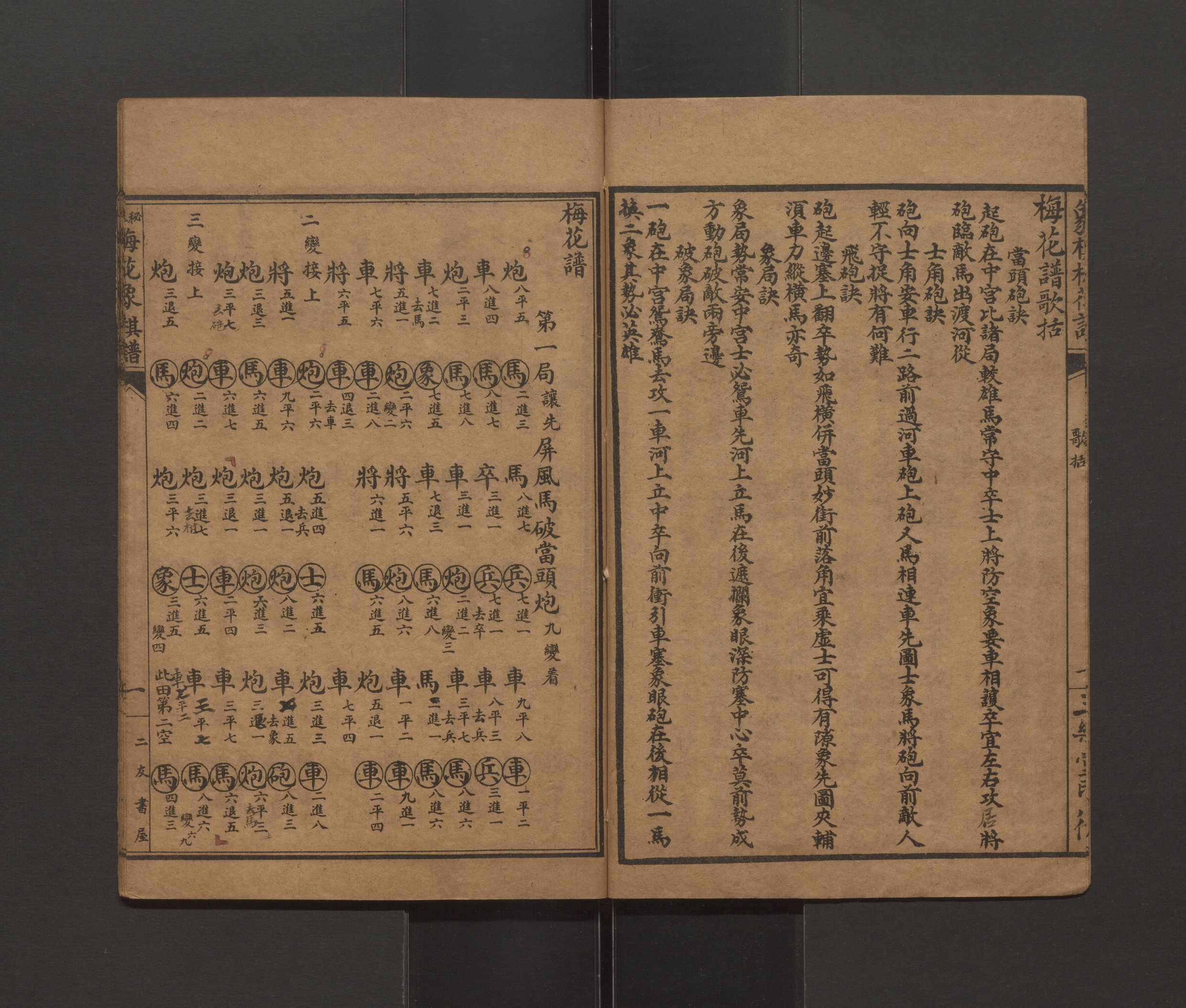
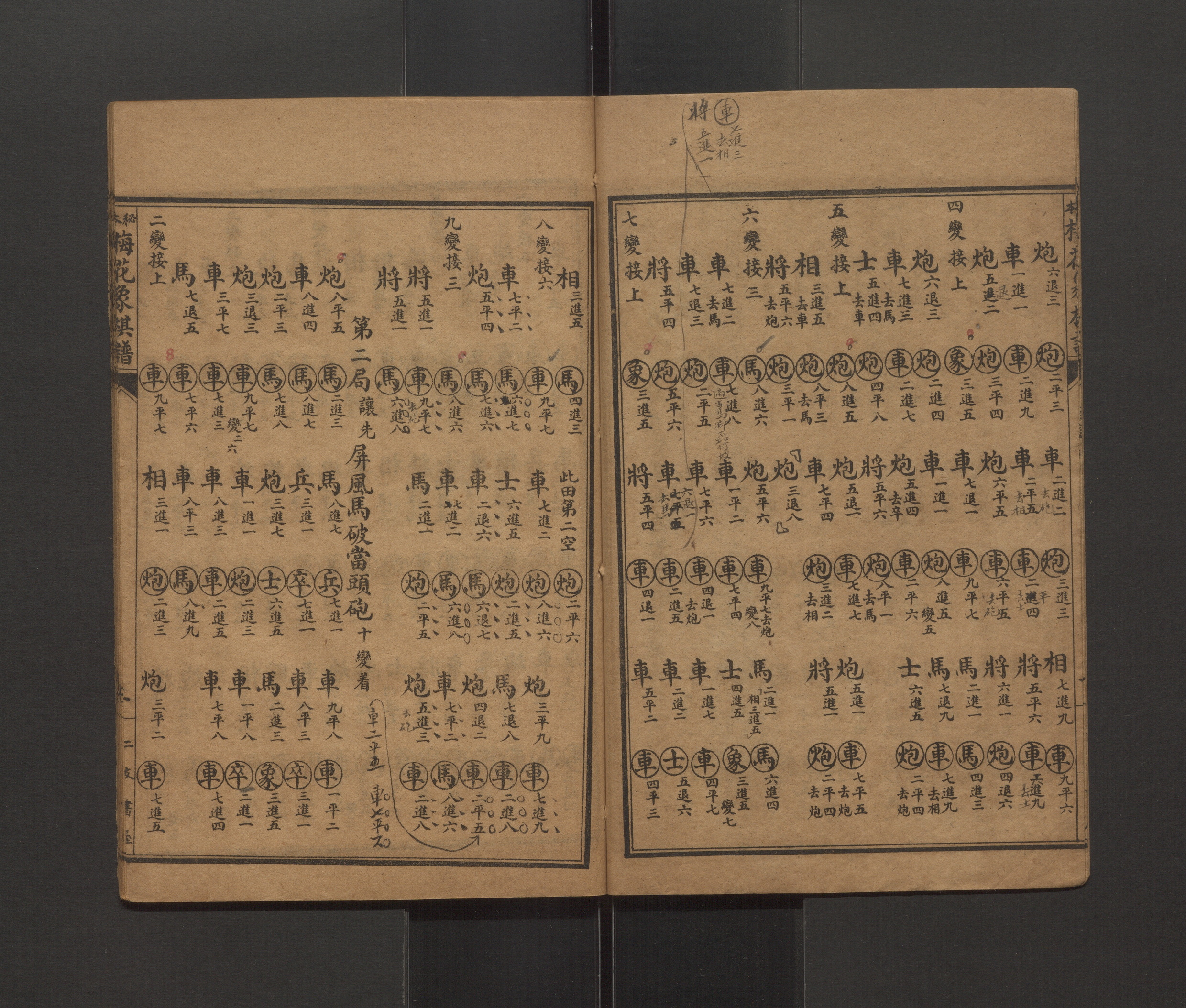
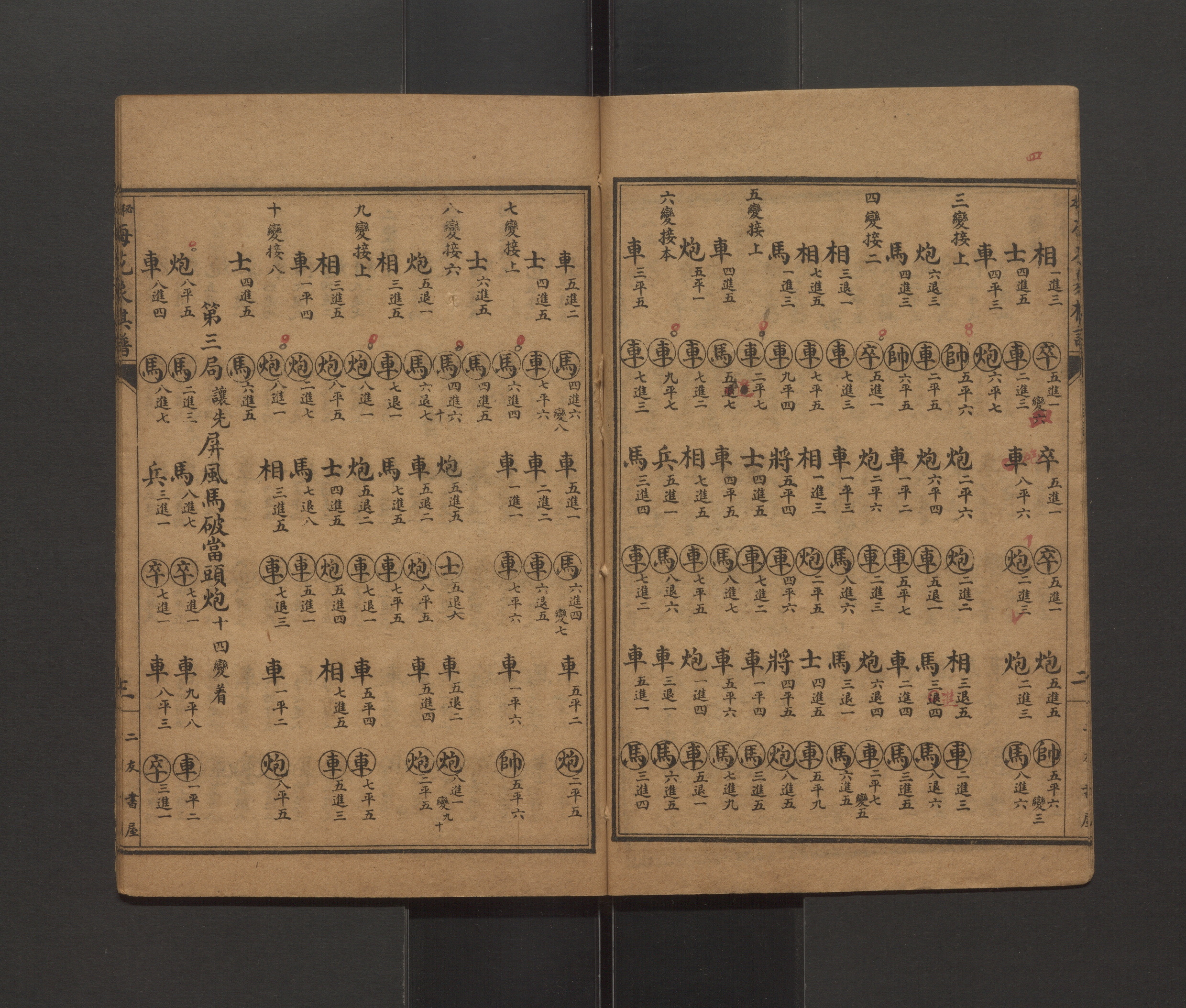
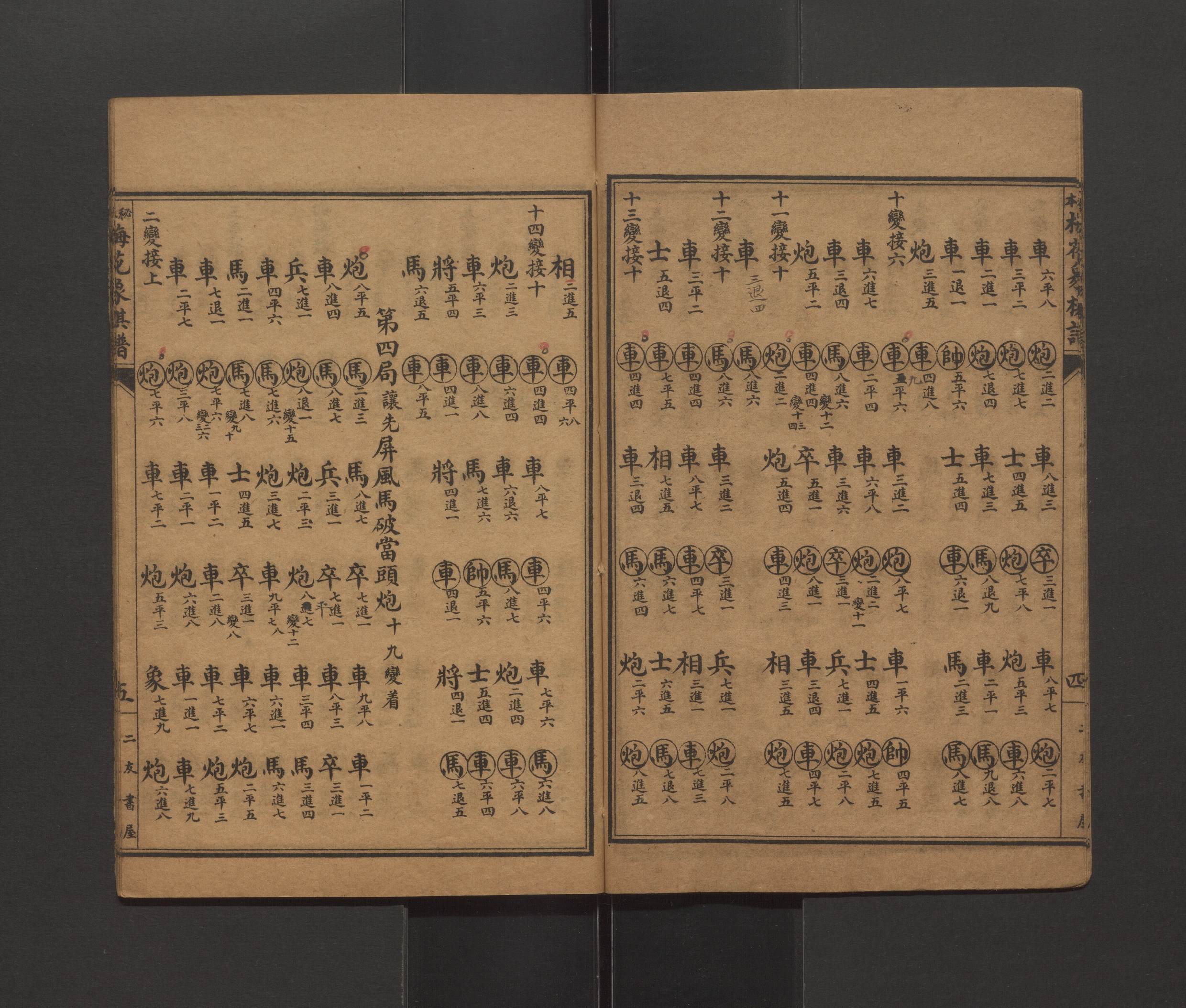
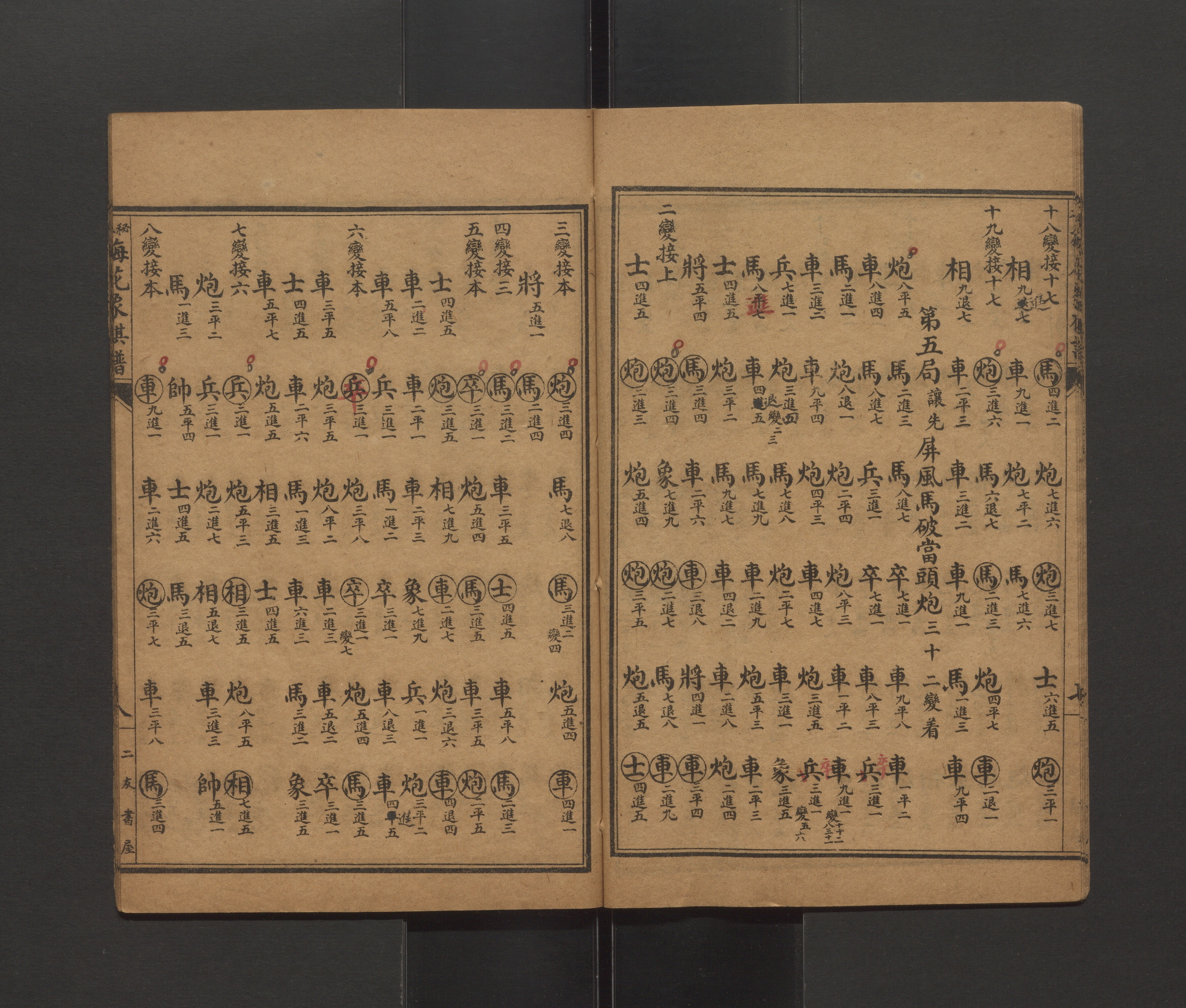
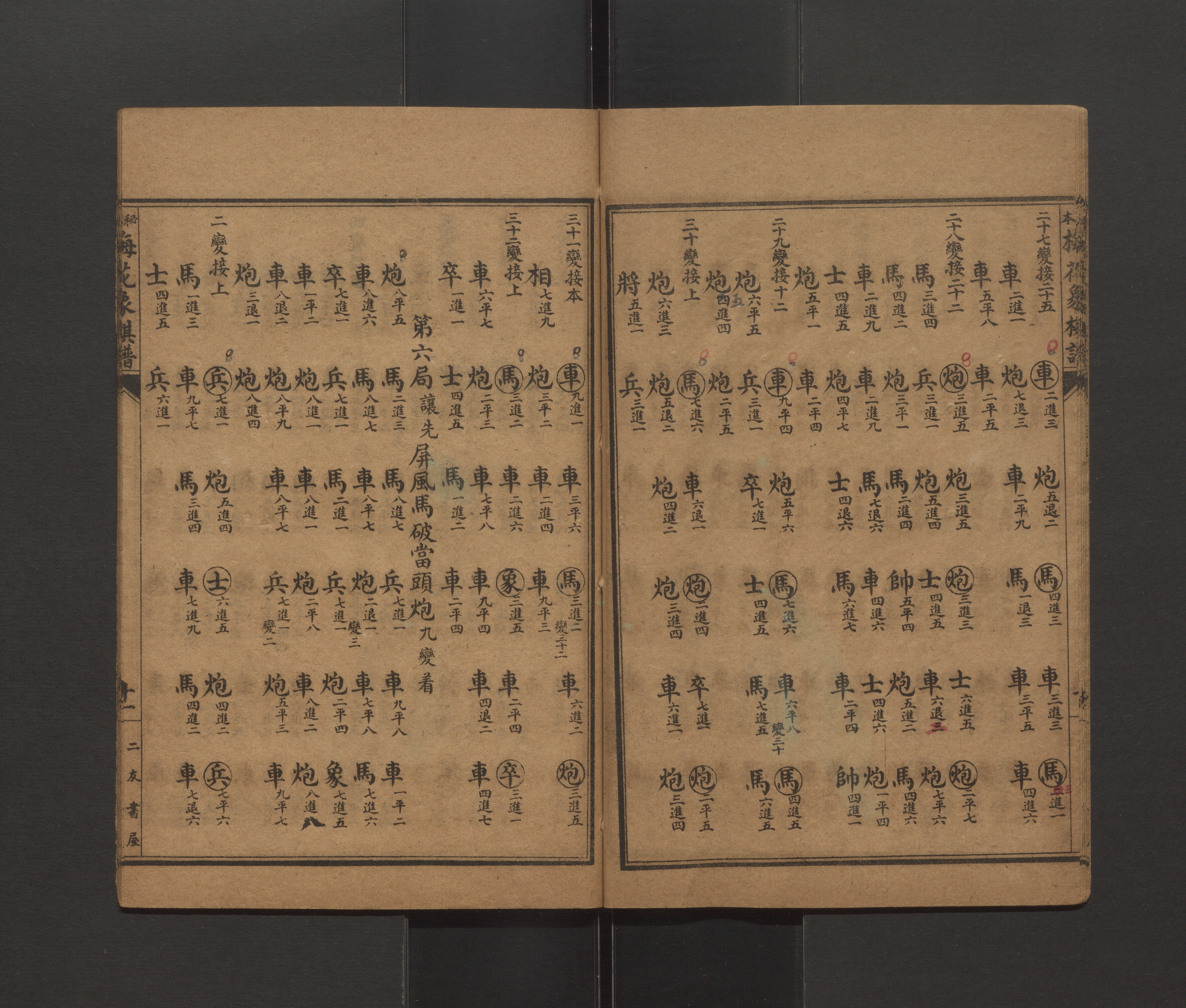
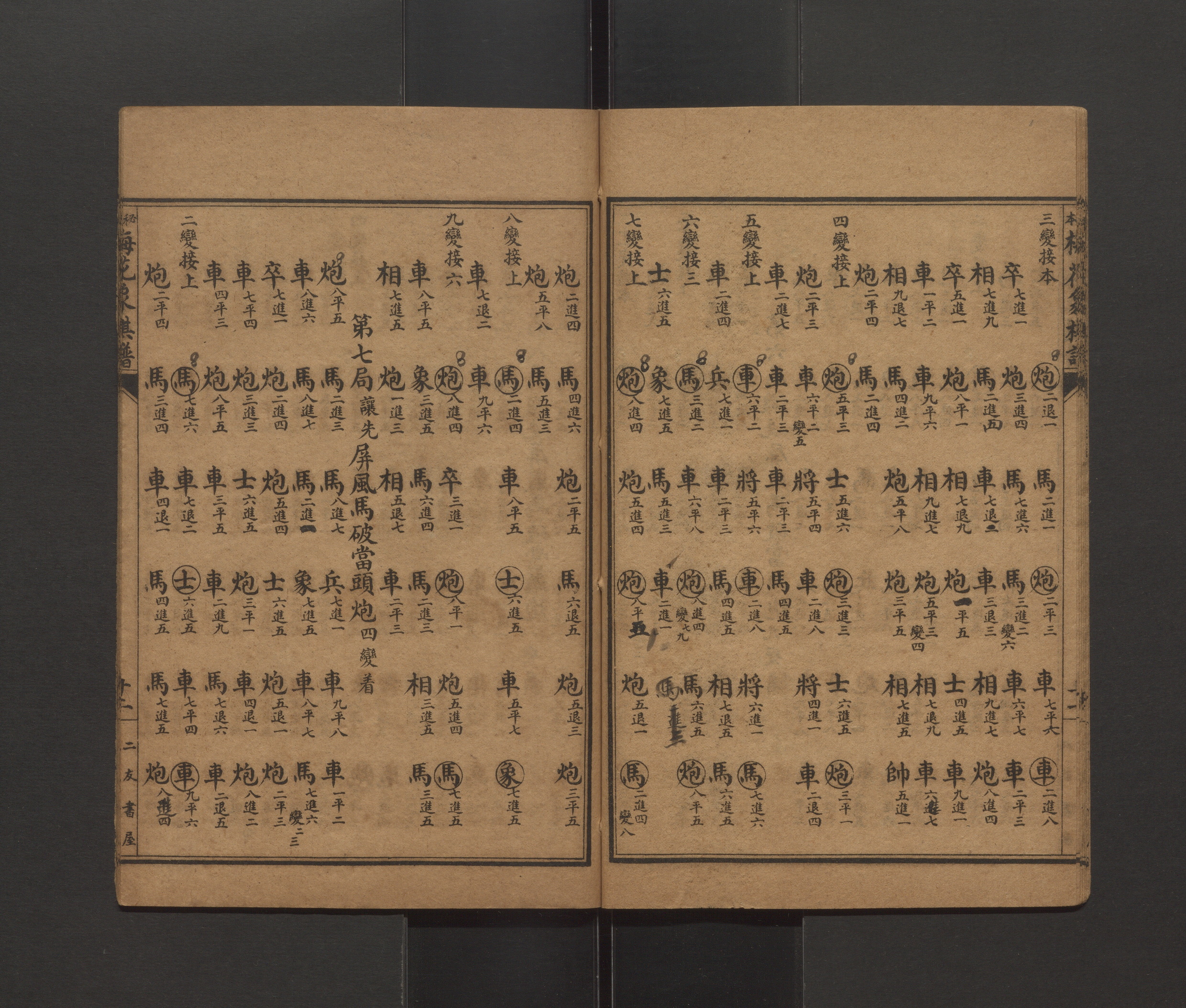
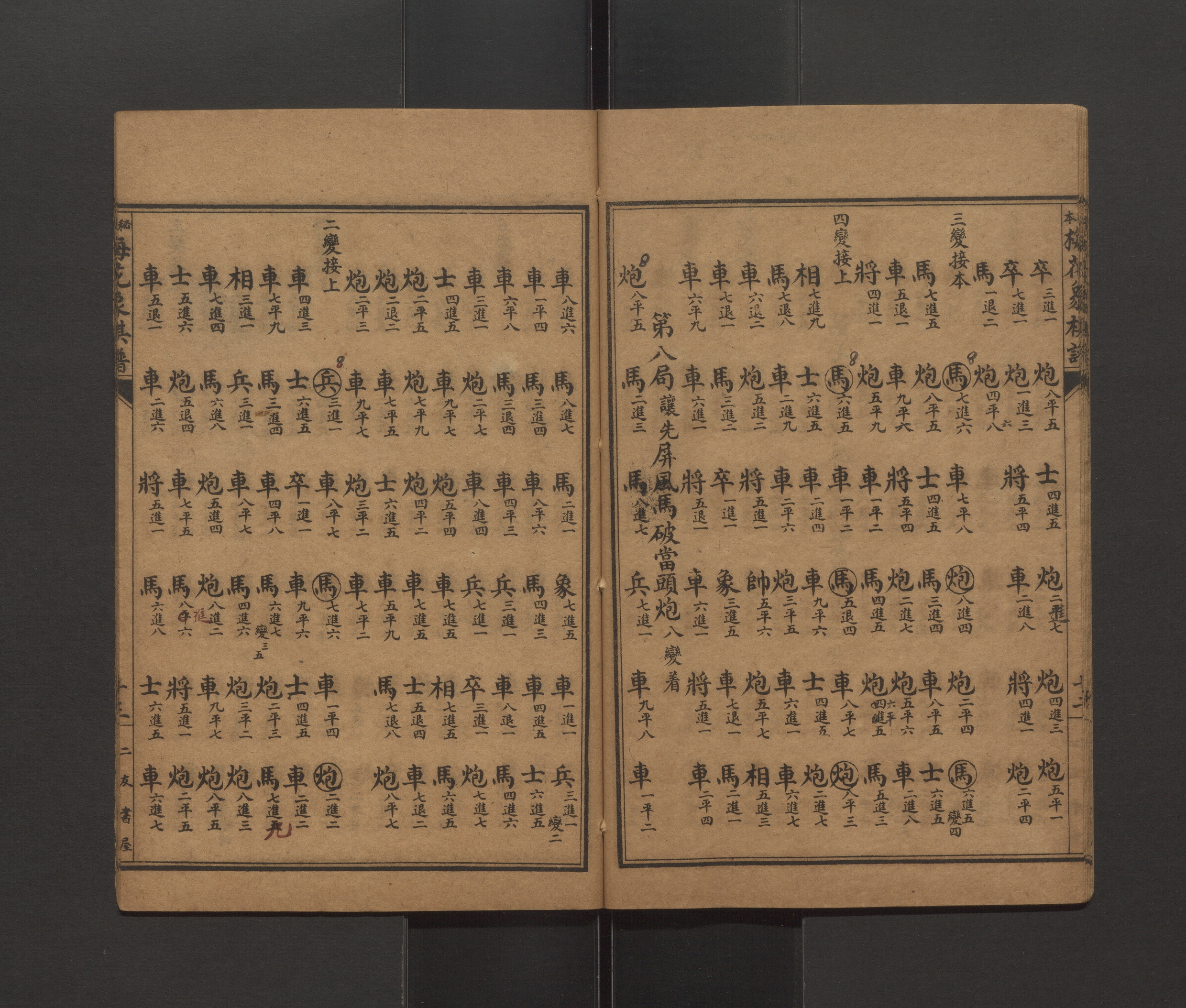
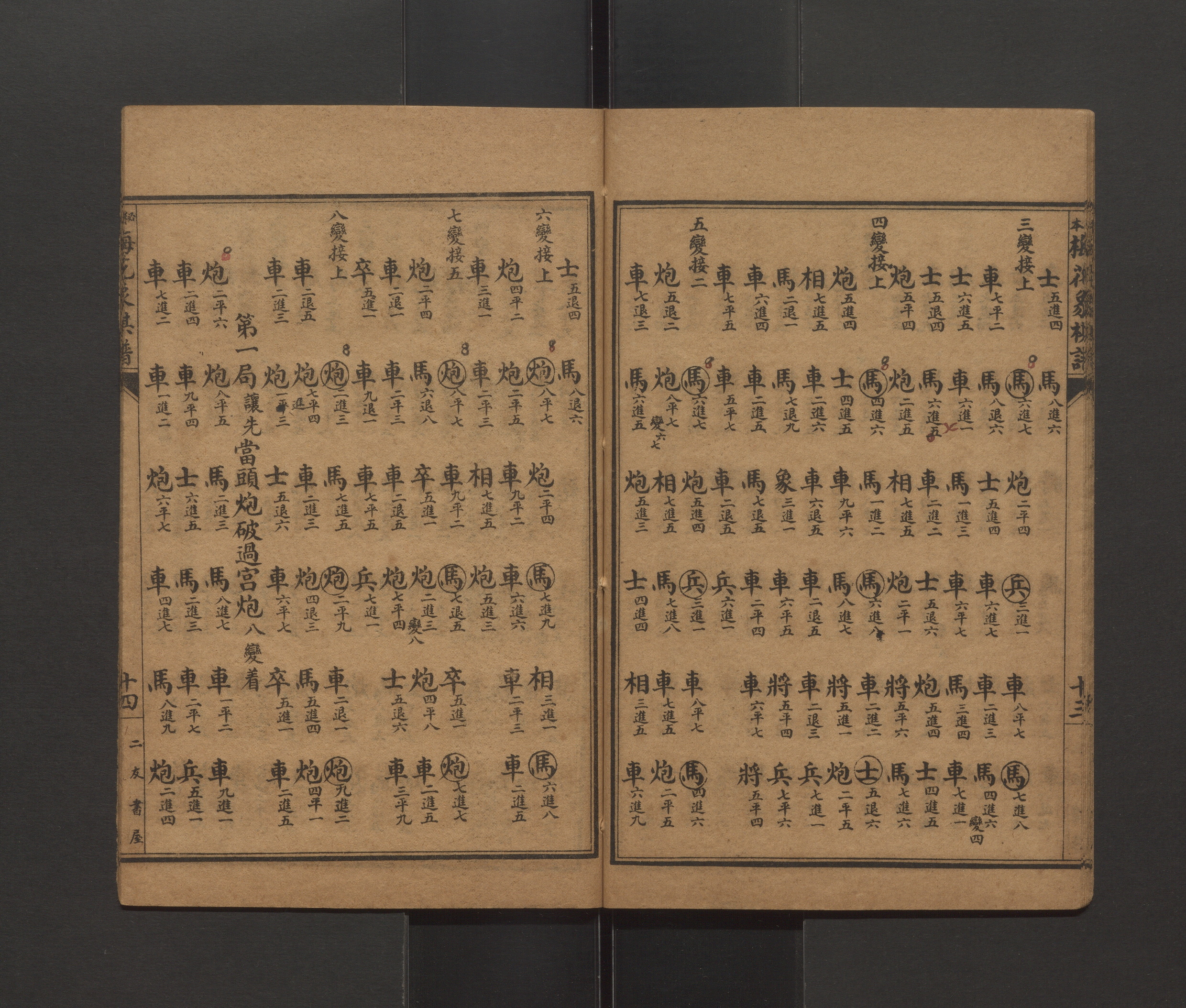
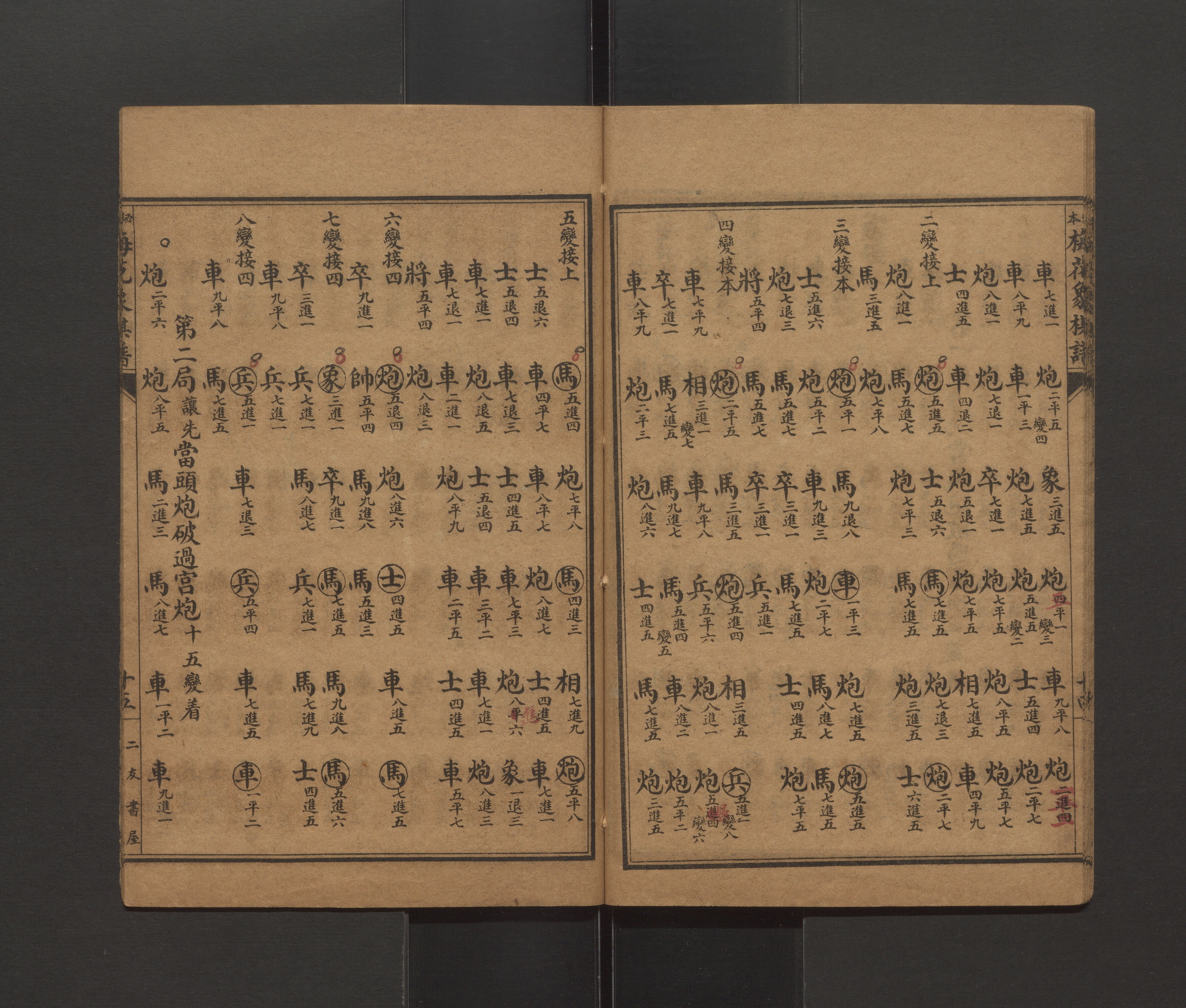
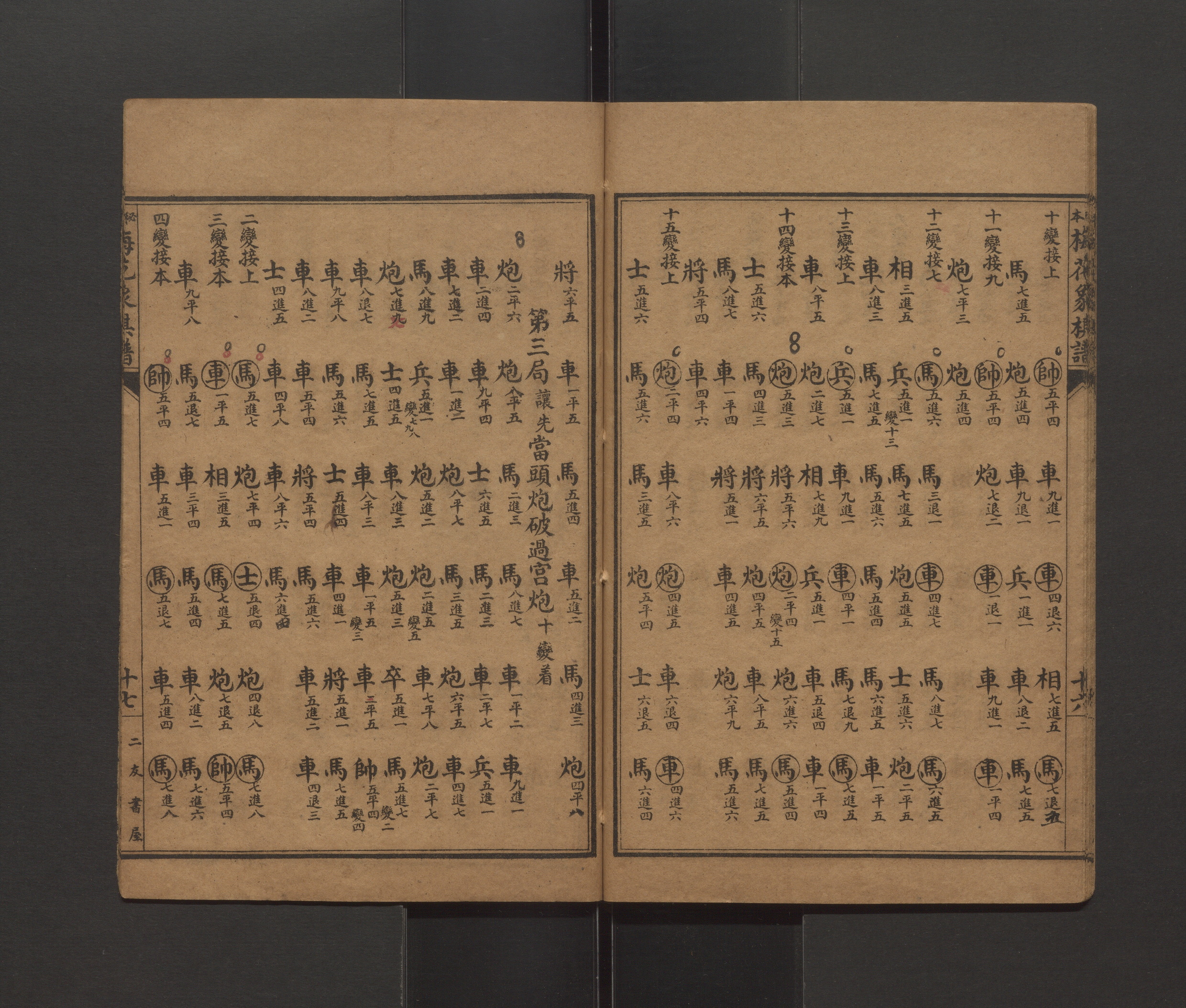
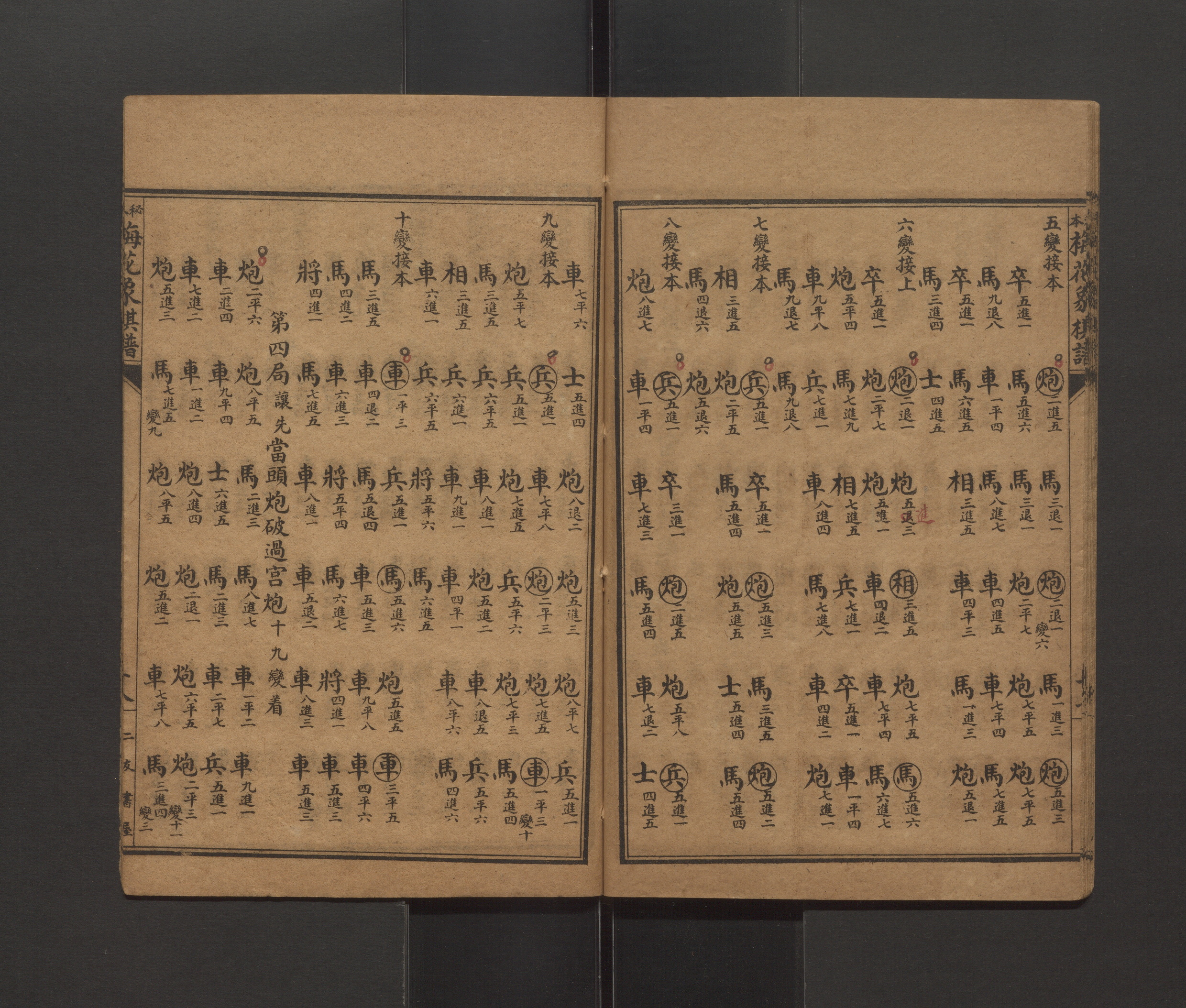
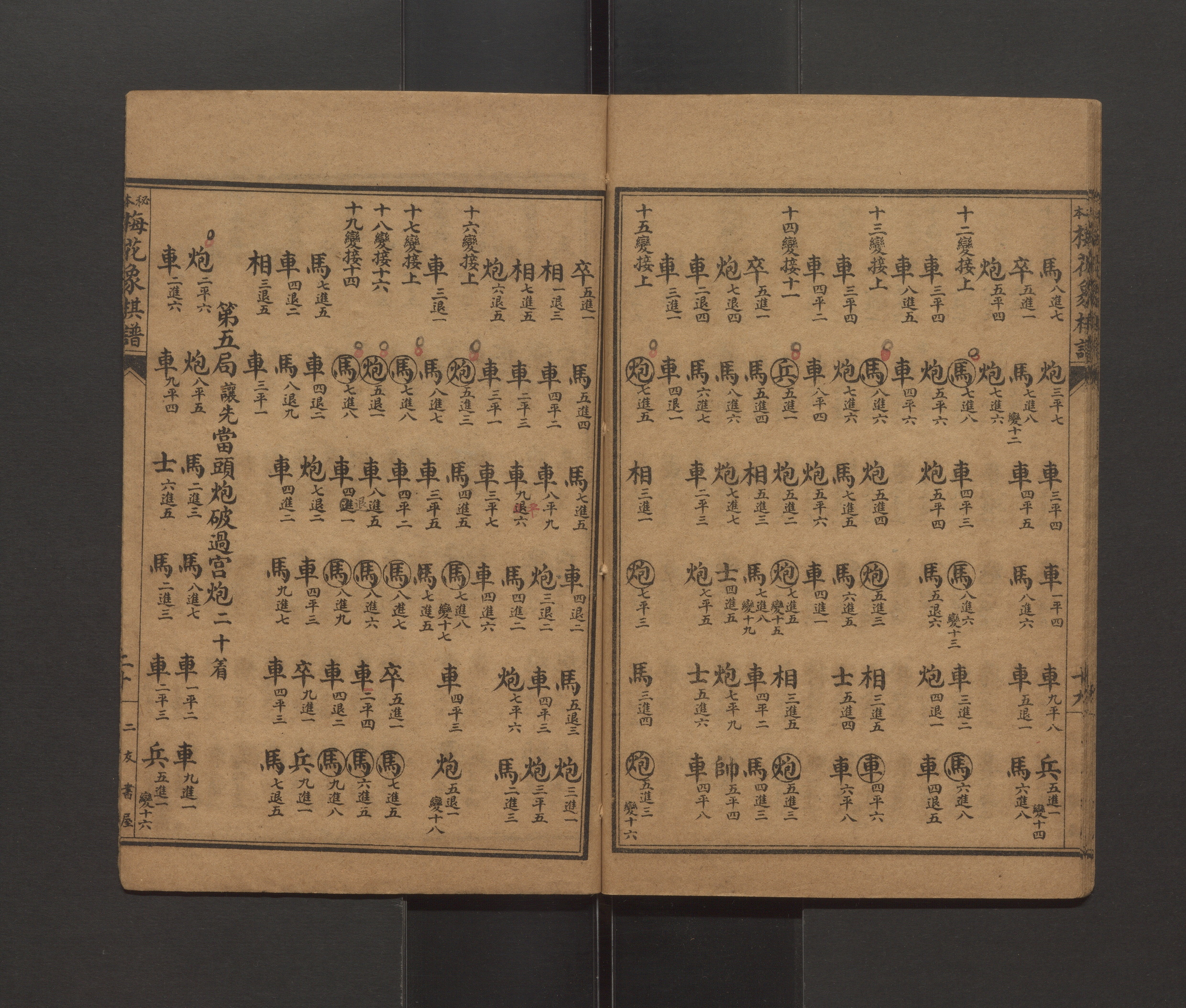
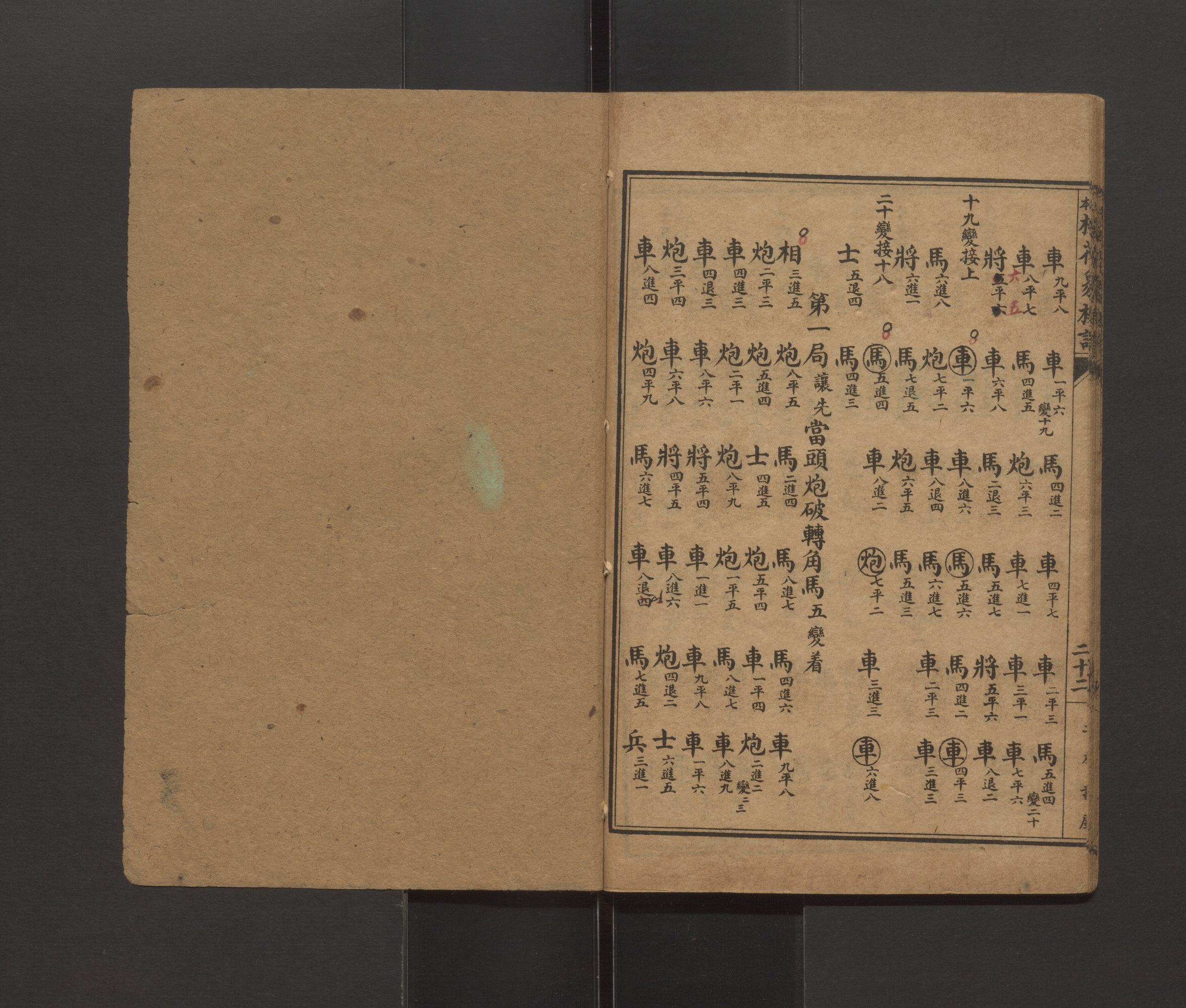
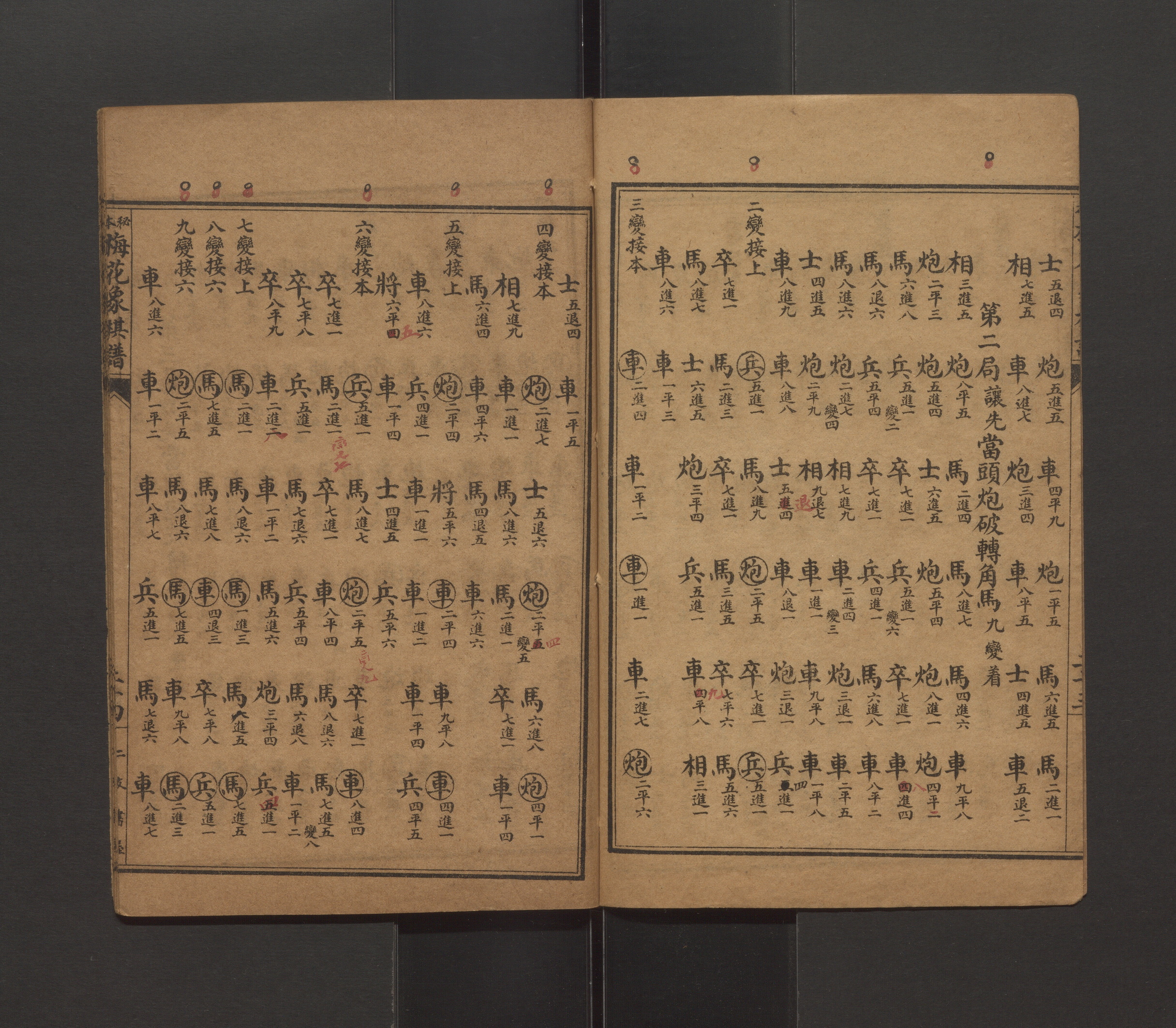
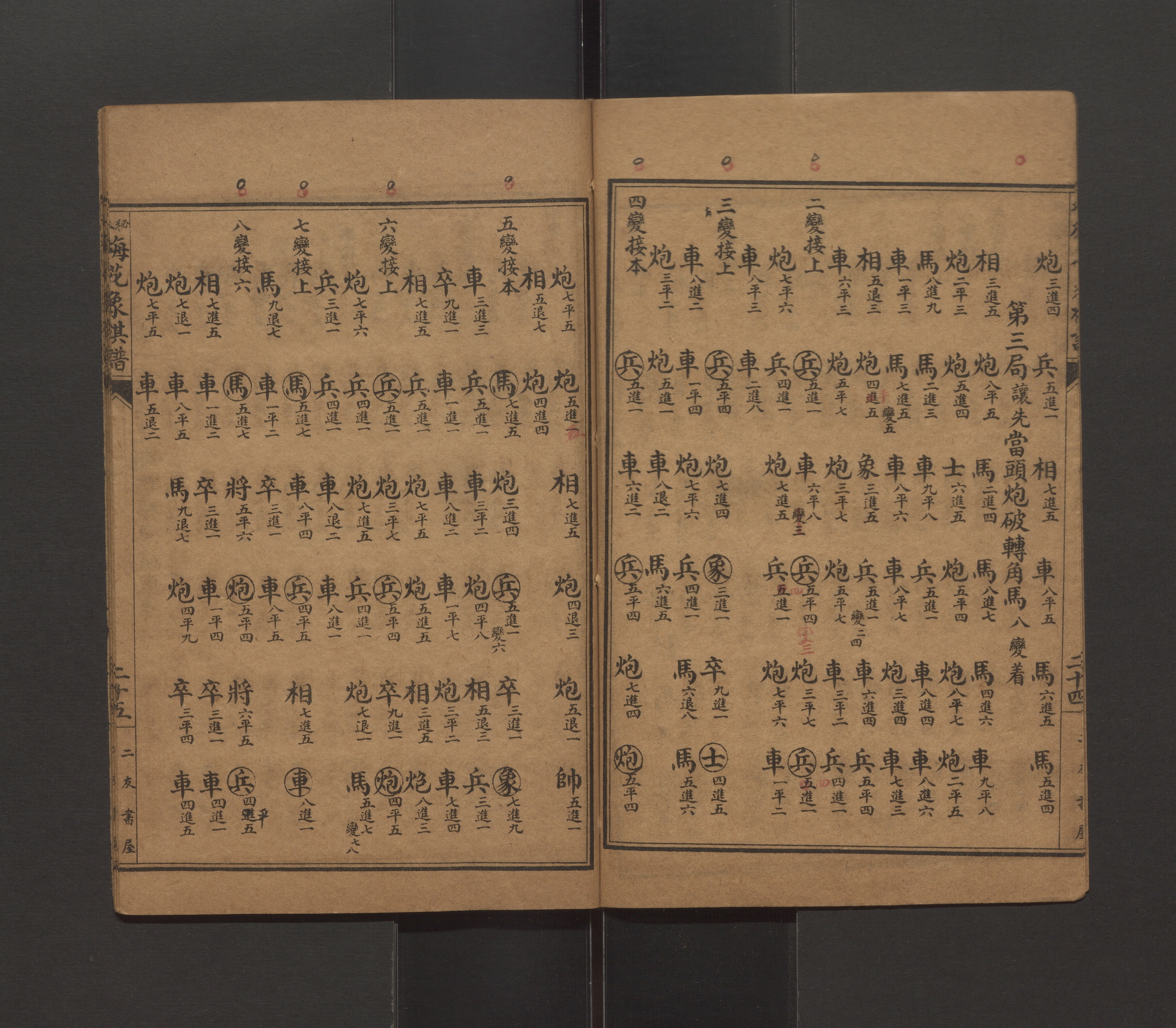
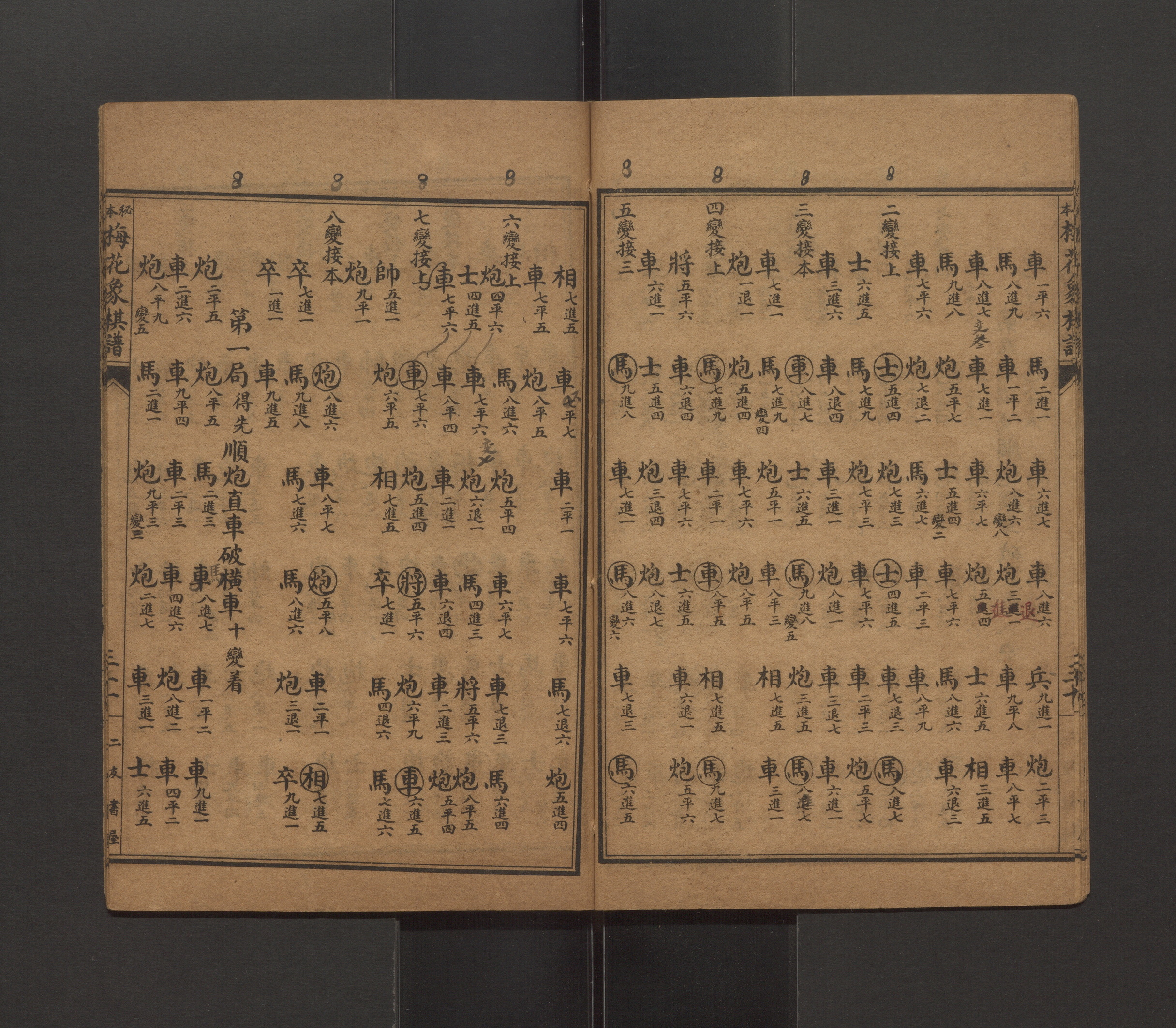
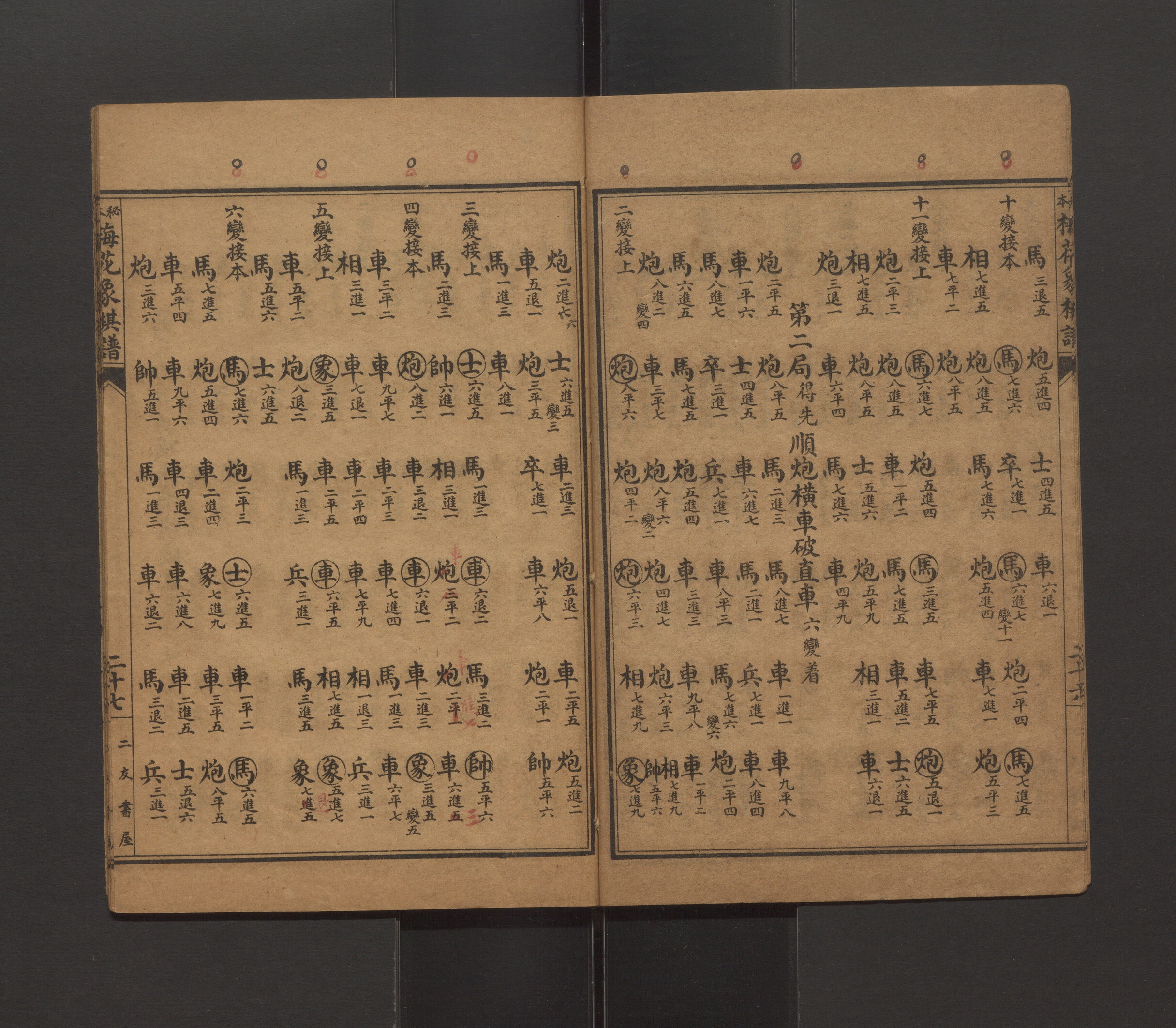
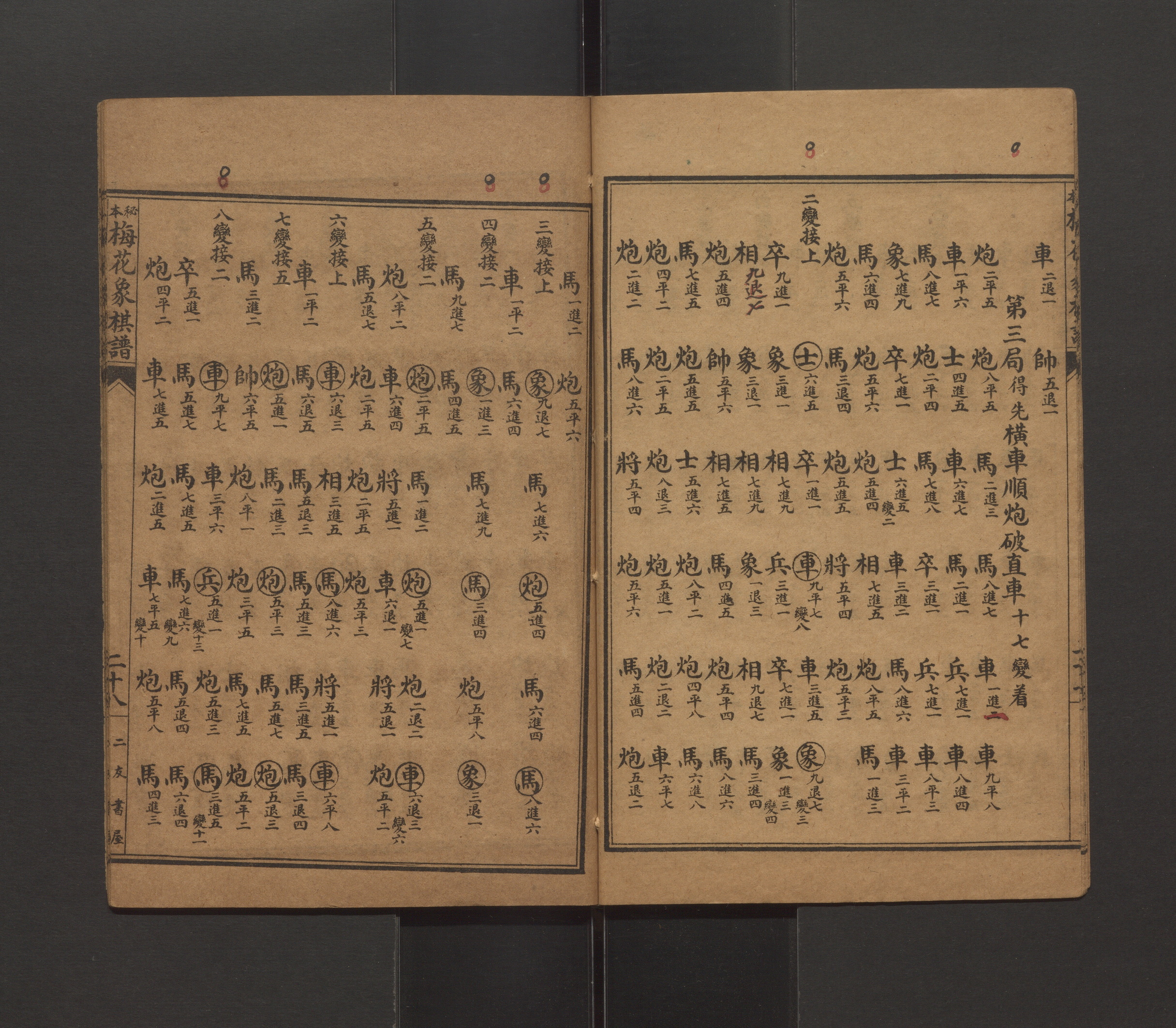
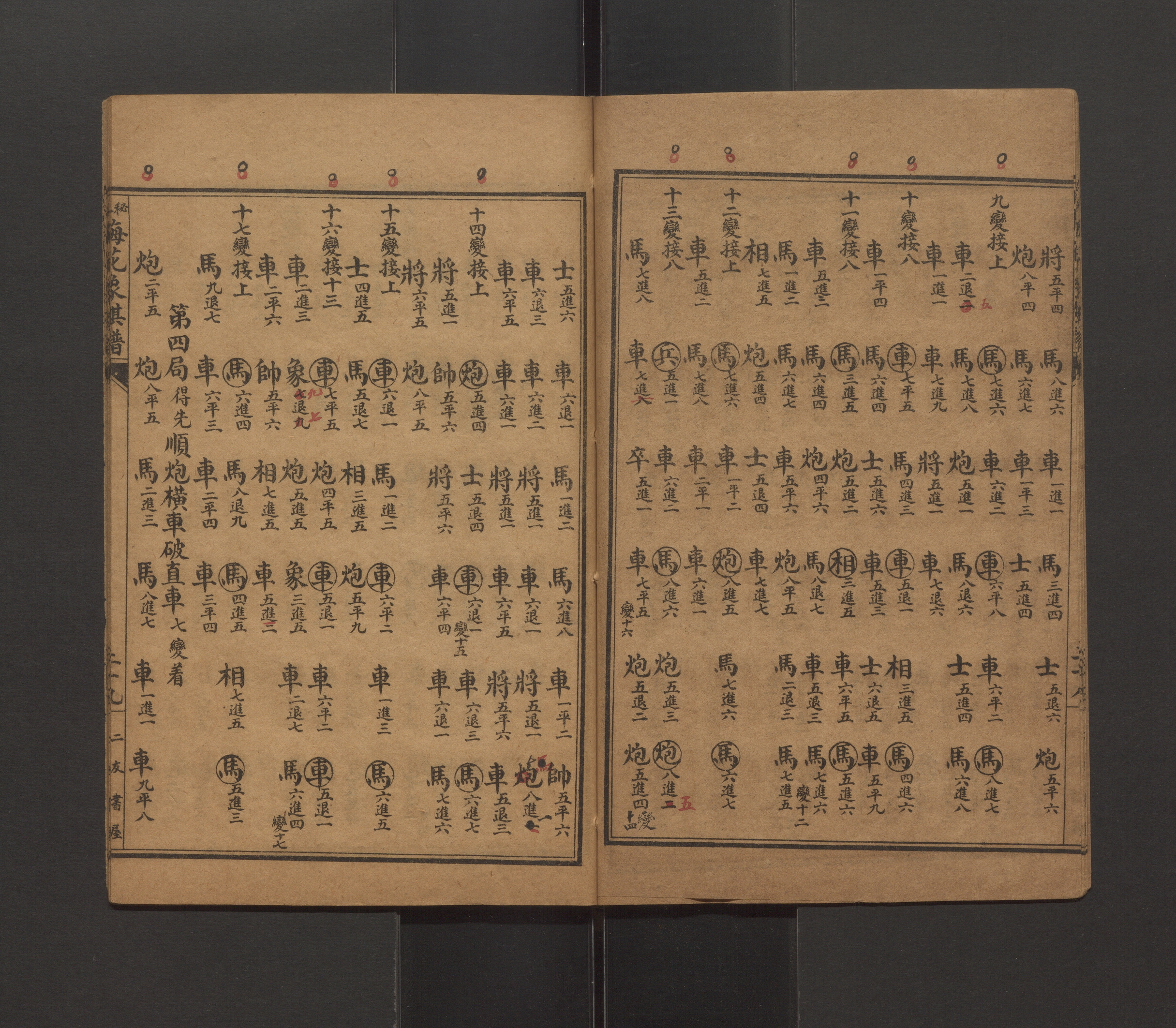
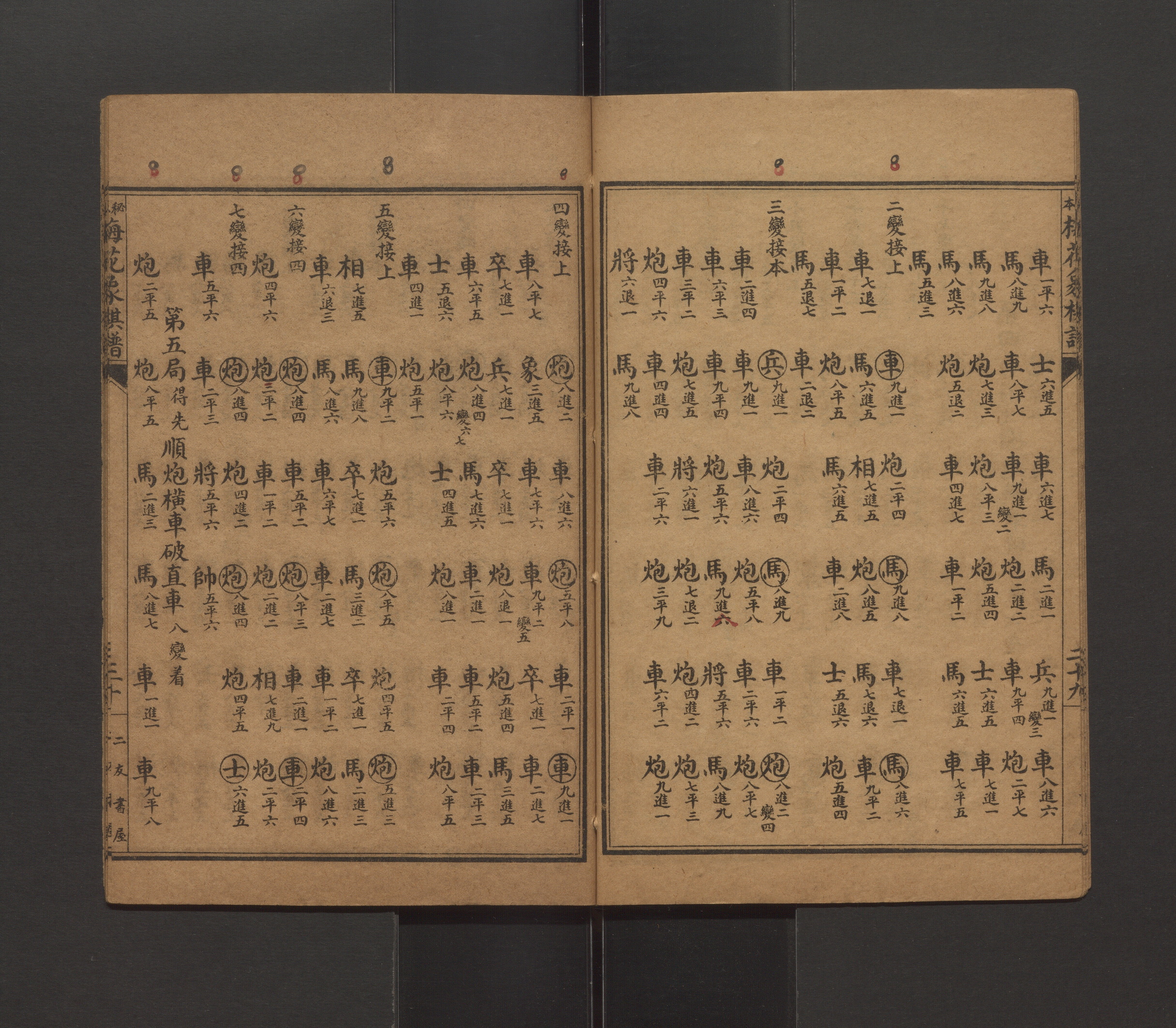
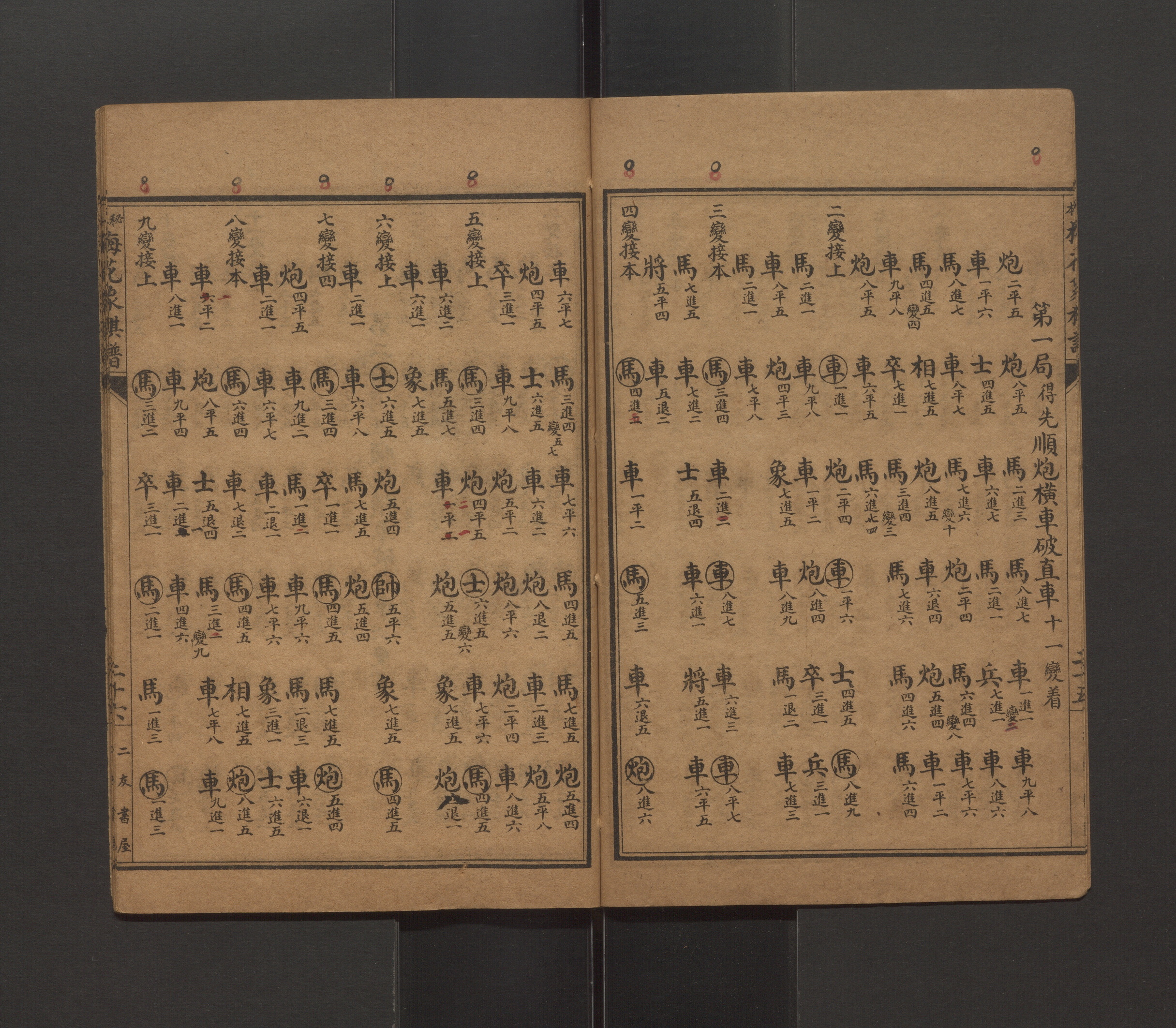
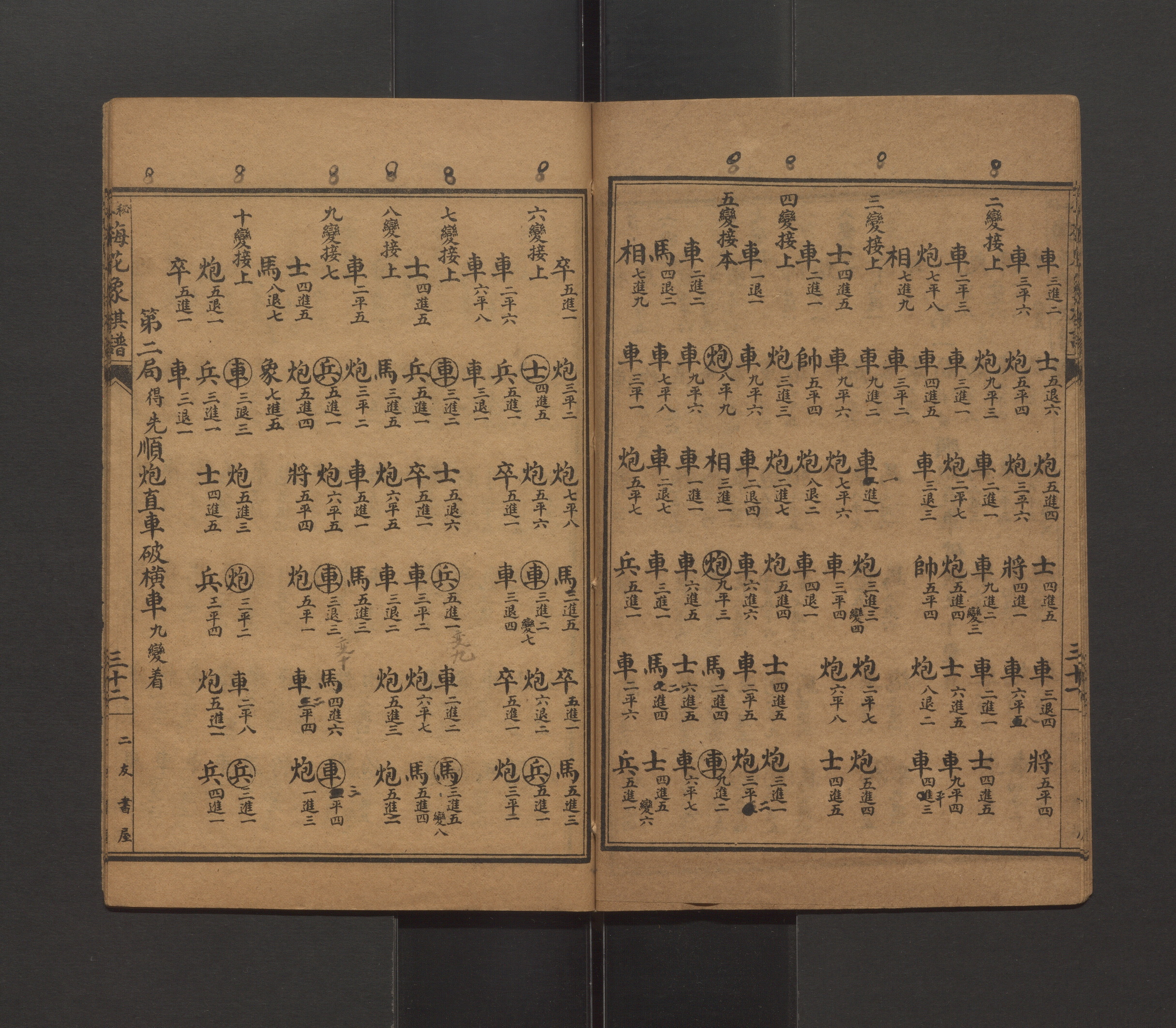
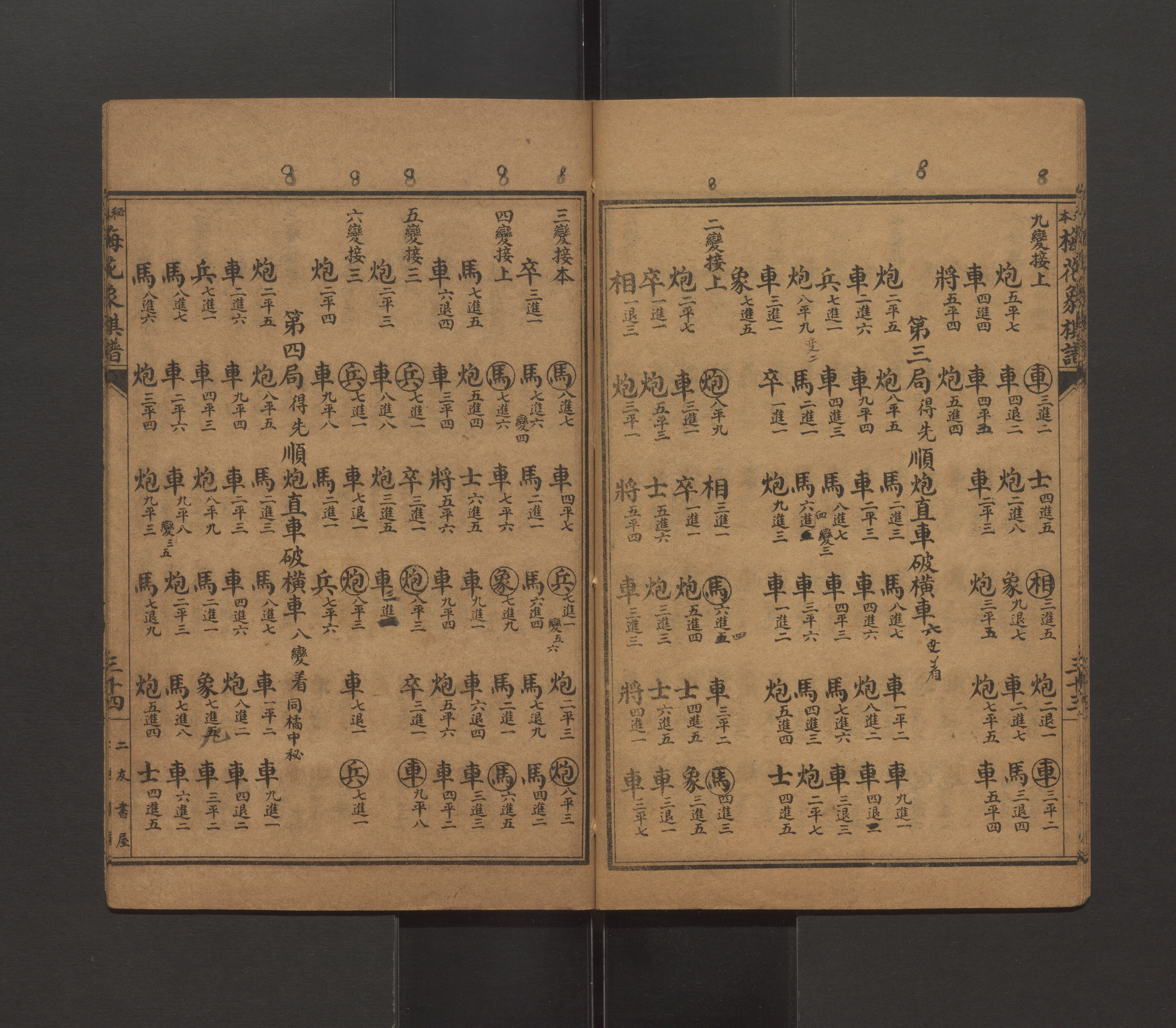
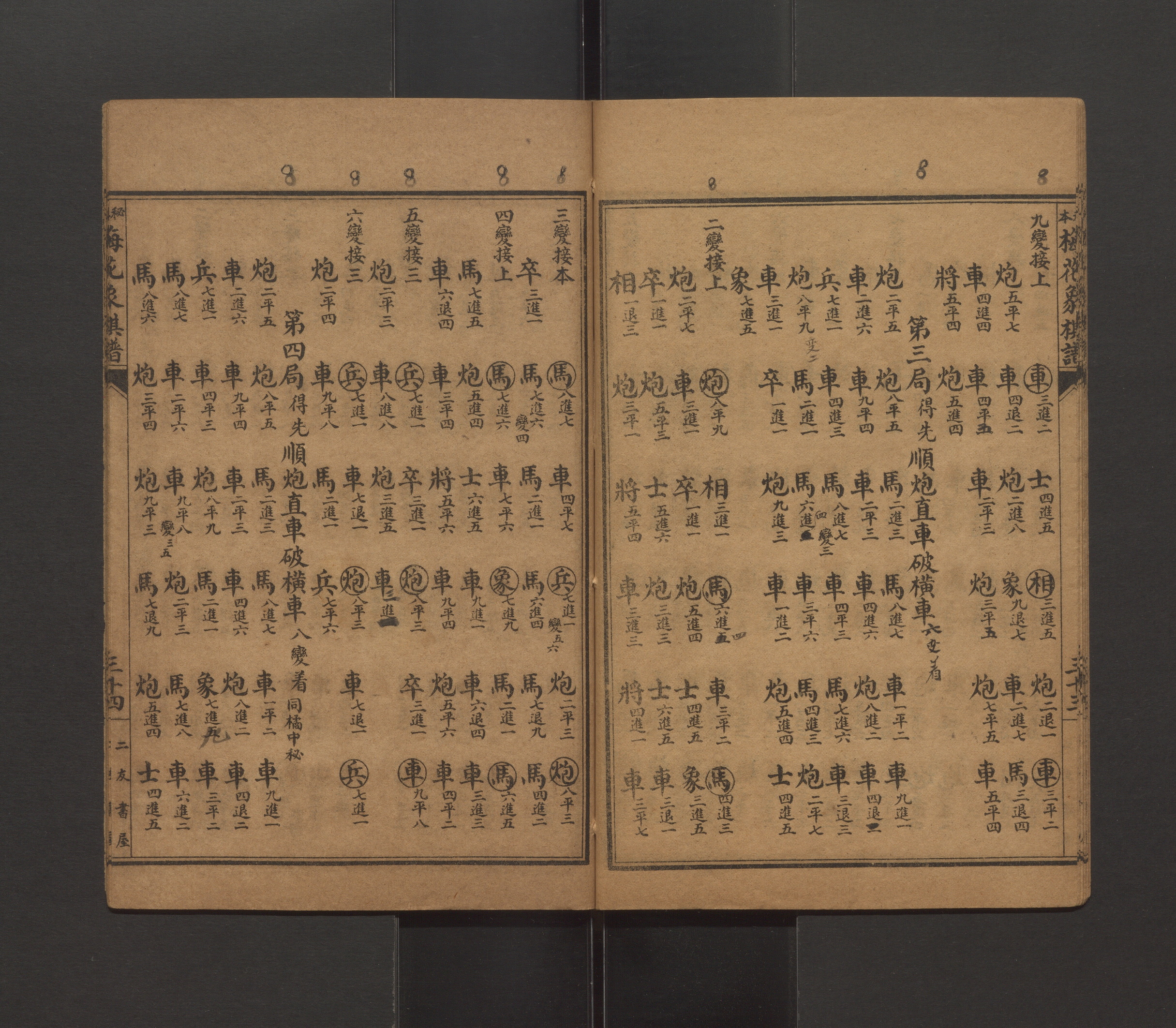
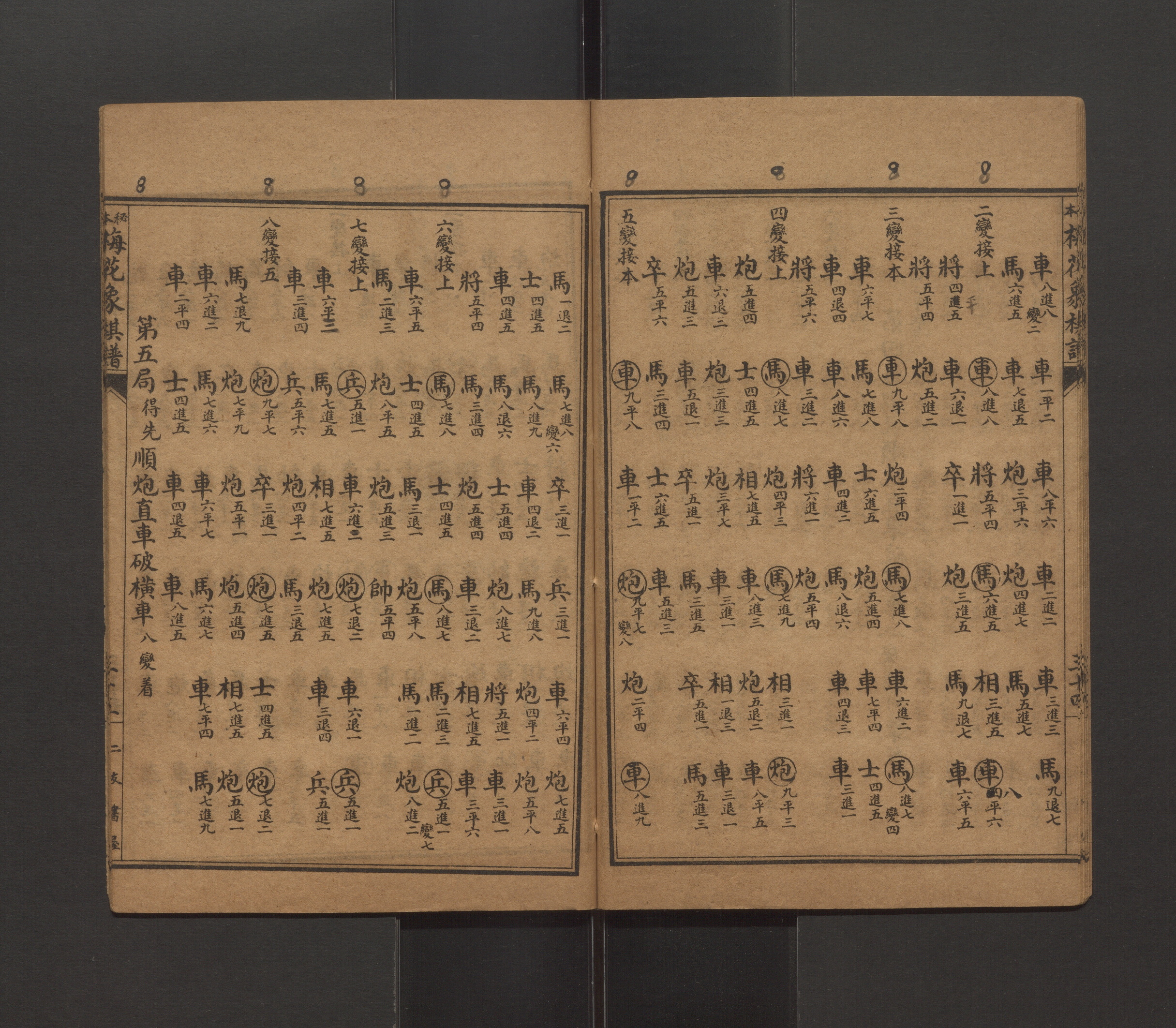
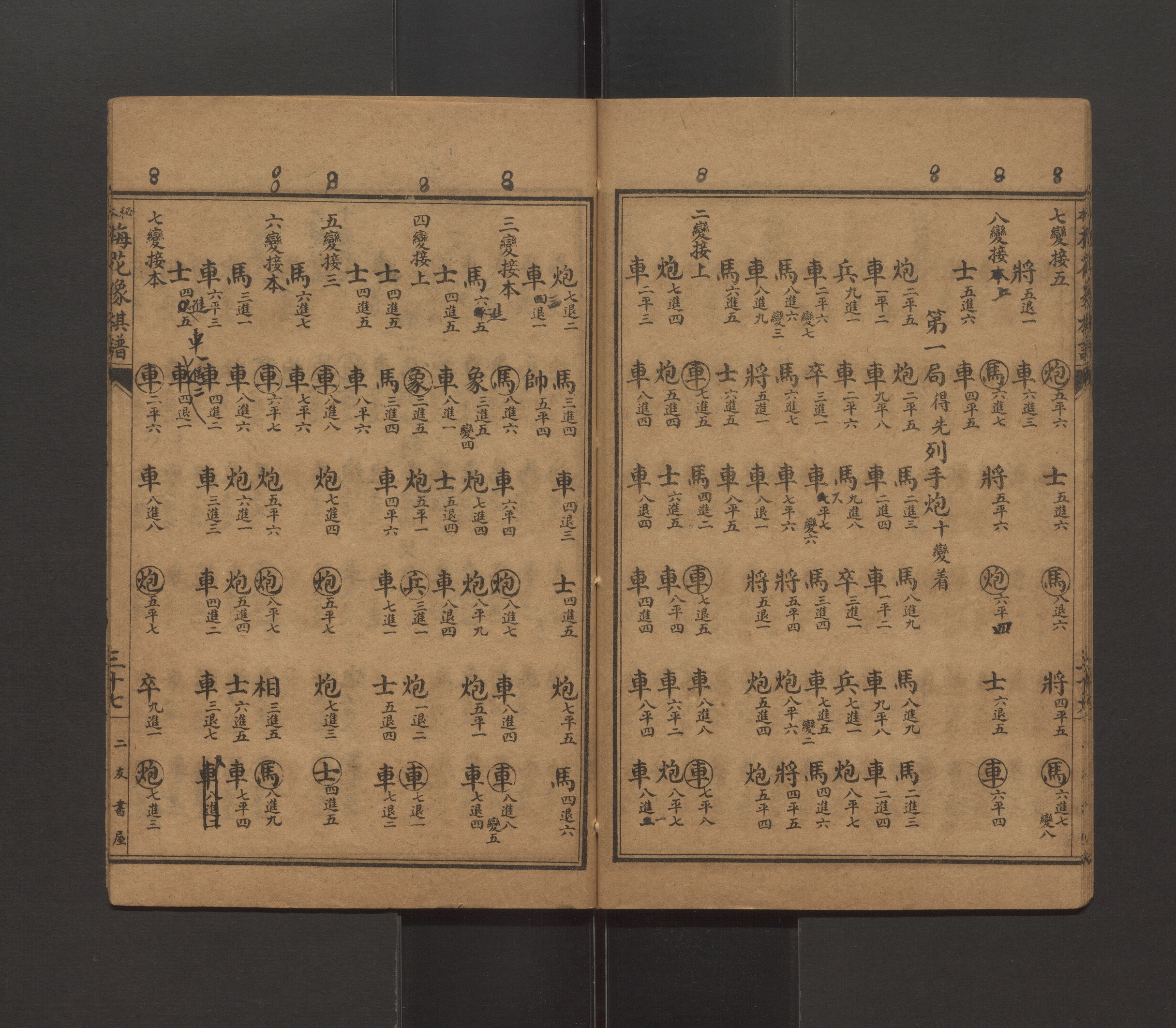
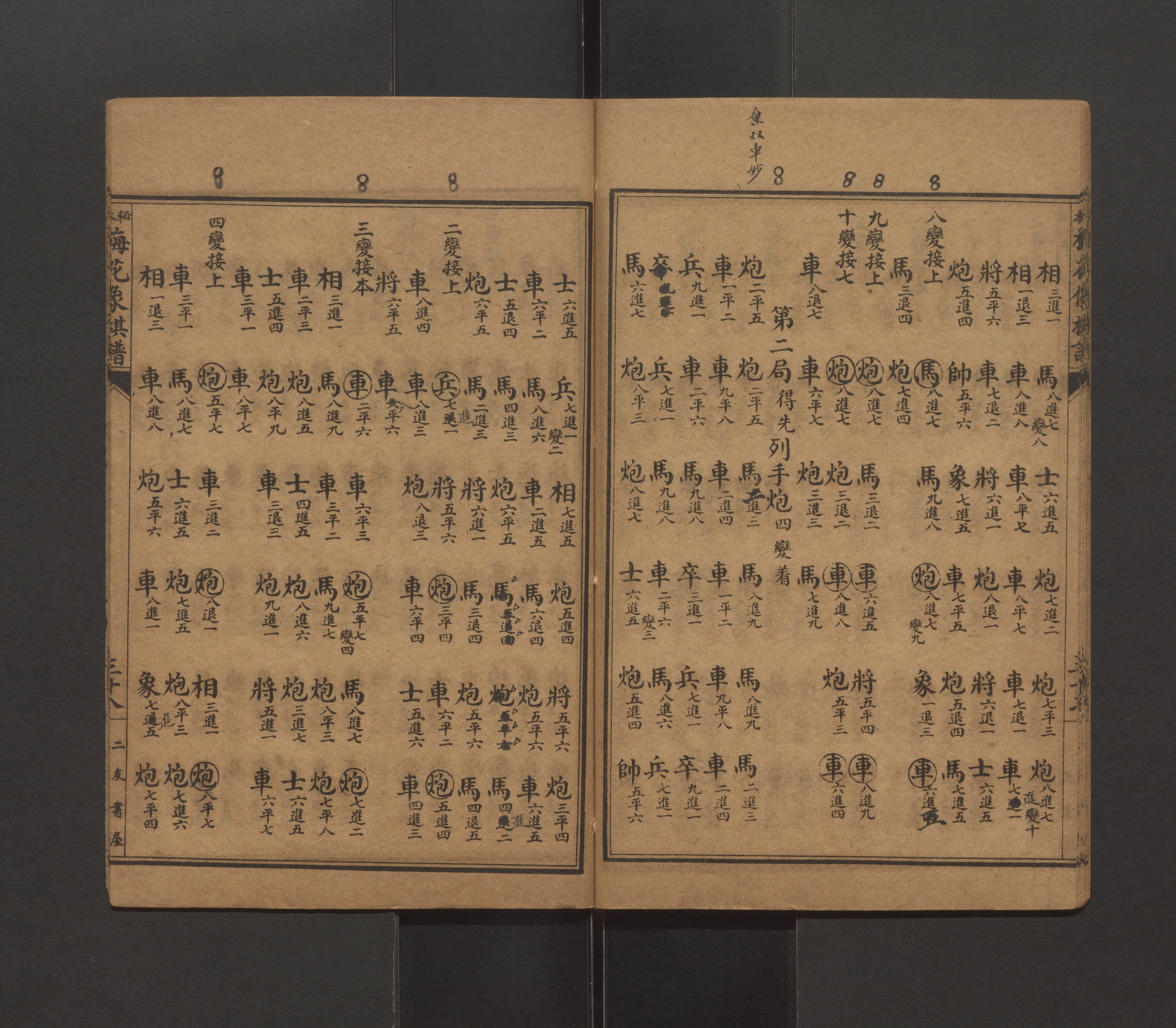
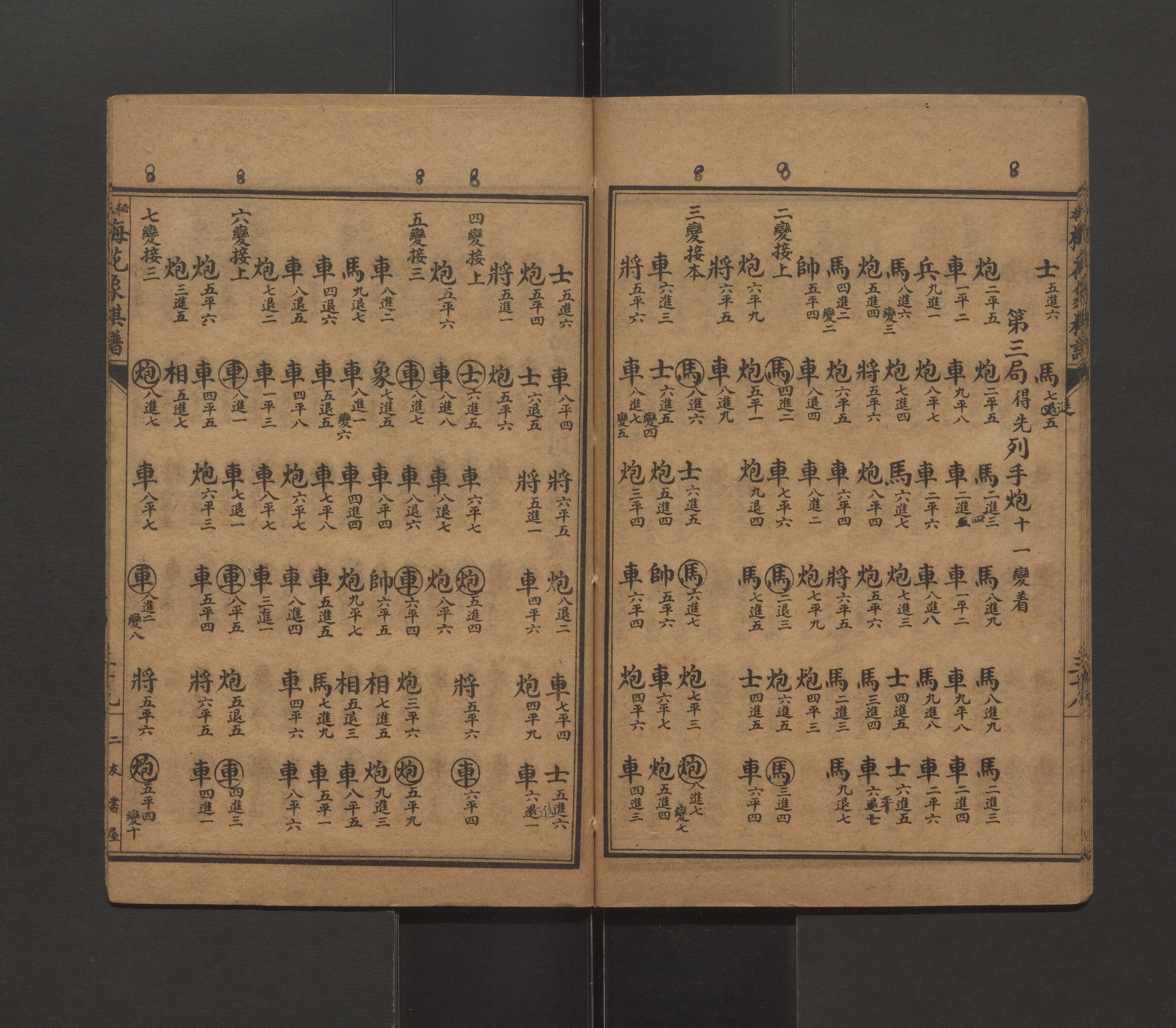
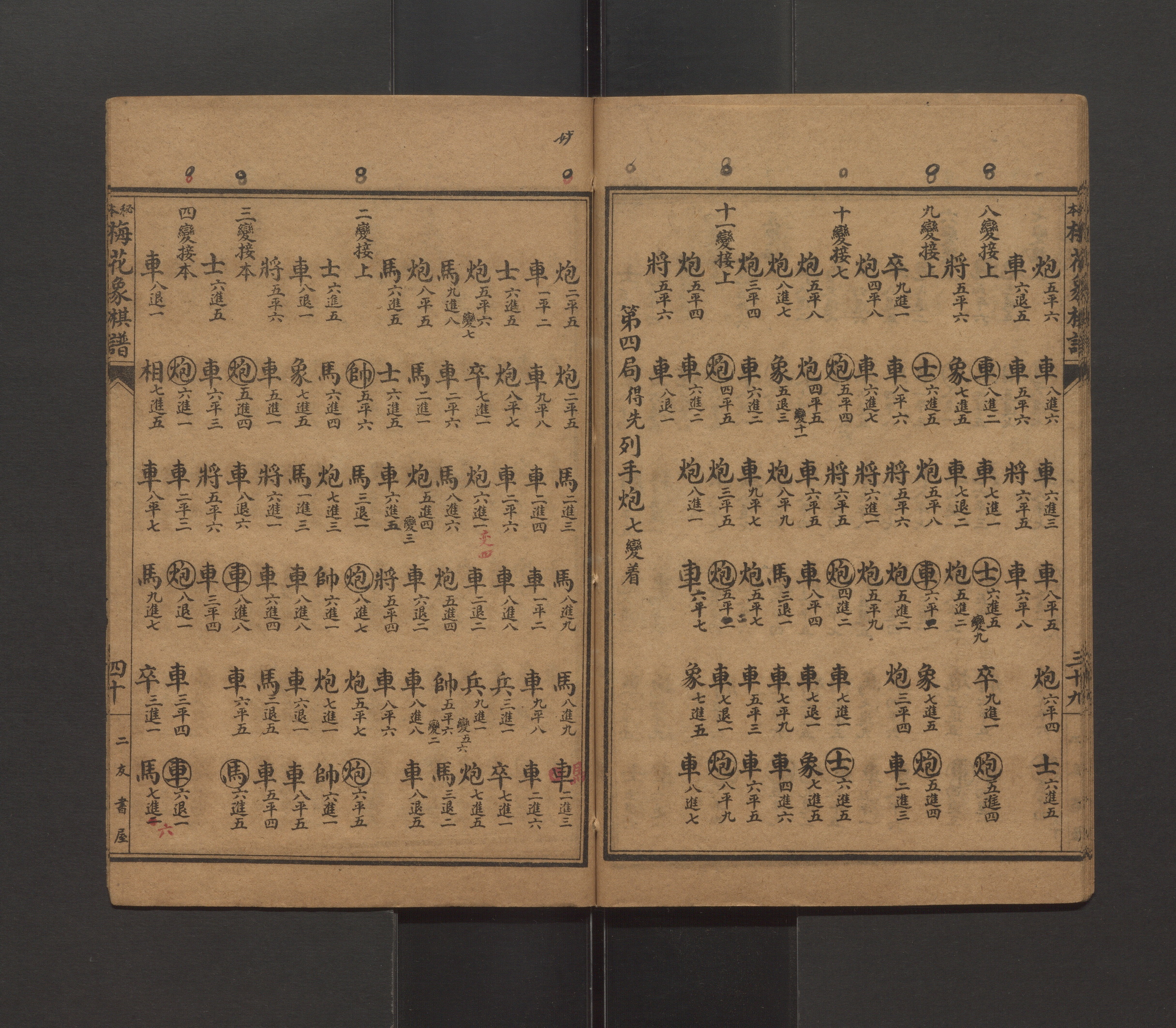
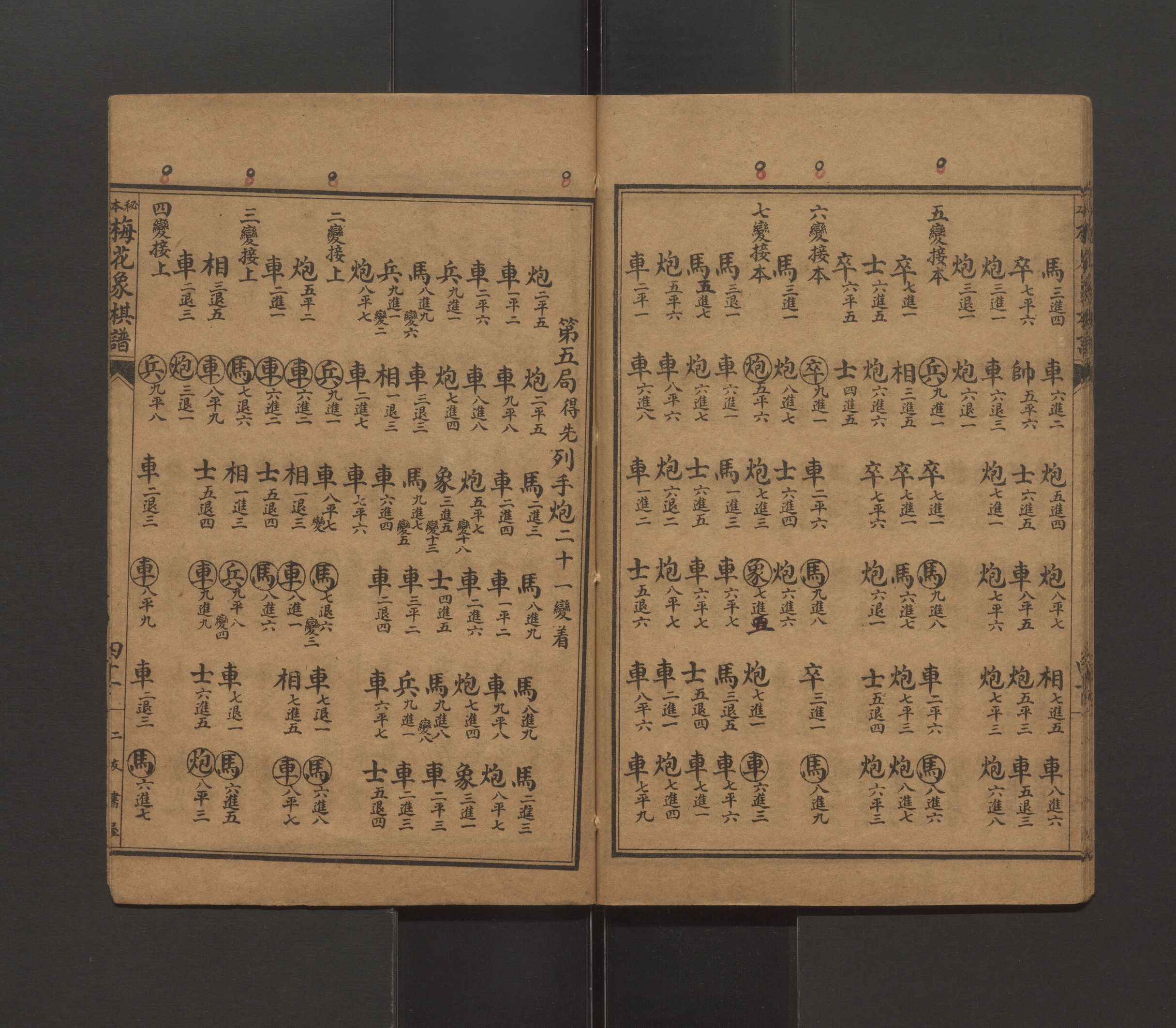
The archive's interactive records for I.3 and I.4 both display the moves of I.2. The score links above use separate transcriptions for those two studies.[34][35]
The opening studies
The second player’s Screen Horses

Screen Horses against the Central Cannon was in print before Wang's lifetime. Zhang Ru'an (張如安) identified it in two late-Ming household encyclopedias, the Wan shu cui bao (萬書萃寶, 1596) and Wu che ba jin (五車拔錦, 1597).[32] In the 1597 score the first player begins with 1. H2+3 and 2. H8+7, forming the screen in answer to 1... c8=5. The score appears under a title identifying the opening material with Jinpeng shiba bian (金鵬十八變).[36][32]
Wang's first division develops the Screen Horses repertoire for the second player. Xie's contents divide the eight studies by the way the Central Cannon player deploys a chariot. The first five use a riverbank chariot. The final three use an overriver chariot and vary when or whether it takes a pawn. Black changes the defence to match, ranging from moving a pawn or a horse to retreating a cannon and changing its file.[4][6][9]

In the first study Red opens with the left cannon, 1. C8=5, an orientation Png calls out in his discussion of the manual.[30][3] Red's chariot reaches the riverbank and takes a pawn with 6. R8=3. Black then advances the other horse pawn and brings a horse out with 7... h7+8.[30] The horse continues inward with 9... h8+6 and later joins a chariot attack beside Red’s palace. The first recorded line ends with 19... r4-3, taking Red’s chariot.[30][37]
Division I, study 1. Black counters the riverbank chariot
Loading xiangqi example…
The same early pawn capture leads to a different counterattack in I.4. After the two sides advance their other horse pawns, Black prepares to come out on the seventh file with 7... c8-1 and 8... c8=7. In I.6, Red's chariot crosses the river before taking the pawn, and Black retreats the cannon on the other wing with 5... c2-1 before sending a horse forward with 6... h7+6.[35][38]
Cannon attacks and chariot deployment
The next division lets the first player open with the Cross-Palace Cannon, 1. C2=6, and assigns the Central Cannon to Black.[39] Black lifts the chariot onto the second rank and shifts it to file four. After Red's riverbank chariot takes the pawn on file seven, Black plays 8... r4+7, bringing the ranked chariot deep into the file beside Red's king.[39] The Xiangqi Memory commentary draws attention to the pressure this creates beside the palace.[39]
Division II, study 1. Central Cannon against Cross-Palace Cannon
Loading xiangqi example…
In the first Palcorner Horse study, Red starts with an elephant and routes the horse through the advisor's corner with 2. H2+4 and 3. H4+6. Black places a chariot behind the cannon and takes the central pawn at 4... c5+4.[40]
Division III, study 1. The Central Cannon takes the central pawn
Loading xiangqi example…
The two Same Direction Cannons divisions develop the same opening from opposite chariot choices. The filed chariot moves sideways from its starting square onto the file the cannon has vacated. The ranked chariot advances a single step and shifts along that rank, giving it a choice of files.[4][9][3]
In the first study of division IV, Red files the chariot at 3. R1=2 and crosses the river with it at 4. R2+6. Black raises and shifts the other chariot to file four. Red's second cannon reaches the riverbank at 6. C8+2 just as Black's ranked chariot swings across to the opposite wing. Red slides the cannon aside on the next move, and Black develops a horse to the edge.[41]
Division IV, study 1. Filed chariot and riverbank cannon against the ranked chariot
Loading xiangqi example…
In the first study of division V, Red plays 3. R1+1 and 4. R1=6, while Black files the chariot behind the cannon with 3... r9=8.[42] Red's chariot invades on 5. R6+7, and Black develops the exposed wing horse to the edge. In the modern archive's notes, the chariot's control of the elephant’s intermediate point explains the restriction on Black's development.[42]
Division V, study 1. Ranked chariot against filed chariot
Loading xiangqi example…
In the first study of the final division the two central cannons come from opposite wings, 1. C2=5 c2=5.[43] Both sides bring a chariot to their own bank of the river, and Red develops both wings before advancing the edge pawn and bringing the horse forward.[43]
Division VI, study 1. Opposite Direction Cannons
Loading xiangqi example…
Related manuals
- Xiangxi huibian (象戲彙編) is a manuscript expansion of Wang's eight Screen Horses studies. Its title leaf credits Tongyin Shanzhuang and Haishang Banxian Jushi with revision. It keeps the verse notation and gives each study a title, beginning with “Subduing the Dragon and Tiger” (降龍伏虎). The cataloguer reports 311 variations in those eight studies, against 105 in the copy of Wang's text used for comparison.[8]
- Plum Blossom Spring (梅花泉, Meihuaquan) is attributed to Tong Shenggong (童聖公). In his 1806 postscript Xue Bing (薛丙) recalled finding the three volumes separately, the middle one in a tavern. He counted 36 games and 132 variations in his copies and expanded them to 50 and 210. He was unsure whether he had recovered the complete work.[44] The Shanghai Library manuscript associated with Han Yingbi (韓應陛) has 55 games and 250 variations. The order in which Tong and Wang composed their manuals is disputed. Shi Weifeng and colleagues argue for Wang's priority, comparing a line in which Tong's horse side retreats a cannon at move six to prepare a lateral attack on the riverbank chariot. Wang's line at that point advances a pawn.[45][2]
- Chongben Tang Meihua mipu (崇本堂梅花秘譜) has a preface and a copying note from 1865. The preface says the text was copied from a Huang family manuscript. The surviving copy described by Dongping's survey was acquired by Su Yuedan (蘇月澹) in Shanghai in 1956 and contains 20 studies with 79 variations.[46] Its fourteenth study uses the cannon retreat 5... c8-1 followed by the lateral move 6... c8=7, this time against an overriver chariot.[47] The three-juan Shanqing Tang chongding Meihua bian (善慶堂重訂梅花變), printed alongside it in Tu Jingming's anthology, has separate sections for play favoring the cannon and the horses. Dongping's survey describes a manuscript with fifteen studies, and Huang Zheng's printed selection gives seventeen.[19][8][16]
- Meihua bianfa xiangqi pu (梅花變法象棋譜) was collated by Zheng Zimei (鄭自梅) in 1897. In “On Xiangqi” he describes inheriting the manuscript from his father and uses “Orange and Plum” (橘梅) as shorthand for the classics. He praises the old copy's analyses of both cannon and horse play.[48] Tu's printing gives it twelve studies. The first two show Screen Horses moving second, and the next two give the first player a win with the Central Cannon.[9]
- Wu's Plum Blossom Manual (吳著梅花譜), by Wu Meisheng (吳梅聖), circulated as Xiangqi rangxian mipu (象棋讓先秘譜) and appeared in print in 1929. Its five studies use Screen Horses against filed- and ranked-chariot versions of the Central Cannon, two forms of the Palace-Corner Cannon, and the Palcorner Horse.[2][8] Guo Yongnian (郭永年) recalled that the Ningbo player Wang Yongsheng credited Wu's book for his skill with the horses. Guo eventually bought a damaged copy that had passed from the player Zhang Guanyun to Xie Hongyuan and made a new transcript by hand.[49] Chess bibliographer Ye Guoqing describes a 1929 first edition in his collection, following the editor Xu Baokang's serialization of the work in Tianjin's Shangbao in 1928.[50] Xie distinguished Wu's and Wang's texts by name in his wartime compilation.[28]
Reception
The argument over cannon and horse
Lü observed that the Plum Blossom Manual and Secrets Inside the Orange direct the reader toward one side winning. He asked whether the losing side had used its best defense, while crediting the accumulated craft that made the combinations possible.[5] In his separate essay “A General Account of Xiangqi Manuals” he praised Screen Horses for using quiet development to blunt the Cannon attack. He also expected the strongest play to combine direct attack and restraint.[51] The Yangzhou collector Zhang Yuying (張毓英) challenged his claim about which formation developed first. Zhang counted roughly equal wins and losses among more than a hundred games between the two formations in his own collection and still considered Screen Horses the best reply to the Central Cannon.[52] In a separate exchange with Xie about Zhang's collection of recorded matches, Zhang distinguished the composed studies in the two classics from records of play between masters. He argued that the care both players take in a competitive game changes the kinds of combinations that can arise.[53]
Ba Jiren's (巴吉人) Counter–Plum Blossom Manual (反梅花譜), also circulated as Xiangqi Meihua xinfa pu (象棋梅花心法譜), answered Wang's system from the cannon side. Ba's first study starts with the same sequence as Wang's first, with the wings reversed. The Central Cannon player advances the middle pawn with 7. P5+1, repeats the advance on moves eight and nine and turns the pawn onto file six at move ten.[2][8][54] Other studies in the collection explore second-player formations including the Turtleback Cannon.[55]
Ba Jiren’s Counter–Plum Blossom Manual, study 1. Red advances the centre pawn
Loading xiangqi example…
In the 1930s Zhou Deyu and Li Shanqing (周德裕、李善卿) included five Central Cannon wins over Screen Horses in the Hong Kong publication Xiangxi gouxuan (象戲勾玄). In his preface Xiao Focheng (蕭佛成) presented the work as an answer to Wang's and argued for the initiative conferred by the first move.[56][57] Jia Titao (賈題韜) assigned Wang's work a place in his reading order for students and praised the range of its variations. He singled out the missing reply to an advance of the central pawn and said he was writing Meihua xinfa (梅花新法) to fill that gap.[58]
Zhu Jianqiu (朱劍秋) treated Wang and Wu's manuals as landmarks of the early Screen Horses repertoire and distinguished them from newer studies of the defense when he wrote in 1951. In 1951–52, Hong Kong author Li Zhihai (李志海) devoted sections of both volumes of Cannon and Horse Compete (炮馬爭雄) to wins and defenses from each side of the matchup.[59][56] The less studied divisions also fed into opening theory. Huang Shaolong and Duan Yali's book on the Cross-Palace Cannon traces its matchup with the left Central Cannon to Wang and follows the later development of the opening.[60]
Players and teaching
The Shenzhen Chess Kingdom Xiangqi Museum records that Lin Yixian (林弈仙) received copies of the two classics from his teacher Chen Sheng (陳笙) and studied both the Cannon attack and the horse defense. In the museum's account of Peng Shusheng (彭述聖), the young player in Lanzhou sought out Wang's manual along with Adaptable Elegance and Secrets Inside the Orange to improve his play.[61][62] Lü's biographer reports that he gave students copies of his edition during the war with Japan.[20] A Wuhan local history describes future national champion Liu Dahua (柳大華) and his brothers studying the book and testing ideas from their reading at the street stalls under Jianghan Bridge.[63]
The paired titles remained a way of teaching how opening play leads to a combination. Chen Gang's (陳鋼) university course book Appreciating Famous Xiangqi Games ends its main lessons with a Same Direction Cannons attack from the Orange and a Screen Horses attack from the Plum.[64] In August 2025 the Singapore Xiangqi General Association hosted Yan Mujiang for a public workshop on the classics that included a solve-at-the-board exercise from Wang's manual.[65]
Later editions and access
Tu Jingming annotated all six opening divisions for a 1950 Shanghai edition, corrected by Tang Zhicheng (唐至誠). The Shanghai Culture Publishing House version of 1958 added a glossary and diagrams at critical positions.[19] In 1987 Tu's Meihua xinbian (梅花新編) paired the work with Zheng's manual and reproduced the key to Wang's character notation. Tu made Red the first player throughout, added diagrams at turning points and supplied a concordance for readers following the older arrangement. He marked especially good moves and errors with symbols alongside the scores.[9]
The titles in modern books can refer to different parts of the tradition. In 1982 Tu and Ju Rongxin (居榮鑫) published an Orange and Plum collection (橘梅新編) containing the Orange games together with Wu's and Ba's manuals. Hu Ronghua's oral history also credits Ju with adapting Wu's book and Plum Blossom Spring.[19][66] Shanghai Bookstore's 1985 reissue of Xie's collection gives Wang's work the same volume as Lanke shenji and Wanguo xiangqi.[67] Cheng Mingsong (程明松) included Wang in his 2006 anthology, and the 2014 expanded edition of his Xinbian Meihua pu (新編梅花譜) places Wang, Wu and Ba in one volume.[68][69]
In 2018 the Hangzhou branch of the Chinese Chess Institute included Wang's manual in volume six of its Collected Xiangqi Documents (象棋文獻集成). The volume also contains Wushuang pin, Wu's manual and Huizhen ge. Volume eight includes Huya ji and the Shanqing Tang manual.[70] Cheng's later six-volume collection groups Wang, Tong, Wu, Zheng, Ba and two other Plum manuals in a dedicated volume. Its foreword describes comparing the older editions, identifying their sources and omitting repeated positions.[71]
In 2025 the Chinese Xiangqi Association led the launch of the Xiangqi Memory platform with four digitized manuals, including Wang's work.[72] The project began in 2024 under the Chinese Chess Institute. Chengdu Shidai Publishing House worked with libraries and private collectors to locate copies for scanning.[73] The Wang volume uses the 1917 copy supplied by collector Wang Ye (王晔) and pairs scans of the pages with playable transcriptions and modern annotations.[1][7]
References
- ↑ a b c d e f g h i j 秘本梅花象棋譜, 1917 printing, preface and imprint. Copy supplied by Wang Ye (王晔), digitized by Xiangqi Memory (象棋记忆), book 12, chapter 1005. Facsimile.
- ↑ a b c d e f g h i j k Ji Benhan (季本涵), “長三角象棋活動史論綱”, 2019, PDF pp. 8–13, sections on Qing full-game manuals and manuscript circulation. Paper hosted by the World Xiangqi Federation.
- ↑ a b c d e Jim Png Hau Cheng, A Lexicon of Xiangqi (Chinese Chess) Terms in English, 2017, pp. 347–348 and 565–566, “List of Plum Flower Manuals”, “Wang, Zaiyue” and “Wang's Plum Flower Manual”. Edition record.
- ↑ a b c d e f g h i j k l m n 秘本梅花象棋譜, 1917 printing, contents and editorial rules (凡例), Xiangqi Memory, book 12, chapter 1006. Facsimile.
- ↑ a b c d e f g h Lü Simian (呂思勉), two editorial notes in Wang Zaiyue, 象棋梅花譜, Shanghai, Wenming Shuju, preliminary pp. 1–5, with contents on p. 1. Notes dated 戊午二月九日 and 丙寅七月. National Library of China scan.
- ↑ a b c d e f g h Xie Xun (謝宣, Xie Xiaxun 謝俠遜), ed., 梅花譜, in 象棋譜大全, first series, third work, Zhonghua Shuju. Upper volume title leaf, “梅花譜原序”, “正校梅花譜序” and following contents. National Chengchi University Library scan. Taiwan National Central Library record for the 1941 printing.
- ↑ a b Shanghai Chess Institute (上海棋院), “象棋记忆|象棋古谱《象棋梅花谱》的数字化重生”, 7 April 2025. Institute article.
- ↑ a b c d e f “象棋古谱介绍”, Dongping Xiangqi, entries 10, 23–24, 26 and 30–37. Survey.
- ↑ a b c d e f Tu Jingming (屠景明), 梅花新編, Shanghai Culture Publishing House, August 1987, colophon, preface pp. 1–2 and contents pp. 1–3. Page images.
- ↑ Xie's “校正梅花譜序”, as transcribed by Guoxue Dashi, first line. Transcription with the reading 息陬.
- ↑ 孔子故里库, “春秋书院”, in the former Shandong provincial gazetteer database. Archived entry.
- ↑ Kong Shang'er (孔尚珥), “息陬乃魯陬邑碑”, Kangxi 54 (1715), in “春秋书院碑碣考”, Confucius Research Institute (孔子研究院), 3 March 2018, appendix 1 and note 18. The transcription is based on Baba Harukichi's 1934 record of the stele. Transcription and annotation. Record for Baba's 孔子聖蹟志.
- ↑ Taiwan Ministry of Education, Dictionary of Chinese Character Variants (異體字字典), “行”, first sense, citing Wang Wei’s “終南別業”. Dictionary entry.
- ↑ a b c d e f Fei Jinqin (費錦欽), “象譜說薈”, in Xie Xun, ed., 象棋譜大全, first series, 弈話, outer section, pp. 6–10, especially pp. 8–10. National Library of China facsimile.
- ↑ a b Lin Youru (林幼如), collation note on 無雙品, 象棋月刊 (Fuzhou), no. 5 (December 1948), including an extract from Ma Xiangru's postscript. Transcribed extracts under entry 37.
- ↑ a b Huang Zheng (黄政), 象棋稀有全局古谱入杀解析, Anhui Science and Technology Publishing House, 2018, contents for 無雙品 (pp. 11–17) and 善慶堂重訂梅花變 (pp. 175–231). Publisher-supplied contents and excerpt.
- ↑ a b c Xie Xun, “四十年來舞象回憶錄”, in 橘裏叢談, 南洋象棋專集 no. 9, Zhonghua Shuju, pp. 260–263. National Library of China scan.
- ↑ Wu Qiangsheng (伍强胜), 2022 paper on the development of xiangqi endgame composition, section “排局鬼手林幼如”. Paper hosted by the World Xiangqi Federation.
- ↑ a b c d Ye Guoqing (叶国庆), “上海象棋元老屠景明象棋谱”, entries 16–18, 35–38, in 棋坛名将屠景明,棋书影响撼人间, 2008. Bibliography.
- ↑ a b “吕思勉三癖:好弈、嗜烟、爱猫”, 28 October 2015, passages on the collation, his correspondence with Xie and wartime visits. Article.
- ↑ 呂思勉先生學術年表, entry for December 1926. Published chronology.
- ↑ a b Gu Jianqiu (顧鑑秋), “象譜叢談”, 時事新報, 27–30 April 1926, reprinted in Xie Xun, ed., 象棋譜大全, first series, 弈話, outer section, pp. 1–6, especially pp. 2 and 6. National Library of China facsimile.
- ↑ a b Zhonghua Shuju, “象棋譜大全初集”, advertisement in 學衡 (The Critical Review), no. 59 (November 1926), advertising leaf 1271. National Library of China facsimile.
- ↑ Zhonghua Shuju, colophon to Xie Xun, ed., 象棋譜大全, first series, 弈話, March 1928 reprint. National Library of China facsimile.
- ↑ Yang Baiwei (杨柏伟), “棋起起落落数百秋——中国象棋出版史的四个高峰期”, 2011, section on Xie's publications. Essay.
- ↑ Beijing Library, 北京圖書館月刊 10(1), 1936, “本館入藏普通書目錄”, entry 象棋梅花譜. Scan.
- ↑ Hong Kong Public Libraries, Lau Wai-mai Collection (劉唯邁文庫), p. 160, entry 997.12/1014, 象棋梅花譜. Catalog.
- ↑ a b Xie Xun, ed., 金鵬訣着譜·王著梅花譜合編, Fengyun Publishing House (風雲出版社), Chongqing, 1944, title leaf, preface and opening leaves of the Wang section. National Library of China scan. National Library of China catalog data.
- ↑ Ye Guoqing (叶国庆), “我珍藏的谢侠逊象棋谱”, 17 March 2007, entries 1, 3, 7 and 16. Bibliographical descriptions of the author's copies.
- ↑ a b c d e f g h 秘本梅花象棋譜, 1917 printing, “梅花譜歌括” and opening of division I, game 1. Xiangqi Memory, book 12, chapters 1007 and 969. Facsimile.
- ↑ Zhu Jinzhen (朱晉楨), 橘中秘, reader's rules (凡例), §§1–5, and “當頭炮訣”. Dongping transcription.
- ↑ a b c Zhang Ru'an (张如安), “晚明通俗日用類書中的象棋史料”, 2019, PDF pp. 1–3 and 6–9. Paper hosted by the World Xiangqi Federation.
- ↑ a b c Zhou Jiasen (周家森), 象棋與棋話, World Book Company (世界書局), 3rd ed., 1947, “象棋要略”, pp. 30–32, “梅花必勝譜以字著法圖” and “象棋速記法說明”. Keyed board and worked position.
- ↑ a b Xiangqi Memory, 象棋梅花谱, book 12, opening leaves of all 31 studies. The beginning of IV.1 appears on the first leaf attached to the V.1 record, and the beginning of V.1 appears on the first leaf attached to the IV.1 record. Archive.
- ↑ a b Xiangqi Pu (象棋谱), 梅花谱, studies “第3局破炮打象后换士上右马” and “第4局退炮破巡河车挺兵兑卒”. Game index.
- ↑ a b 新鍥全補天下四民利用便觀五車拔錦, corrected by Xu Sanyou (徐三友), 1597 woodblock printing, juan 12, “棋譜門”, scan images 3 and 10. Library of Congress facsimile.
- ↑ Xiangqi Memory, book 12, chapter 969, recorded first line of “第1局破巡河車吃卒用炮打象”; see also Transcription of the first study, moves 1–19. Opening score in the 1917 witness.
- ↑ 秘本梅花象棋譜, 1917 printing, division I, study 6, Xiangqi Memory, book 12, chapter 979, moves 4–7. Opening leaf.
- ↑ a b c 秘本梅花象棋譜, 1917 printing, division II, game 1, with the Xiangqi Memory transcription and commentary, book 12, chapter 982, especially comments 2, 14 and 16. Facsimile of the opening score.
- ↑ 秘本梅花象棋譜, 1917 printing, division III, game 1, and the Xiangqi Memory transcription, book 12, chapter 987, moves 1–5. Facsimile of the opening score.
- ↑ 秘本梅花象棋譜, 1917 printing, division IV, study 1, with the corresponding Xiangqi Memory transcription, book 12, chapter 990. Opening score on the left-hand leaf.
- ↑ a b 秘本梅花象棋譜, 1917 printing, division V, game 1, with Xiangqi Memory transcription and commentary, book 12, chapter 993, move 4 and following. Facsimile of the opening score.
- ↑ a b 秘本梅花象棋譜, 1917 printing, division VI, game 1, with Xiangqi Memory transcription and commentary, book 12, chapter 992, especially comments 2, 4 and 9. Facsimile of the opening score.
- ↑ Xue Bing (薛丙), postscript to 梅花泉, 嘉慶丙寅孟秋, 1806. Transcription under entry 13.
- ↑ Shi Weifeng (施伟峰), Sha Zhuoqun (沙卓群) and Yang Wenhua (杨文华), “古谱梅花泉韵长”, 2022, PDF pp. 1–14, especially the manuscript description and the comparison of the openings. Paper hosted by the World Xiangqi Federation.
- ↑ Fangliu Zhuren (仿柳主人), preface to 梅花秘譜, 同治乙丑 (1865), and the copyist's notes in the manuscript attributed to Lu Yuxi (陸愚溪). Transcribed marks and description under entry 36.
- ↑ 崇本堂梅花譜, study 14, “屏風馬變邊馬局”, moves 1–6. Digital score.
- ↑ Zheng Zimei (鄭自梅), “棋論”, in 梅花變法象棋譜, 1897. Transcribed extract under entry 33, from Huang Delin's copy.
- ↑ Guo Yongnian (郭永年), preface to 象棋讓先秘譜, on the circulation of Wu Meisheng's manuscript. Transcribed extract under entry 26.
- ↑ Ye Guoqing (葉國慶), “珍藏象棋秘譜”, account of the manuscript and twentieth-century editions. Reproduced text.
- ↑ Lü Simian (呂思勉), “象譜概說”, in Xie Xun, ed., 象棋譜大全, first series, 弈話, outer section, p. 23. National Library of China facsimile.
- ↑ Zhang Yuying (張毓英), “與武進呂誠之討論象藝函稿”, in Xie Xun, ed., 象棋譜大全, first series, 弈話, outer section, pp. 33–36, especially p. 35. National Library of China facsimile.
- ↑ Zhang Yuying, response to Xie's comments on the match collection 象棋萃鯖, quoted in “《象棋萃鲭》:我国最早象棋对局谱”, Guangming Online, 27 December 2014. Reproduced article.
- ↑ Ba Jiren (巴吉人), 反梅花譜, study 1, “當頭炮直車破屏風馬局”, moves 1–14. Digital score.
- ↑ 反梅花譜, table of eight studies, in particular studies 5 and 6. Digital index of the eight-study version.
- ↑ a b Yan Mujiang (言穆江) and Chen Yiqiu (陈弈秋), “香港象棋谱点评”, 2022, pp. 1–4, entries 1 and 5. Paper hosted by the World Xiangqi Federation.
- ↑ Xiao Focheng (蕭佛成), preface to 象戲勾玄, excerpted in Chu Shi and Xu Ji (褚石、徐骥), 广州棋坛六十年, pp. 74–75. Reproduced book section.
- ↑ Jia Titao (賈題韜), 象棋指歸, “象棋之階段及其進修方法”, section on reading manuals. Chinese Text Project transcription.
- ↑ Zhu Jianqiu (朱劍秋), 1951 preface to 最新開局法, reproduced in Wu Ruopeng (吴若鹏), “剑胆琴心,秋实春华——朱剑秋的遗著《最新开局法》惊现人间”, PDF pp. 8–13, especially p. 9. Facsimile and discussion.
- ↑ Huang Shaolong and Duan Yali (黄少龙、段雅丽), 过宫炮对左中炮, Economic Management Publishing House, publisher's description. Bibliographic record and summary.
- ↑ Chess Kingdom Xiangqi Museum, “中国象棋名手-林弈仙”, 13 February 2023. Museum biography.
- ↑ Chess Kingdom Xiangqi Museum, “中国象棋名手-彭述圣”, 15 February 2023. Museum biography.
- ↑ 硚口史话, “人事·事件”, “柳大华” account, next to fig. 102. Wuhan Publishing House PDF.
- ↑ Chen Gang (陈钢), ed., 中国象棋名局欣赏, China Renmin University Press, lesson 18, p. 155, and publisher's description of the course. Publisher's contents and summary.
- ↑ Singapore Xiangqi General Association (新加坡象棋總會), “言穆江大师 精彩解读古谱古局” and Yan Mujiang's “象棋古谱与棋局”, lecture dated 30 August 2025. Association report and lecture notes.
- ↑ Hu Ronghua (胡荣华), “我与梁羽生等文人棋手的交往”, extract from 胡荣华口述历史, Shanghai Bookstore Press. Shanghai Research Institute of Culture and History, 7 July 2025.
- ↑ National Diet Library, record XP-A-36912, 烂柯神机;梅花谱;万国象棋, Shanghai Bookstore, February 1985. Catalog.
- ↑ Fuzhou University Library, catalog record for Cheng Mingsong, ed., 中国象棋谱大全, Chengdu: Chengdu Shidai Chubanshe, 2006, contents summary. Library record.
- ↑ Wang Zaiyue and Cheng Mingsong, 新編梅花譜(增訂本), Chengdu Shidai Chubanshe, 2014, ISBN 9787546411682. Bibliographic record and publisher's description.
- ↑ Wang Guoping (王國平), ed., 象棋文獻集成, vols. 6 and 8, Zhejiang Guji Publishing House, 2018. Publisher's description of vol. 6. Series list and vol. 8 description.
- ↑ Cheng Mingsong, ed., 象棋古谱大全, Chengdu Shidai Chubanshe, ISBN 9787546431819, foreword and description of the six volumes. Reproduced bibliographic record and text.
- ↑ Xinhua News Agency, “四部经典古谱在‘象棋记忆’平台上线展示”, 5 March 2025. Report reproduced by Great Wall New Sports.
- ↑ Zhang Jie (张杰) and Lu Menglin (鲁孟琳), “四部珍贵象棋古谱数字化‘变身’ 上线公共平台邀你隔空‘对弈’”, Cover News, 5 March 2025, reporting from the project and publisher. Report.
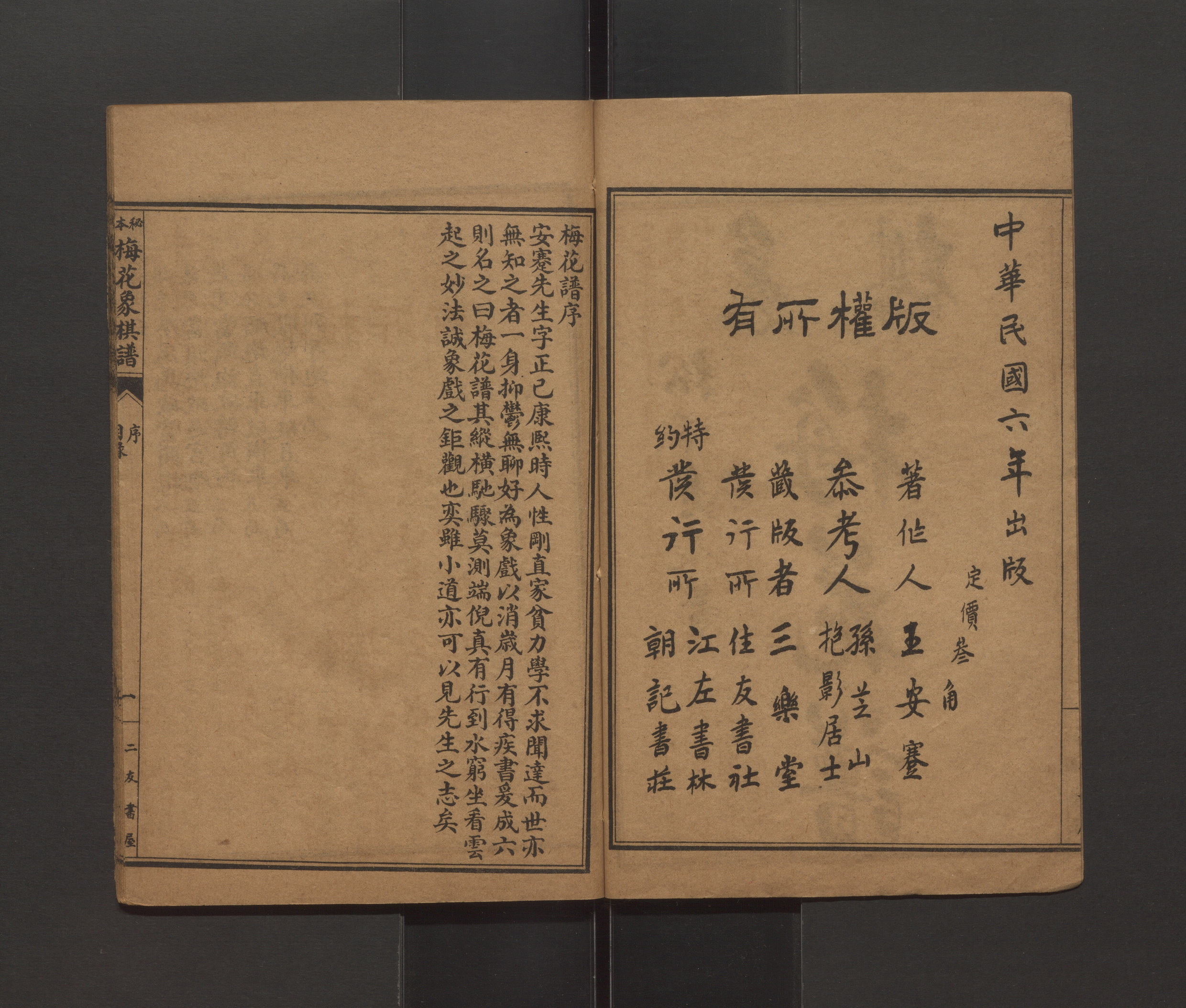
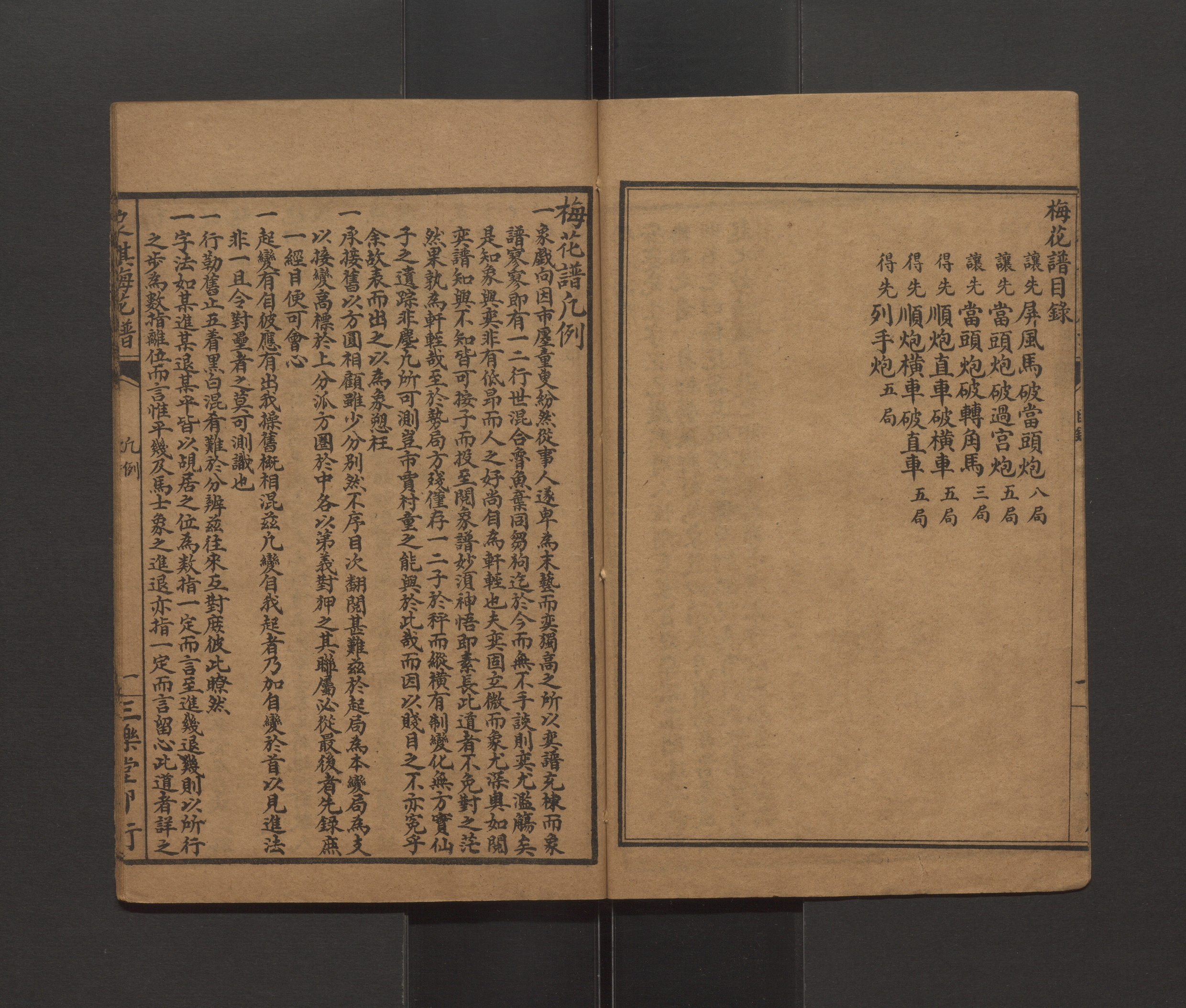
External links
- Xiangqi Memory — 象棋梅花谱, book 12, with a facsimile and interactive scores
- Wenming Shuju edition — scan with Lü Simian's two editorial notes
- Zhonghua Shuju edition — library copy of Xie's text with both prefaces
- Verse notation chart — Zhou Jiasen's worked example