Plum Blossom Manual: Difference between revisions
Publish researched article on Wang Zaiyue’s manual |
Improve facsimile placement and clear the first player caption |
||
| Line 1: | Line 1: | ||
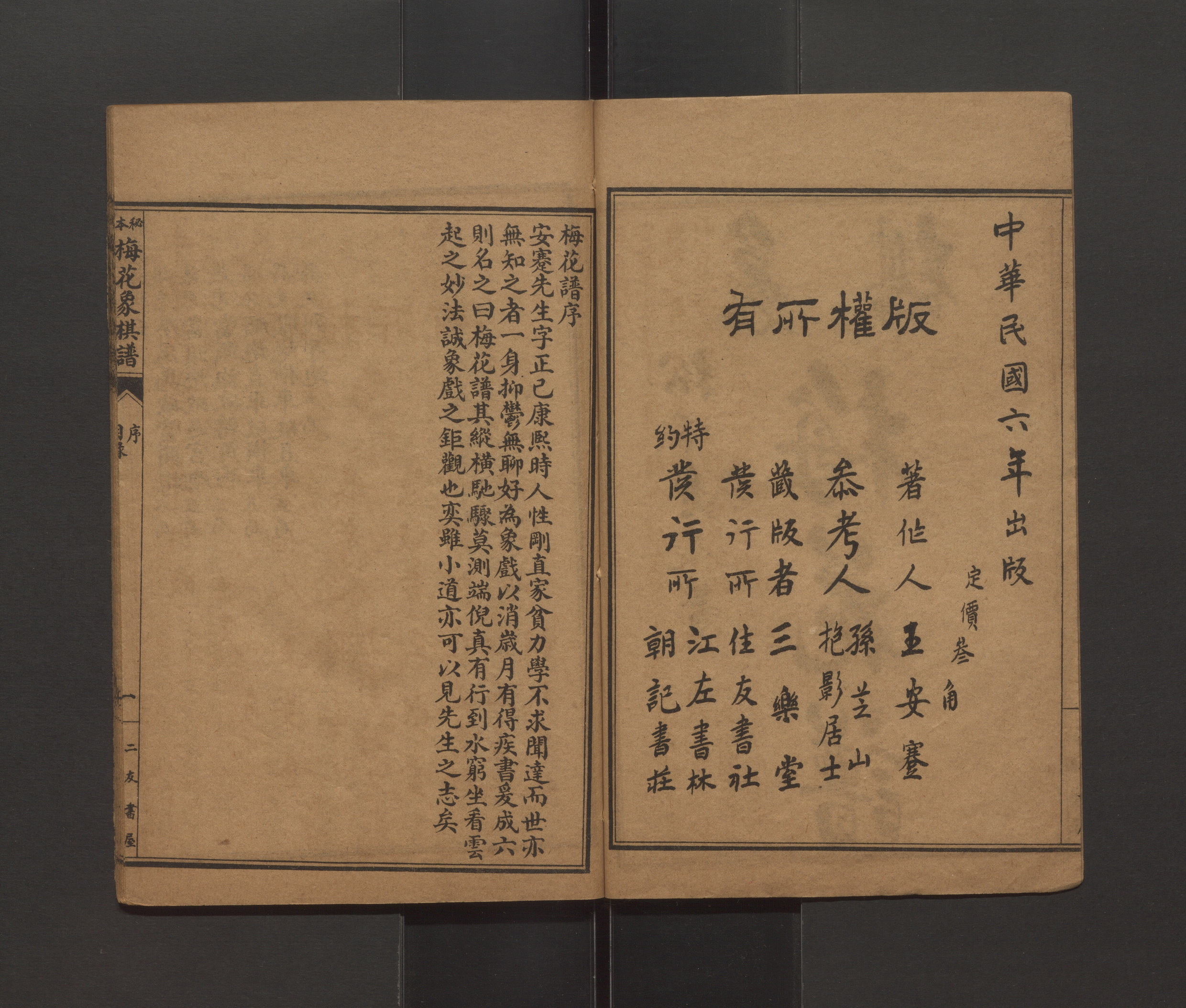
[[File:Plum Blossom Manual 1917 preface and imprint.jpg|thumb| | [[File:Plum Blossom Manual 1917 preface and imprint.jpg|thumb|350px|alt=Open brown-paper volume with the preface at left and the publication date, credits and price in large vertical characters at right.|The preface and imprint of the 1917 printing. The imprint dates the edition to the sixth year of the Republic and credits Wang Anjian.<ref name="preface">Wang Anjian (王安蹇), ''梅花象棋譜'', 1917 printing, preface and imprint. Copy supplied by Wang Ye (王晔), digitized by ''Xiangqi Memory'' (象棋记忆), book 12, chapter 1005. [https://chinese-chess.obs.cidc-rp-2065.cdmgcloud.com/ams/file/2025-01-14/ams202501141140410733545255241.jpg Facsimile].</ref>]] | ||
The '''''Plum Blossom Manual''''' (<span lang="zh">梅花譜</span>, simplified <span lang="zh">梅花谱</span>, ''Méihuā pǔ'') is a xiangqi manual attributed to Wang Zaiyue (<span lang="zh">王再越</span>), whom its preface places in the Kangxi reign of the Qing dynasty (1662–1722).<ref name="preface" /><ref name="ji">Ji Benhan (季本涵), “長三角象棋活動史論綱”, 2019, PDF pp. 8–13, sections on Qing full-game manuals and manuscript circulation. [https://www.wxf-xiangqi.org/images/hangzhou-chess/0101_Ji_Benhan_620192019.pdf Paper hosted by the World Xiangqi Federation].</ref><ref name="lexicon">Jim Png Hau Cheng, ''A Lexicon of Xiangqi (Chinese Chess) Terms in English'', 2017, pp. 347–348 and 565–566, “List of Plum Flower Manuals”, “Wang, Zaiyue” and “Wang's Plum Flower Manual”. [https://books.google.com/books/about/Lexicon_of_Xiangqi_Chinese_Chess_Terms_i.html?id=yhCbtAEACAAJ Edition record].</ref> Its reputation rests on eight studies in which [[Screen Horses]] meets the Central Cannon while moving second.<ref name="ji" /><ref name="contents">Wang Anjian, ''梅花象棋譜'', 1917 printing, contents and editorial rules (凡例), ''Xiangqi Memory'', book 12, chapter 1006. [https://chinese-chess.obs.cidc-rp-2065.cdmgcloud.com/ams/file/2025-01-14/ams202501141141258871882879211.jpg Facsimile].</ref> The 1917 edition contains 31 full-game studies across six divisions, including two divisions of [[Same Direction Cannons]] in which each chariot deployment wins in turn.<ref name="contents" /> | The '''''Plum Blossom Manual''''' (<span lang="zh">梅花譜</span>, simplified <span lang="zh">梅花谱</span>, ''Méihuā pǔ'') is a xiangqi manual attributed to Wang Zaiyue (<span lang="zh">王再越</span>), whom its preface places in the Kangxi reign of the Qing dynasty (1662–1722).<ref name="preface" /><ref name="ji">Ji Benhan (季本涵), “長三角象棋活動史論綱”, 2019, PDF pp. 8–13, sections on Qing full-game manuals and manuscript circulation. [https://www.wxf-xiangqi.org/images/hangzhou-chess/0101_Ji_Benhan_620192019.pdf Paper hosted by the World Xiangqi Federation].</ref><ref name="lexicon">Jim Png Hau Cheng, ''A Lexicon of Xiangqi (Chinese Chess) Terms in English'', 2017, pp. 347–348 and 565–566, “List of Plum Flower Manuals”, “Wang, Zaiyue” and “Wang's Plum Flower Manual”. [https://books.google.com/books/about/Lexicon_of_Xiangqi_Chinese_Chess_Terms_i.html?id=yhCbtAEACAAJ Edition record].</ref> Its reputation rests on eight studies in which [[Screen Horses]] meets the Central Cannon while moving second.<ref name="ji" /><ref name="contents">Wang Anjian, ''梅花象棋譜'', 1917 printing, contents and editorial rules (凡例), ''Xiangqi Memory'', book 12, chapter 1006. [https://chinese-chess.obs.cidc-rp-2065.cdmgcloud.com/ams/file/2025-01-14/ams202501141141258871882879211.jpg Facsimile].</ref> The 1917 edition contains 31 full-game studies across six divisions, including two divisions of [[Same Direction Cannons]] in which each chariot deployment wins in turn.<ref name="contents" /> | ||
| Line 47: | Line 47: | ||
|} | |} | ||
The printed reader's rules explain how to return to the point where a variation branches, with marked, numbered links that distinguish changes initiated by the two sides.<ref name="contents" /> Several of the rules also appear in ''Secrets Inside the Orange'', as does the central-cannon verse that opens the 1917 manual's set of mnemonic songs.<ref name="contents" /><ref name="songs">Wang Anjian, ''梅花象棋譜'', 1917 printing, “梅花譜歌括” and opening of division I, game 1. ''Xiangqi Memory'', book 12, chapters 1007 and 969. [https://chinese-chess.obs.cidc-rp-2065.cdmgcloud.com/ams/file/2025-01-14/ams202501141141470612027619076.jpg Facsimile].</ref><ref name="orange">Zhu Jinzhen (朱晉楨), ''橘中秘'', reader's rules (凡例), §§1–5, and “當頭炮訣”. [https://www.dpxq.com/hldcg/share/xiangqigupu/juzhongmi/ Dongping transcription].</ref> The verse calls the Central Cannon stronger than other setups | The printed reader's rules explain how to return to the point where a variation branches, with marked, numbered links that distinguish changes initiated by the two sides.<ref name="contents" /> Several of the rules also appear in ''Secrets Inside the Orange'', as does the central-cannon verse that opens the 1917 manual's set of mnemonic songs.<ref name="contents" /><ref name="songs">Wang Anjian, ''梅花象棋譜'', 1917 printing, “梅花譜歌括” and opening of division I, game 1. ''Xiangqi Memory'', book 12, chapters 1007 and 969. [https://chinese-chess.obs.cidc-rp-2065.cdmgcloud.com/ams/file/2025-01-14/ams202501141141470612027619076.jpg Facsimile].</ref><ref name="orange">Zhu Jinzhen (朱晉楨), ''橘中秘'', reader's rules (凡例), §§1–5, and “當頭炮訣”. [https://www.dpxq.com/hldcg/share/xiangqigupu/juzhongmi/ Dongping transcription].</ref> The verse calls the Central Cannon stronger than other setups.<ref name="songs" /> The manual's first division is devoted to countering it.<ref name="contents" /> | ||
=== Writing a move with verse characters === | === Writing a move with verse characters === | ||
| Line 61: | Line 61: | ||
Screen Horses against the Central Cannon was already in print before Wang's lifetime. Zhang Ru'an (<span lang="zh">張如安</span>) identified it in two late-Ming household encyclopedias, the ''Wan shu cui bao'' (<span lang="zh">萬書萃寶</span>, 1596) and ''Wu che ba jin'' (<span lang="zh">五車拔錦</span>, 1597).<ref name="ming">Zhang Ru'an (张如安), “晚明通俗日用類書中的象棋史料”, 2019, PDF pp. 1–3 and 6–9. [https://www.wxf-xiangqi.org/images/hangzhou-chess/0137_2019.pdf Paper hosted by the World Xiangqi Federation].</ref> In the 1596 title the horse side moves first.<ref name="ming" /> The first division of Wang's manual makes the horse side the second player through all eight studies.<ref name="ming" /><ref name="contents" /> Xie's contents show the range of the attack it meets. The first five studies treat the riverbank chariot, with lines involving pawn or cannon captures and different ways of developing Red's other pieces. The final three take up the overriver chariot and vary when or whether it takes a pawn.<ref name="xie" /> | Screen Horses against the Central Cannon was already in print before Wang's lifetime. Zhang Ru'an (<span lang="zh">張如安</span>) identified it in two late-Ming household encyclopedias, the ''Wan shu cui bao'' (<span lang="zh">萬書萃寶</span>, 1596) and ''Wu che ba jin'' (<span lang="zh">五車拔錦</span>, 1597).<ref name="ming">Zhang Ru'an (张如安), “晚明通俗日用類書中的象棋史料”, 2019, PDF pp. 1–3 and 6–9. [https://www.wxf-xiangqi.org/images/hangzhou-chess/0137_2019.pdf Paper hosted by the World Xiangqi Federation].</ref> In the 1596 title the horse side moves first.<ref name="ming" /> The first division of Wang's manual makes the horse side the second player through all eight studies.<ref name="ming" /><ref name="contents" /> Xie's contents show the range of the attack it meets. The first five studies treat the riverbank chariot, with lines involving pawn or cannon captures and different ways of developing Red's other pieces. The final three take up the overriver chariot and vary when or whether it takes a pawn.<ref name="xie" /> | ||
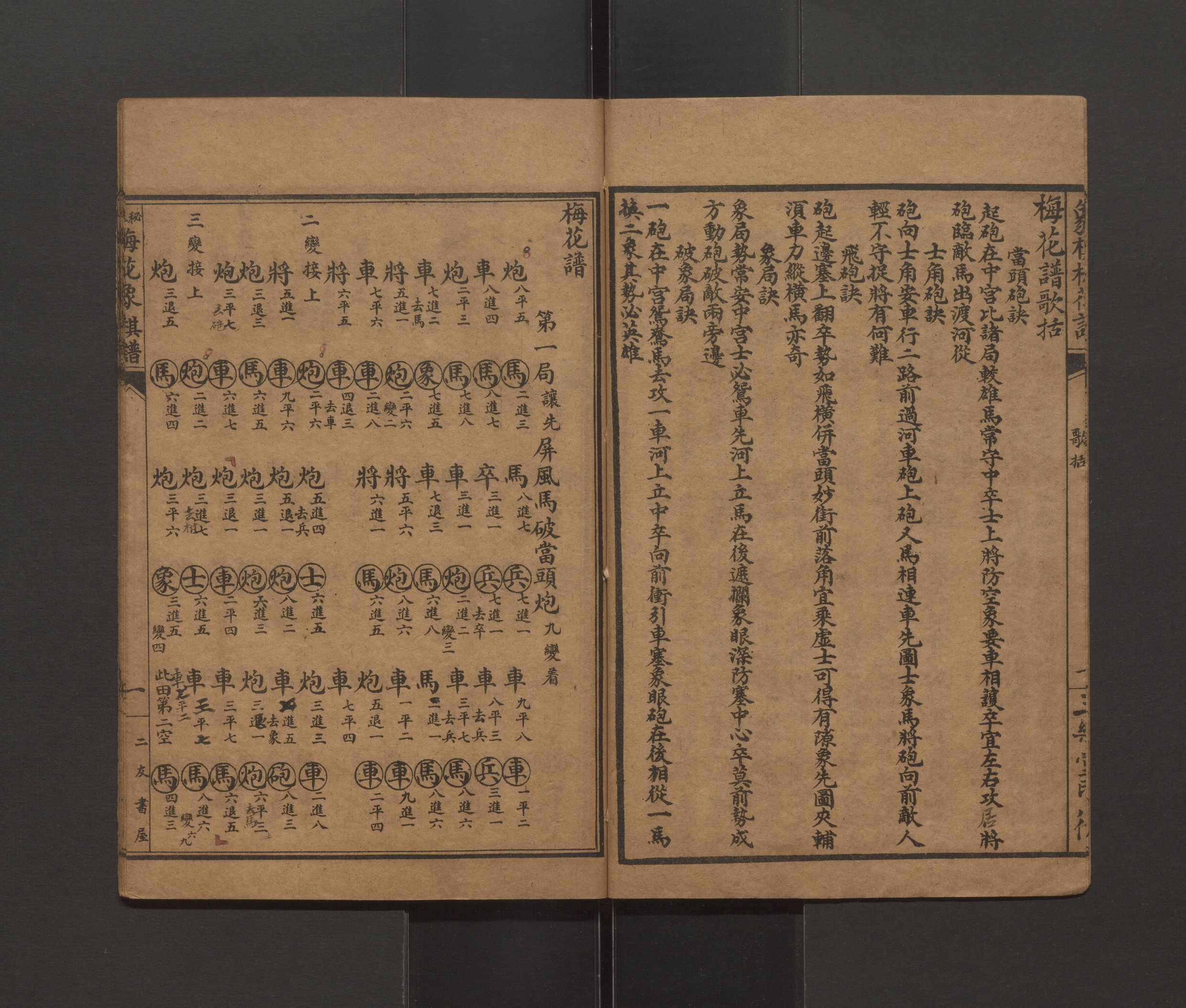
[[File:Plum Blossom Manual 1917 verse and first game.jpg|thumb| | [[File:Plum Blossom Manual 1917 verse and first game.jpg|thumb|350px|alt=Right page of five vertical mnemonic verses and left page of alternate xiangqi moves, some marked by circles around the piece name.|The opening songs and the start of the first Screen Horses study. Circled piece names distinguish the replies. <span lang="zh">二變接上</span> marks where the second variation resumes an earlier line.<ref name="songs" />]] | ||
In the first study Red opens with the left cannon, ''1. C8=5'', an orientation Png calls out in his discussion of the manual.<ref name="songs" /><ref name="lexicon" /> Red's chariot reaches the riverbank and takes a pawn with ''6. R8=3''. Black then advances the other horse pawn and brings a horse out with ''7... h7+8''.<ref name="songs" /> The horse continues inward with ''9... h8+6'' and later joins a chariot attack beside Red’s palace. The first recorded line ends with ''19... r4-3'', taking Red’s chariot.<ref name="songs" /><ref name="game1score">''Xiangqi Memory'', book 12, chapter 969, recorded first line of “第1局破巡河車吃卒用炮打象”; see also [https://zh.wikisource.org/zh-hans/%E6%A2%85%E8%8A%B1%E8%AD%9C#第一局破巡河车吃卒用炮打象 Transcription of the first study], moves 1–19. [https://chinese-chess.obs.cidc-rp-2065.cdmgcloud.com/ams/file/2025-01-14/ams202501141141470612027619076.jpg Opening score in the 1917 witness].</ref> | In the first study Red opens with the left cannon, ''1. C8=5'', an orientation Png calls out in his discussion of the manual.<ref name="songs" /><ref name="lexicon" /> Red's chariot reaches the riverbank and takes a pawn with ''6. R8=3''. Black then advances the other horse pawn and brings a horse out with ''7... h7+8''.<ref name="songs" /> The horse continues inward with ''9... h8+6'' and later joins a chariot attack beside Red’s palace. The first recorded line ends with ''19... r4-3'', taking Red’s chariot.<ref name="songs" /><ref name="game1score">''Xiangqi Memory'', book 12, chapter 969, recorded first line of “第1局破巡河車吃卒用炮打象”; see also [https://zh.wikisource.org/zh-hans/%E6%A2%85%E8%8A%B1%E8%AD%9C#第一局破巡河车吃卒用炮打象 Transcription of the first study], moves 1–19. [https://chinese-chess.obs.cidc-rp-2065.cdmgcloud.com/ams/file/2025-01-14/ams202501141141470612027619076.jpg Opening score in the 1917 witness].</ref> | ||
<div style="clear:both"></div> | |||
<xiangqi-player> | <xiangqi-player> | ||
{ | { | ||
Revision as of 17:59, 17 November 2026

The Plum Blossom Manual (梅花譜, simplified 梅花谱, Méihuā pǔ) is a xiangqi manual attributed to Wang Zaiyue (王再越), whom its preface places in the Kangxi reign of the Qing dynasty (1662–1722).[1][2][3] Its reputation rests on eight studies in which Screen Horses meets the Central Cannon while moving second.[2][4] The 1917 edition contains 31 full-game studies across six divisions, including two divisions of Same Direction Cannons in which each chariot deployment wins in turn.[4]
The manual circulated in handwritten copies and appeared in several different print editions in the early Republic.[1][5][6] Against the strong attacking reputation of the Central Cannon in Secrets Inside the Orange, Wang's studies gave the second player a developed repertoire of counterattacks from the two-horse formation.[3][7] Later writers extended those studies or wrote counterexamples in which the cannon side prevailed.[2][8]
Wang Zaiyue and the early text
The preface calls Wang by the courtesy name Zhengji (正己).[1][6] It portrays a studious man of modest means who passed his time with xiangqi and wrote down discoveries as he made them, eventually assembling six divisions and calling the work Meihua pu.[1] The 1917 imprint calls him Wang Anjian (王安蹇), while the preface in Xie's edition supplies the full name Wang Zaiyue.[1][6] Lü Simian (呂思勉) noticed that the Shanghai lithograph and his own copy gave different forms of the sobriquet, and left the reading unresolved.[5] The preface dates Wang to a reign, leaving the composition year uncertain.[1][8]
The preface describes the unexpected turns in Wang's play with the words 行到水窮,坐看雲起.[1] The phrase echoes the Tang poet Wang Wei (王維) in “Retreat at Mount Zhongnan” (終南別業), whose speaker walks to where the water ends, then sits and watches clouds rise.[1][9] The preface gives the title Meihua pu in the same passage and leaves the choice of the plum blossom unexplained.[1]
Handwritten copies and revisions
Later accounts credit the Qianlong-era player Zhou Tingmei (周廷梅) of Wujin with revising Wang’s text.[2][8] Fei Jinqin (費錦欽), writing in the material collected by Xie Xiaxun, listed a two-volume revision of the Plum Blossom Manual alongside Zhou's forty-volume Huizhen ge (會珍閣).[8] The surviving account of that revision comes through later copyists and collectors.[8]
In 1948, the Fuzhou periodical Xiangqi yuekan reported a copy by Ma Xiangru (馬相如) in which the eight Screen Horses studies had expanded to twelve.[8] According to Lin Youru (林幼如), Ma had copied a text seen in Shi Xiaogu's possession and believed to be Zhou's revision.[8] Lin separately obtained four Screen Horses studies from the collection of Qian Mengwu (錢夢吾), identified them provisionally as the added studies, and titled the edited group Wushuang pin (無雙品, “Unparalleled Works”).[8] Tu Jingming's (屠景明) later annotated collection under that name presents four studies attributed to Zhou together with two separately titled manuals.[10]
From manuscript to print
- 1917. The imprint in the surviving copy digitized by Xiangqi Memory dates the edition to the sixth year of the Republic. It names Sanle Tang (三樂堂) as holder of the printing blocks or plates and 住友書社 as distributor.[1]
- 1926. Lü had collated his text in 1918 and deferred publication after learning that another edition had appeared in Shanghai.[5][11] He later found the lithograph difficult to read because of its errors and turned his version over to Wenming Shuju (文明書局), which published it in December 1926.[5][12]
- 1927. In his preface for Zhonghua Shuju's Xiangqi pu daquan (象棋譜大全), Xie Xiaxun said that Pan Dingsi (潘定思) had sent him a handwritten copy in the winter of 1915.[6][2] Xie explained that he had clarified the links between variations and added notes where their final moves were obscure.[6] The first series, which paired Wang's text with Secrets Inside the Orange, appeared in April 1927.[6][13] A separate Chongqing printing pairs it with Xie's selections from the Jinpeng tradition.[14]
- 1935. A Beijing Library accession register records a one-volume Wenming Shuju issue dated 1935.[15] Hong Kong Public Libraries' Lau Wai-mai Collection records a separate Shanghai issue from Huanqiu Shuju (環球書局) in the same year.[16]
Lü replaced the customary “moves first” and “yields the first move” labels with ones that explicitly say which side wins, and numbered the first continuation of a game on the same footing as its other variations.[5] His contents put the ranked-chariot wins before the filed-chariot wins. The 1917 printing lists them in the reverse order.[5][4]
Contents and notation

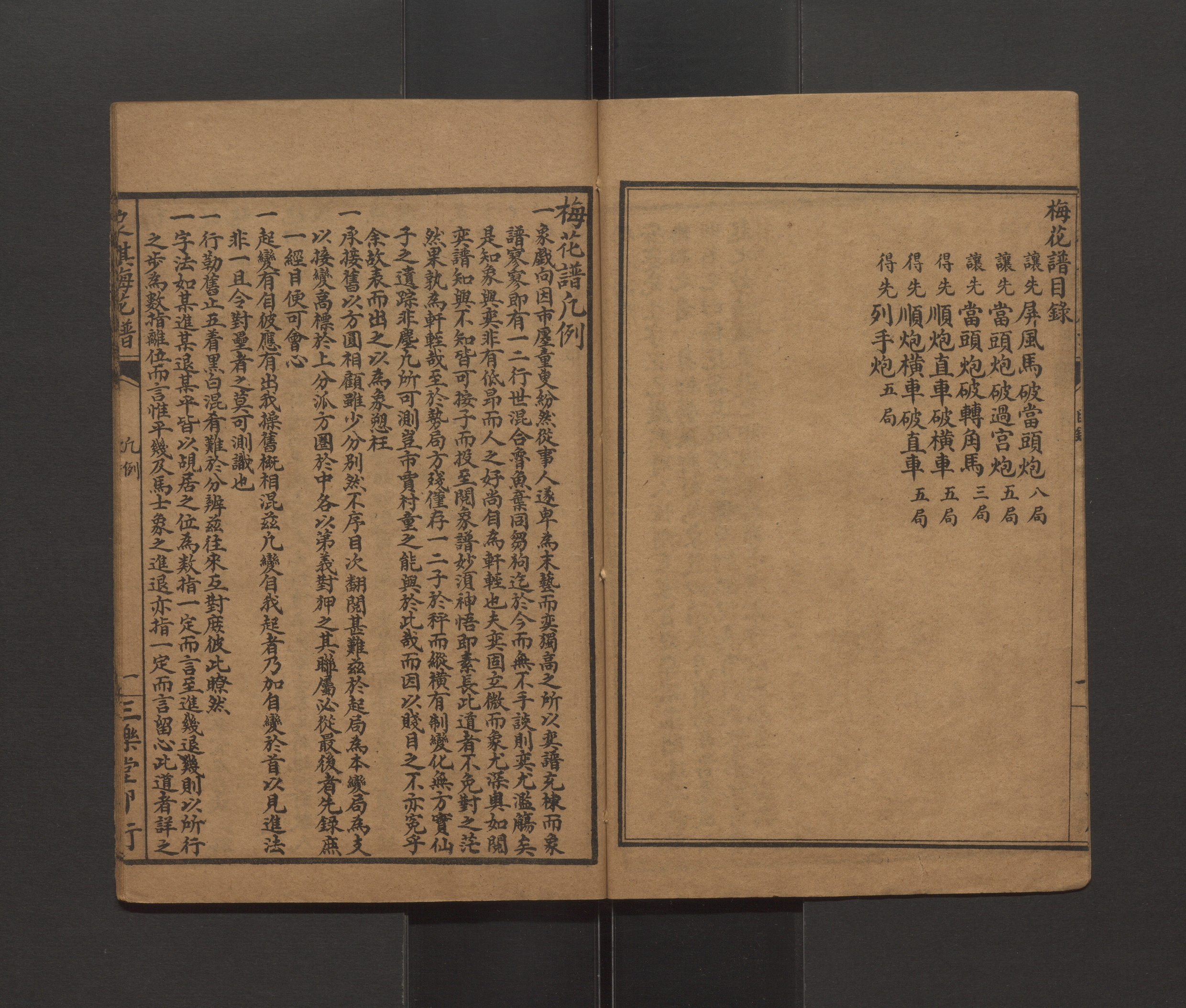
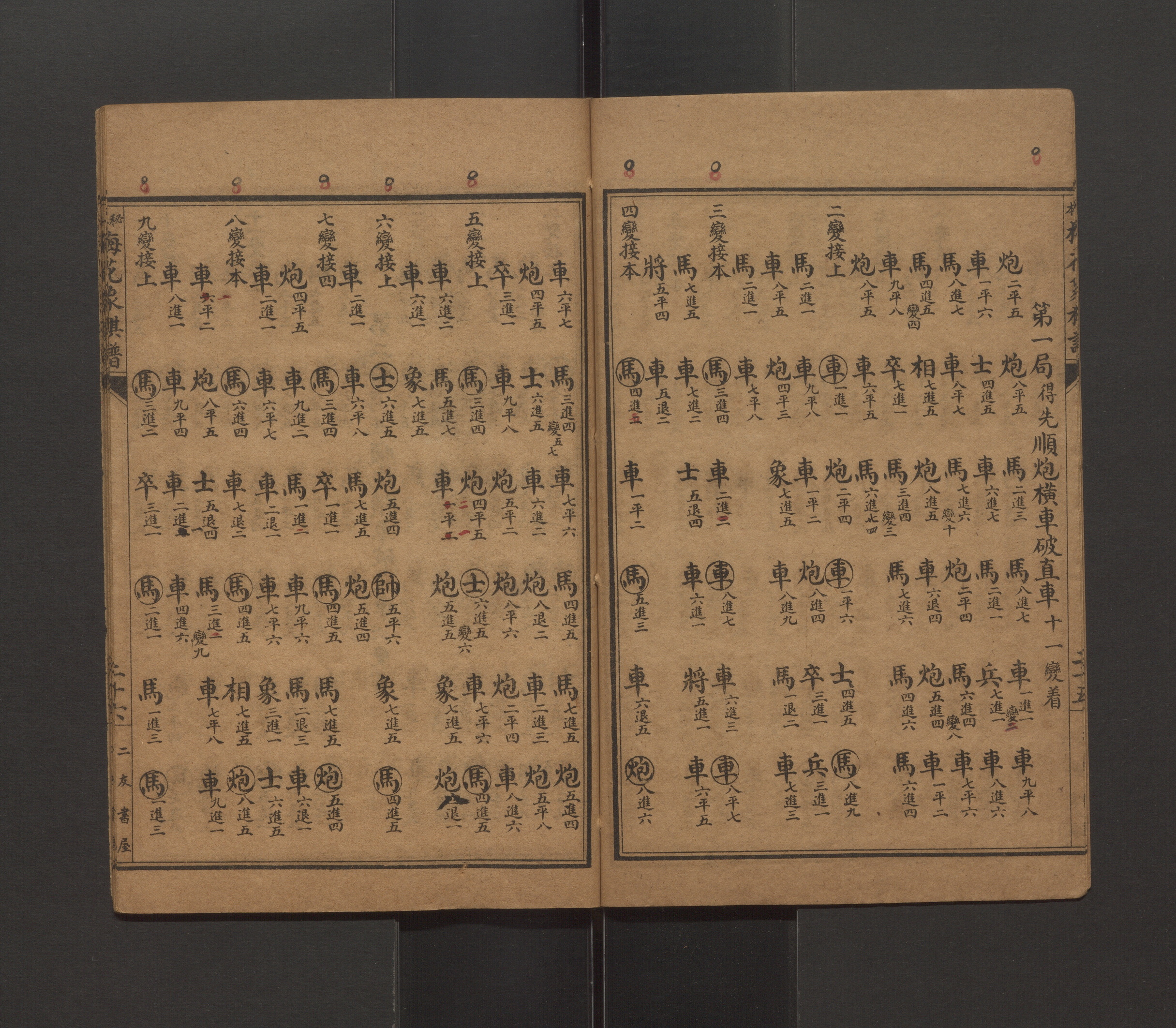
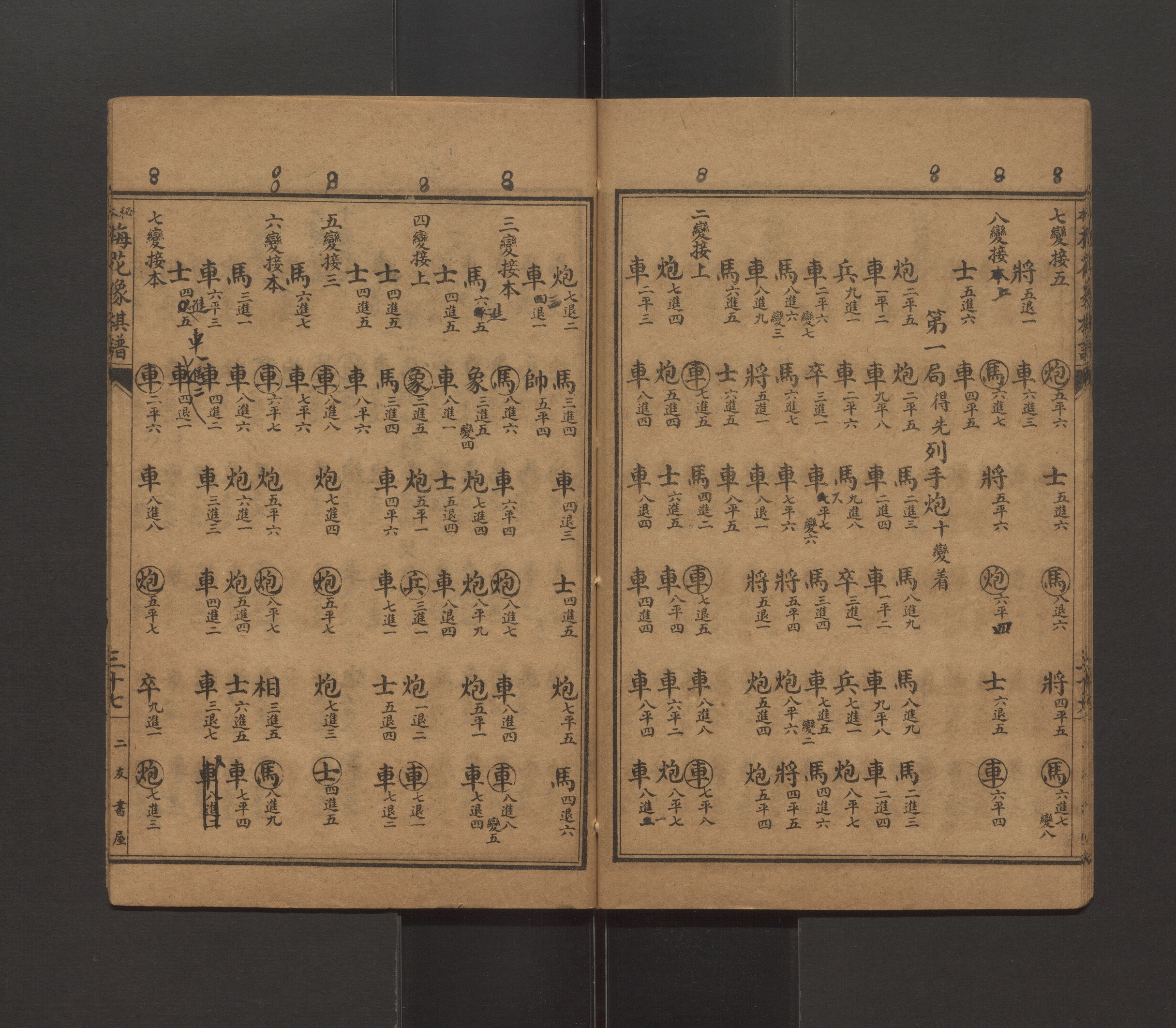
The 1917 contents divides the studies into three sections with the winning side moving second (讓先, ràngxiān) and three with the winning side moving first (得先, déxiān).[4][5] The name of each division identifies an opening or a confrontation between opening setups.[4]
| Division | Subject | Studies | Favored side moves |
|---|---|---|---|
| I | Screen Horses against the Central Cannon (屏風馬破當頭炮) | 8 | Second |
| II | Central Cannon against Cross-Palace Cannon (當頭炮破過宮炮) | 5 | Second |
| III | Central Cannon against the Palcorner Horse (當頭炮破轉角馬) | 3 | Second |
| IV | Same Direction Cannons, filed chariot against ranked chariot (順炮直車破橫車) | 5 | First |
| V | Same Direction Cannons, ranked chariot against filed chariot (順炮橫車破直車) | 5 | First |
| VI | Opposite Direction Cannons (列手炮) | 5 | First |
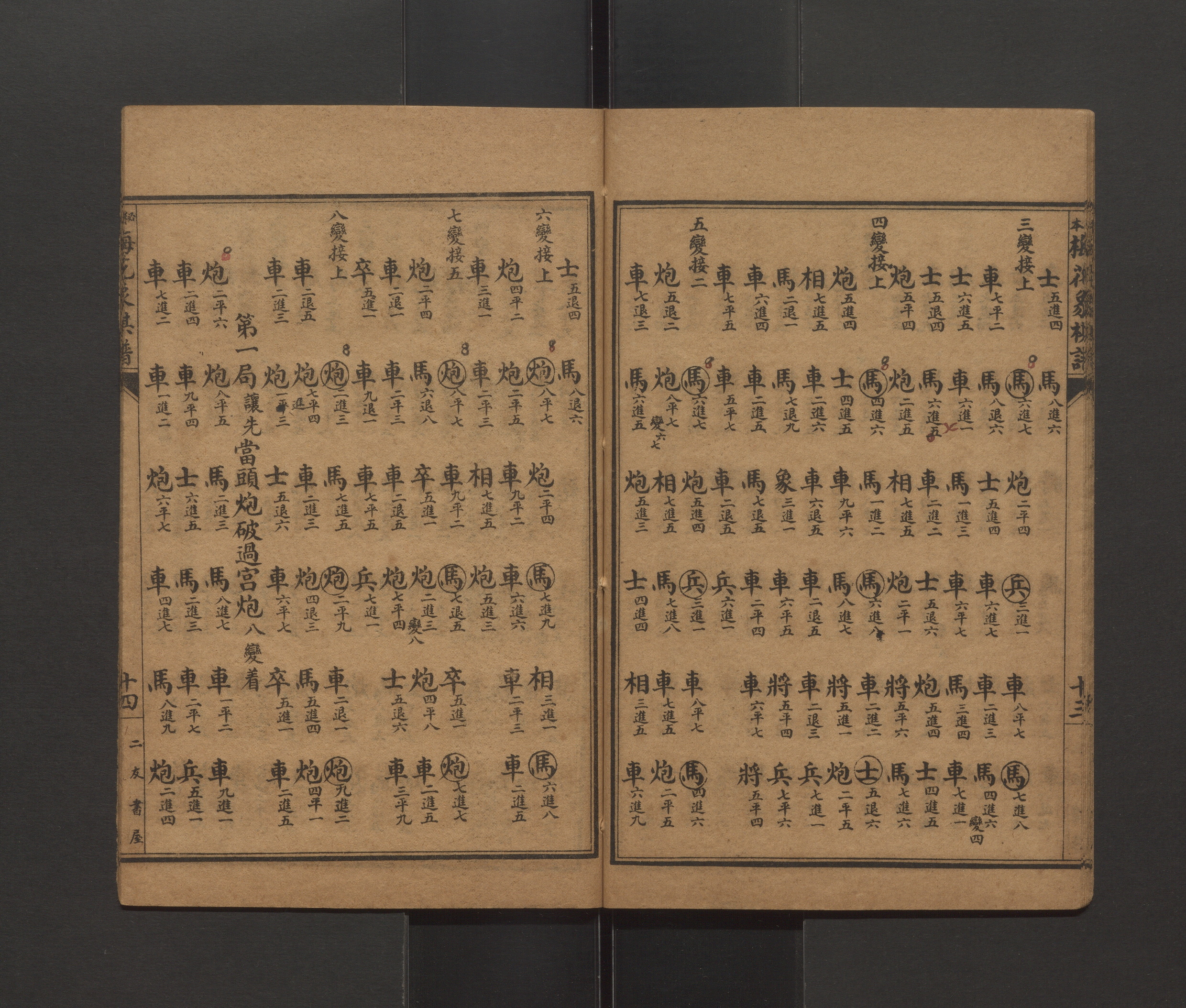
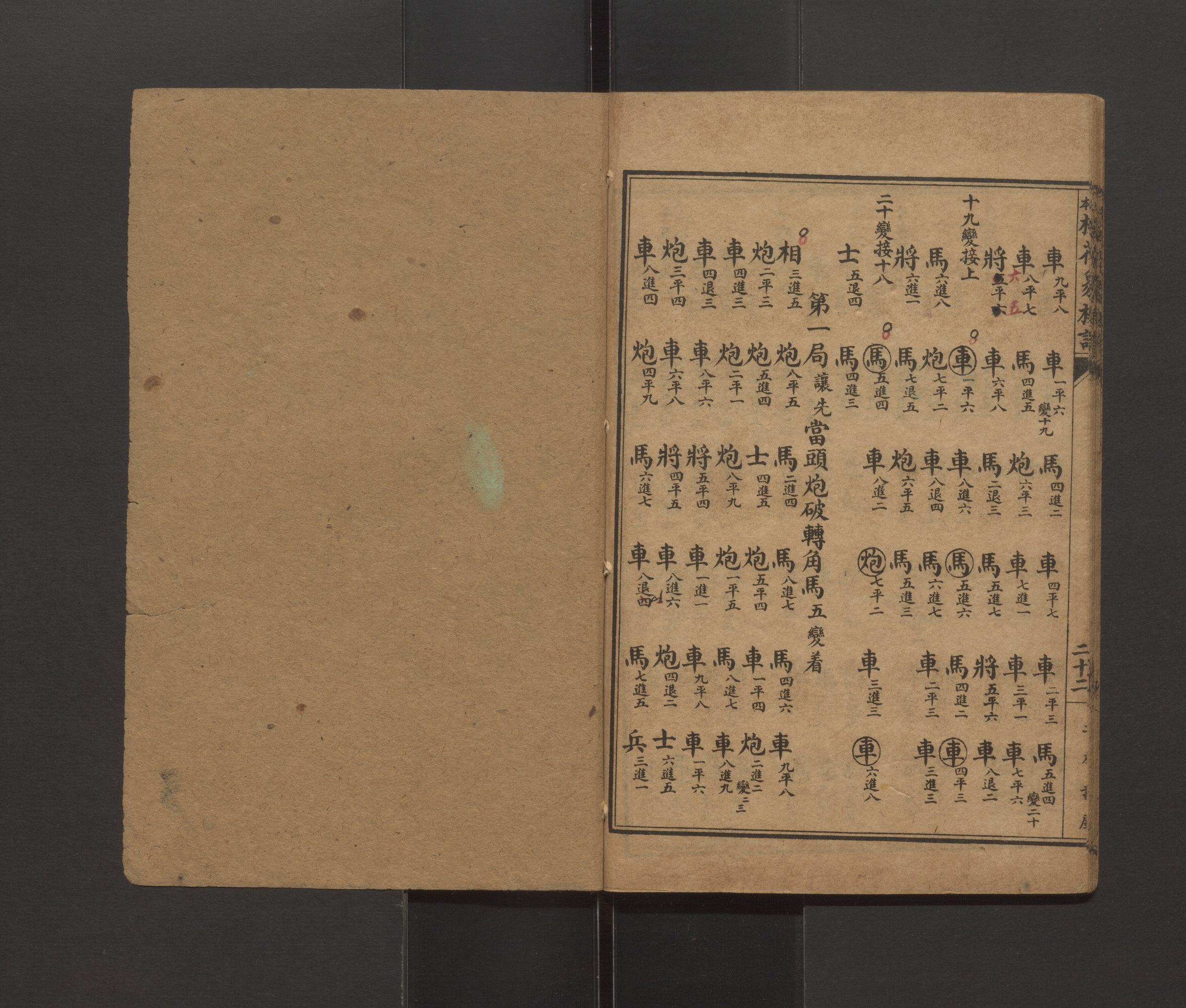
The printed reader's rules explain how to return to the point where a variation branches, with marked, numbered links that distinguish changes initiated by the two sides.[4] Several of the rules also appear in Secrets Inside the Orange, as does the central-cannon verse that opens the 1917 manual's set of mnemonic songs.[4][17][18] The verse calls the Central Cannon stronger than other setups.[17] The manual's first division is devoted to countering it.[4]
Writing a move with verse characters
Handwritten copies used a system in which 90 characters from two verses stood for the 90 intersections of the xiangqi board.[2][3] The verses describe deploying troops, marshaling formations and protecting the borders. One imagines seeing in an instant that Chu is weak and Qin strong (楚弱秦強).[2] The characters also serve as coordinates. In a short move the piece name is followed by the character for where it lands; a character for the starting intersection can resolve ambiguity.[3] Zhou Jiasen (周家森) reproduced a keyed board and a worked example in Xiangqi yu qihua (象棋與棋話), where 炮就飛 encodes C2+3, a cannon on file two advancing three steps.[19]
The 1917 printing writes moves by file and by direction, using 進, 退 and 平 for advance, retreat and lateral movement.[4][17] The piece names in one side's replies are circled on the score, so the columns can alternate the sides without writing a color at every turn.[17] The opening remarks defend the difficulty and dignity of xiangqi, whose association with market traders and children, they argue, had led readers to assign it a lower status than Go.[4] Lü returned to the same social distinction when explaining why so many more Go manuals had reached print.[5]
The opening studies
The second player’s Screen Horses
Screen Horses against the Central Cannon was already in print before Wang's lifetime. Zhang Ru'an (張如安) identified it in two late-Ming household encyclopedias, the Wan shu cui bao (萬書萃寶, 1596) and Wu che ba jin (五車拔錦, 1597).[20] In the 1596 title the horse side moves first.[20] The first division of Wang's manual makes the horse side the second player through all eight studies.[20][4] Xie's contents show the range of the attack it meets. The first five studies treat the riverbank chariot, with lines involving pawn or cannon captures and different ways of developing Red's other pieces. The final three take up the overriver chariot and vary when or whether it takes a pawn.[6]

In the first study Red opens with the left cannon, 1. C8=5, an orientation Png calls out in his discussion of the manual.[17][3] Red's chariot reaches the riverbank and takes a pawn with 6. R8=3. Black then advances the other horse pawn and brings a horse out with 7... h7+8.[17] The horse continues inward with 9... h8+6 and later joins a chariot attack beside Red’s palace. The first recorded line ends with 19... r4-3, taking Red’s chariot.[17][21]
Division I, study 1. Black counters the riverbank chariot
Loading xiangqi example…
Cannon attacks and chariot deployment
The next division lets the first player open with the Cross-Palace Cannon, 1. C2=6, and assigns the Central Cannon to Black.[22] Black lifts the chariot onto the second rank and shifts it to file four. After Red's riverbank chariot takes the pawn on file seven, Black plays 8... r4+7, bringing the ranked chariot deep into the file beside Red's king.[22] The Xiangqi Memory commentary draws attention to the pressure this creates beside the palace.[22]
Division II, study 1. Central Cannon against Cross-Palace Cannon
Loading xiangqi example…
In the first Palcorner Horse study, Red starts with an elephant and routes the horse through the advisor's corner with 2. H2+4 and 3. H4+6. Black places a chariot behind the cannon and takes the central pawn at 4... c5+4.[23]
Division III, study 1. The Central Cannon takes the central pawn
Loading xiangqi example…
The Same Direction Cannons divisions give each chariot route a winning section.[4] In the first study of division V, Red plays 3. R1+1 and 4. R1=6, while Black files the chariot behind the cannon with 3... r9=8.[24] Red's chariot invades on 5. R6+7, and Black develops the exposed wing horse to the edge. In the modern archive's notes, the chariot's control of the elephant’s intermediate point explains the restriction on Black's development.[24]
Division V, study 1. Ranked chariot against filed chariot
Loading xiangqi example…
In the first study of the final division the two central cannons come from opposite wings, 1. C2=5 c2=5.[25] Both sides bring a chariot to their own bank of the river, and Red develops both wings before advancing the edge pawn and bringing the horse forward.[25]
Division VI, study 1. Opposite Direction Cannons
Loading xiangqi example…
The shorthand “Orange and Plum” (橘梅) for Wang's work and Secrets Inside the Orange appears in the preface transmitted with Zheng Zimei’s 1897 collation of another Plum manual.[8] Lü observed that both the Plum Blossom Manual and Secrets Inside the Orange consistently give a winner and a loser. He asked whether the losing side had used its best defense, while crediting the accumulated craft that made the combinations possible.[5] Zhu Jianqiu (朱劍秋) later treated Wang and Wu’s manuals as landmarks of the era of Screen Horses resistance, and distinguished that era from the newer studies of the defense being pursued when he wrote in 1951.[26]
- Meihuaquan (梅花泉, “Plum Blossom Spring”) is a distinct collection attributed to Tong Shenggong (童聖公) and enlarged by Xue Bing (薛丙) in 1806. A manuscript associated with Han Yingbi (韓應陛) is held by Shanghai Library.[27] Its original date is disputed.[27][2] A 2022 study argues that it followed Wang's work, comparing a line in which Black retreats a cannon at move six to prepare a lateral attack on the riverbank chariot. At the corresponding point Wang's line advances a pawn.[27]
- Xiangxi huibian (象戲彙編) is described in the specialist survey as a manuscript expansion of the eight Screen Horses studies, with new variation counts and individual headings such as “Subduing the Dragon and Tiger” (降龍伏虎).[8] The survey describes another work, Zheng Zimei's (鄭自梅) 1897 collation of the Meihua bianfa xiangqi pu (梅花變法象棋譜), as a twelve-study collection.[8]
- Wu's Plum Blossom Manual (吳著梅花譜), by Wu Meisheng (吳梅聖), circulated under the title Xiangqi rangxian mipu (象棋讓先秘譜) and reached print in 1929.[2] Its five studies use Screen Horses against several different first-player formations.[2][8] Xie explicitly distinguished Wu's and Wang's texts in his combined edition.[14]
- Counter–Plum Blossom Manual (反梅花譜), also called Xiangqi Meihua xinfa pu (象棋梅花心法譜), answered the horse repertoire from the cannon side.[2][8] Its author Ba Jiren (巴吉人) used a riverbank chariot and an advancing central pawn as a counter to Wang's system.[2]
Modern editions and access
Lü's biographer reports that he gave copies of his edition to students who visited him to play during the war with Japan.[11] Tu Jingming annotated all six opening divisions for a 1950 Shanghai edition, corrected by Tang Zhicheng (唐至誠).[10] The Shanghai Culture Publishing House version of 1958 added a glossary and diagrams at critical positions.[10] In 1987 Tu's Meihua xinbian (梅花新編) brought Wang's manual together with Zheng's, explained Wang's character notation and provided a concordance between the older and revised contents.[10] Cheng Mingsong's (程明松) collected Chinese Xiangqi Manuals included the text under Wang's name in its 2006 edition.[28]
In 2025 the Chinese Xiangqi Association led the launch of the Xiangqi Memory platform with four digitized manuals, including Wang's work.[29] The archive uses the 1917 copy supplied by collector Wang Ye (王晔) and pairs scans of the pages with playable transcriptions and modern annotations.[1][7]
References
- ↑ a b c d e f g h i j k l Wang Anjian (王安蹇), 梅花象棋譜, 1917 printing, preface and imprint. Copy supplied by Wang Ye (王晔), digitized by Xiangqi Memory (象棋记忆), book 12, chapter 1005. Facsimile.
- ↑ a b c d e f g h i j k l Ji Benhan (季本涵), “長三角象棋活動史論綱”, 2019, PDF pp. 8–13, sections on Qing full-game manuals and manuscript circulation. Paper hosted by the World Xiangqi Federation.
- ↑ a b c d e Jim Png Hau Cheng, A Lexicon of Xiangqi (Chinese Chess) Terms in English, 2017, pp. 347–348 and 565–566, “List of Plum Flower Manuals”, “Wang, Zaiyue” and “Wang's Plum Flower Manual”. Edition record.
- ↑ a b c d e f g h i j k l m n Wang Anjian, 梅花象棋譜, 1917 printing, contents and editorial rules (凡例), Xiangqi Memory, book 12, chapter 1006. Facsimile.
- ↑ a b c d e f g h i Lü Simian (呂思勉), two editorial notes in Wang Zaiyue, 象棋梅花譜, Shanghai, Wenming Shuju, preliminary pp. 1–5, with contents on p. 1. Notes dated 戊午二月九日 and 丙寅七月. National Library of China scan.
- ↑ a b c d e f g Xie Xun (謝宣, Xie Xiaxun 謝俠遜), ed., 梅花譜, in 象棋譜大全, first series, third work, Zhonghua Shuju. Upper volume title leaf, “梅花譜原序”, “正校梅花譜序” and following contents. National Chengchi University Library scan. Taiwan National Central Library record for the 1941 printing.
- ↑ a b Shanghai Chess Institute (上海棋院), “象棋记忆|象棋古谱《象棋梅花谱》的数字化重生”, 7 April 2025. Institute article.
- ↑ a b c d e f g h i j k l m “象棋古谱介绍”, Dongping Xiangqi, entries 10, 24, 26, 32–33 and 35–37; includes extracts from the accounts of Fei Jinqin and Lin Youru. Survey.
- ↑ Taiwan Ministry of Education, Dictionary of Chinese Character Variants (異體字字典), “行”, first sense, citing Wang Wei’s “終南別業”. Dictionary entry.
- ↑ a b c d Ye Guoqing (叶国庆), “上海象棋元老屠景明象棋谱”, entries 16–18, 35–38, in 棋坛名将屠景明,棋书影响撼人间, 2008. Bibliography.
- ↑ a b “吕思勉三癖:好弈、嗜烟、爱猫”, 28 October 2015, passages on the collation, his correspondence with Xie and wartime visits. Article.
- ↑ 呂思勉先生學術年表, entry for December 1926. Published chronology.
- ↑ Yang Baiwei (杨柏伟), “棋起起落落数百秋——中国象棋出版史的四个高峰期”, 2011, section on Xie's publications. Essay.
- ↑ a b Xie Xun, ed., 金鵬訣着譜·王著梅花譜合編, Chongqing printing, title leaf, preface and opening leaves of the Wang section. National Library of China scan.
- ↑ Beijing Library, 北京圖書館月刊 10(1), 1936, “本館入藏普通書目錄”, entry 象棋梅花譜. Scan.
- ↑ Hong Kong Public Libraries, Lau Wai-mai Collection (劉唯邁文庫), p. 160, entry 997.12/1014, 象棋梅花譜. Catalog.
- ↑ a b c d e f g h Wang Anjian, 梅花象棋譜, 1917 printing, “梅花譜歌括” and opening of division I, game 1. Xiangqi Memory, book 12, chapters 1007 and 969. Facsimile.
- ↑ Zhu Jinzhen (朱晉楨), 橘中秘, reader's rules (凡例), §§1–5, and “當頭炮訣”. Dongping transcription.
- ↑ Zhou Jiasen (周家森), 象棋與棋話, World Book Company (世界書局), 3rd ed., 1947, “象棋要略”, pp. 30–32, especially the chart under “象棋速記法說明”. Facsimile.
- ↑ a b c Zhang Ru'an (张如安), “晚明通俗日用類書中的象棋史料”, 2019, PDF pp. 1–3 and 6–9. Paper hosted by the World Xiangqi Federation.
- ↑ Xiangqi Memory, book 12, chapter 969, recorded first line of “第1局破巡河車吃卒用炮打象”; see also Transcription of the first study, moves 1–19. Opening score in the 1917 witness.
- ↑ a b c Wang Anjian, 梅花象棋譜, 1917 printing, division II, game 1, with the Xiangqi Memory transcription and commentary, book 12, chapter 982, especially comments 2, 14 and 16. Facsimile of the opening score.
- ↑ Wang Anjian, 梅花象棋譜, 1917 printing, division III, game 1, and the Xiangqi Memory transcription, book 12, chapter 987, moves 1–5. Facsimile of the opening score.
- ↑ a b Wang Anjian, 梅花象棋譜, 1917 printing, division V, game 1, with Xiangqi Memory transcription and commentary, book 12, chapter 993, move 4 and following. Facsimile of the opening score.
- ↑ a b Wang Anjian, 梅花象棋譜, 1917 printing, division VI, game 1, with Xiangqi Memory transcription and commentary, book 12, chapter 992, especially comments 2, 4 and 9. Facsimile of the opening score.
- ↑ Wu Ruopeng (吴若鹏), “剑胆琴心,秋实春华——朱剑秋的遗著《最新开局法》惊现人间”, pp. 8–13, especially the reproduction of Zhu’s 1951 preface on p. 9. Paper hosted by the World Xiangqi Federation.
- ↑ a b c Shi Weifeng (施伟峰), Sha Zhuoqun (沙卓群) and Yang Wenhua (杨文华), “古谱梅花泉韵长”, 2022, PDF pp. 1–14, sections on the manuscript and the chronology of the openings. Paper hosted by the World Xiangqi Federation.
- ↑ Fuzhou University Library, catalog record for Cheng Mingsong, ed., 中国象棋谱大全, Chengdu: Chengdu Shidai Chubanshe, 2006, contents summary. Library record.
- ↑ Xinhua News Agency, “四部经典古谱在‘象棋记忆’平台上线展示”, 5 March 2025. Report reproduced by Great Wall New Sports.
External links
- Xiangqi Memory — 象棋梅花谱, book 12, with a facsimile and interactive scores
- Wenming Shuju edition — scan with Lü Simian's two editorial notes