Screen Horses: Difference between revisions
Link the Sandwiched Horses article from opening navigation |
Link discussion of Wang’s manual to the published article |
||
| Line 715: | Line 715: | ||
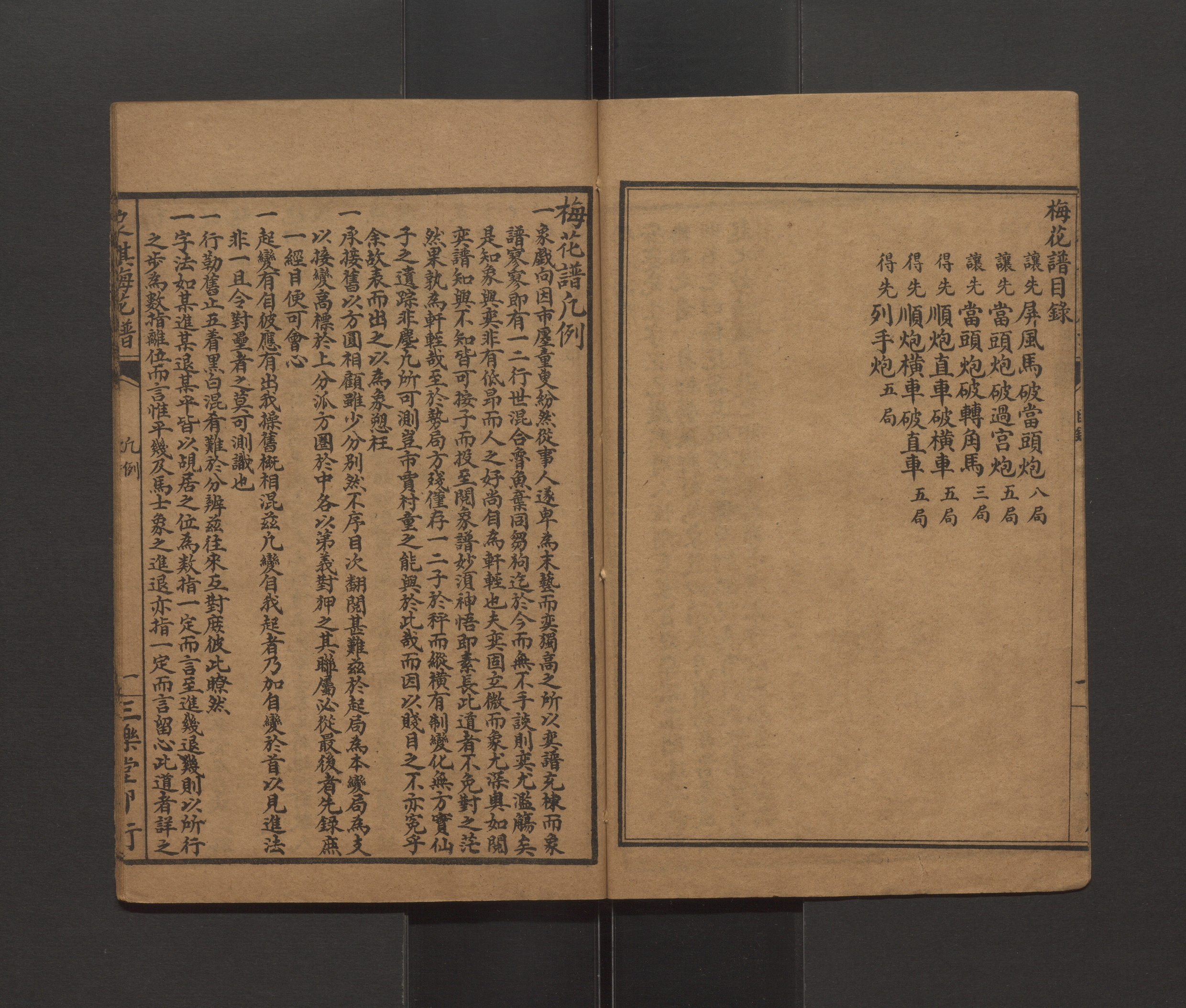
[[File:Meihua manual 1917 contents.jpg|thumb|400px|alt=Two facing pages of a Chinese printed manual, with six vertical contents entries on the right and editorial rules on the left.|Contents and editorial rules in a 1917 printing of Wang's ''Plum-blossom Manual''; the first division lists eight Screen Horses games.<ref name="S36">Wang Anjian (王安蹇), identified with Wang Zaiyue, ''梅花象棋譜'', 1917 printing, colophon, contents and first Screen Horses game. [http://xiangqi.sdcbs.com/ 象棋记忆 digital archive], book 12, chapters 1005–1006 and 969; copy supplied by collector Wang Ye (王晔). [https://chinese-chess.obs.cidc-rp-2065.cdmgcloud.com/ams/file/2025-01-14/ams202501141141258871882879211.jpg Contents facsimile].</ref>]] | [[File:Meihua manual 1917 contents.jpg|thumb|400px|alt=Two facing pages of a Chinese printed manual, with six vertical contents entries on the right and editorial rules on the left.|Contents and editorial rules in a 1917 printing of Wang's ''Plum-blossom Manual''; the first division lists eight Screen Horses games.<ref name="S36">Wang Anjian (王安蹇), identified with Wang Zaiyue, ''梅花象棋譜'', 1917 printing, colophon, contents and first Screen Horses game. [http://xiangqi.sdcbs.com/ 象棋记忆 digital archive], book 12, chapters 1005–1006 and 969; copy supplied by collector Wang Ye (王晔). [https://chinese-chess.obs.cidc-rp-2065.cdmgcloud.com/ams/file/2025-01-14/ams202501141141258871882879211.jpg Contents facsimile].</ref>]] | ||
Wang's ''Meihua pu'' (梅花谱, ''Plum | Wang's ''[[Plum Blossom Manual|Meihua pu]]'' (梅花谱, ''Plum Blossom Manual'') belongs to the Kangxi-period tradition and organizes six divisions of opening studies, beginning with eight games in which Screen Horses meets the Central Cannon.<ref name="S21" /><ref name="S36" /> Its significance lay in developing the horse defense systematically and challenging the cannon's privileged position in earlier opening literature.<ref name="S22">Shanghai Chess Institute (上海棋院), “象棋记忆|象棋古谱《象棋梅花谱》的数字化重生”, 7 April 2025. [https://www.shqipai.org/App/Web/HistoryCultureDetail.aspx?masterIds=20250407101344716506620063842733 Institute article].</ref> A 1917 printing preserved in the ''Xiangqi Memory'' digital archive makes that organization visible in its contents, with the eight Screen Horses games followed by studies of other cannon and horse systems.<ref name="S36" /> | ||
Several different works belong to the broader ''Plum-blossom'' tradition.<ref name="S21" /> ''Meihuaquan'' (梅花泉, ''Plum-blossom Spring''), attributed to Tong Shenggong (童圣公), was expanded by Xue Bing (薛丙) in 1806 and survives in a further annotated manuscript associated with Han Yingbi (韩应陛).<ref name="S20">Shi Weifeng (施伟峰), Sha Zhuoqun (沙卓群) and Yang Wenhua (杨文华), “古谱梅花泉韵长 课程基地绽芬芳”, 2022, pp. 2,5–13. [https://www.wxf-xiangqi.org/images/hangzhou-chess/2022_50_shi_weifeng_sha_zhuoqun_.pdf Paper hosted by WXF].</ref> Its original date is disputed: a 2022 study challenges the earlier dating repeated in some histories and places it after Wang's manual but before 1799.<ref name="S20" /> | Several different works belong to the broader ''Plum-blossom'' tradition.<ref name="S21" /> ''Meihuaquan'' (梅花泉, ''Plum-blossom Spring''), attributed to Tong Shenggong (童圣公), was expanded by Xue Bing (薛丙) in 1806 and survives in a further annotated manuscript associated with Han Yingbi (韩应陛).<ref name="S20">Shi Weifeng (施伟峰), Sha Zhuoqun (沙卓群) and Yang Wenhua (杨文华), “古谱梅花泉韵长 课程基地绽芬芳”, 2022, pp. 2,5–13. [https://www.wxf-xiangqi.org/images/hangzhou-chess/2022_50_shi_weifeng_sha_zhuoqun_.pdf Paper hosted by WXF].</ref> Its original date is disputed: a 2022 study challenges the earlier dating repeated in some histories and places it after Wang's manual but before 1799.<ref name="S20" /> | ||
Revision as of 17:57, 17 November 2026

Screen Horses (屏风马; traditional: 屏風馬), also called the Screen Horse Defense, is a xiangqi opening formation in which both horses develop inward to protect the central pawn, forming a defensive screen in front of the general.[2] It is a major answer to the Central Cannon, with systems ranging from careful pawn restraint to sharp counterattacks and deliberate piece sacrifices.[3][4]
The formation appears in late-Ming evidence and became a central subject of the Qing Plum-blossom manuals, whose horse defenses challenged the attacking claims made for the central cannon.[5][6] Modern theory turns on how Red combines central pressure with chariot activity, and how Black uses pawn advances, cannon maneuvers and horse sorties to prevent that pressure from becoming a sustained attack.[7]
Formation and name
A common route is 1. C2=5 h8+7 2. H2+3 r9=8 3. R1=2 h2+3, after which Black's two horses guard the central pawn and the left chariot stands behind its cannon.[8] The horses can develop in a different order, and pawn or chariot moves can intervene before the formation is complete.[2]
The two inward horses protect Black's central pawn
Loading xiangqi example…
The name compares the two inward horses to a pingfeng (屏风), a screen or partition.[2] In Chinese interiors, screens shielded occupants from wind and sight, divided space and provided surfaces for decoration; folding screens joined several leaves, while standing screens could be mounted on a base.[9] On the board, the image concerns the horses' protective arrangement, while their eventual mobility depends heavily on the third- and seventh-file pawns.[2]
Bowing Screen Horses (屈头屏风马) develops both horses before committing either of those pawns.[2] Yang Guanlin (杨官璘) explains the choice as retaining flexibility until the opponent's arrangement becomes clearer, whereas an early pawn advance declares a more definite plan.[10] Screen Horses can also be adopted by Red in openings that begin with another piece; the Central Cannon matchup is its principal application rather than the definition of every possible use.[2]
Scale and principal systems
In a deduplicated snapshot of the DPXQ Master Games collection, 41,267 of 141,548 games carry a Central Cannon–Screen Horses classification in the stored ECCO tags: 29.2% of the entire archive and 59.3% of its 69,613 Central Cannon starts.[11] These are counts in that curated archive, whose Screen Horses records span 1917–2026, rather than a survey confined to one season or tournament.[11]

The principal names describe different layers of the position: an advanced chariot, a central-pawn attack, the two cannon files, or Black's pawn structure.[2] Consequently, a Five–Nine Cannon formation can also belong to an edge-cannon exchange system, while Two-headed Snake identifies Black's two advanced horse pawns.[12][13]
| System | Central contest |
|---|---|
| Overriver chariot and edge cannon | Red presses the horse; Black opens a chariot exchange and gains time by chasing the invading chariot.[7] |
| Rapid central pawn | Red drives through the center while Black advances a wing pawn and activates a chariot and horse.[14] |
| Two-headed Snake | Black's third and seventh pawns restrain Red's horses; Red's two chariots seek rapid, coordinated activity.[13] |
| Five–Six, Five–Seven, Five–Eight and Five–Nine Cannons | Red's second cannon changes the balance between central pressure, wing attack and development of the left chariot.[15][16] |
| Riverbank cannon and linked central horses | Red can postpone chariot commitment or concentrate a pawn-supported horse attack in the center.[16][17] |
Strategic choices
Pawn space and the horses
An early p3+1 or p7+1 gives Black's corresponding horse a route forward; it also determines which Red horse can be restrained by a further pawn advance.[18] Red's choice between P3+1 and P7+1 likewise combines development of one horse with restriction of the opposing horse.[10] Nie Tiewen's development examples treat freeing one's own horse and limiting the opposing horse as connected tasks.[18]
The choice of Red's left horse is closely related.[7][18] The inward H8+7 supports central play, whereas the edge horse H8+9 keeps the seventh file available to a cannon and avoids some pawn restraints on an inward horse.[7][18] Black can answer the edge horse by advancing the edge pawn, gaining space and potentially opening a chariot route after an exchange.[18] In Five–Seven systems, the resulting struggle can draw Black's right horse away from central defense while Red mobilizes a ranked left chariot.[19]
Chariot activity and the cost of a tempo
Red's overriver chariot reaches Black's pawn rank, where it restricts the opposing chariot and cannon and can prevent a cannon blockade from being established.[20] Its advanced position also supplies Black with a target: a cannon retreat, supported pawn push or horse advance can force it to move again.[8] Red must judge whether keeping that chariot active compensates for time spent before the left wing has fully developed.[8][21]
A ranked chariot rises from the back rank before moving sideways, allowing its owner to choose a file for concentrated pressure.[17] For Black, early development of the right ranked chariot can accelerate counterplay at the cost of delaying some advisor and elephant reinforcement.[22] The example below combines that chariot with the left elephant and a riverbank cannon preparing the third-pawn advance.[22]
Black's right ranked chariot with left-elephant development
Loading xiangqi example…
The center and the second cannon
The central cannon supports a pawn-and-horse attack, but occupying the center does not remove the need to develop the remaining pieces.[17][21] In Huang Shaolong and Duan Yali's annotated rapid game, Red's central-pawn rush begins before the left chariot is available, allowing Black to seize counterplay against the resulting arrangement.[21] Conversely, Yang Guanlin's linked-horse example shows Black answering a central advance by opening a cannon exchange and reducing the concentration of attacking pieces.[17]
Red's second cannon can support the central cannon from the palace corner, pressure a horse from the seventh file, or advance while retaining the eighth file.[15][16] Which arrangement works depends on Black's actual defenses: Yan Wenqing and Zhang Qiang criticize a Five–Seven setup copied against the wrong elephant development and favor a Five–Eight cannon advance in that position.[23]
Overriver chariot systems
Edge cannon and chariot exchange
After 1. C2=5 h8+7 2. H2+3 r9=8 3. R1=2 h2+3 4. P7+1 p7+1 5. R2+6, Black can play 5... c8=9, clearing the chariot file and offering an exchange of chariots.[8] The common refusal 6. R2=3 keeps Red's chariot in attacking territory and presses Black's left horse; 6... c9-1 prepares c9=7, turning the cannon into an attacker against the chariot.[7][8] Thus an offer to simplify can lead to a contest of threats instead.[8]
In Yan and Zhang's example, Red develops the left horse to the river with 8. H7+6, while Black's 9... h7+8 supports a pawn advance against the chariot.[8] Red's further 10. H6+4 maintains the attack but neglects that counterthreat; the following pawn and horse maneuvers force the chariot through repeated changes of position.[8] The authors contrast this with 10. R4-3, withdrawing the chariot to the pawn rank before continuing the attack.[8]
Edge cannon and chariot exchange: counterplay against the advanced chariot
Loading xiangqi example…
Red's left horse and cannon choices produce different continuations from this common structure: edge horse, seventh-file horse, Five–Six, Five–Seven and Five–Nine systems all occur in the specialist literature.[7] The decision to accept or decline the offered exchange is therefore tied to the rest of the army's development.[7]
Rapid central-pawn attack
The rapid central-pawn attack (急进中兵, also 急冲中兵) combines the overriver chariot with successive central-pawn advances and a horse arriving behind the pawn.[14] Liang Wenbin dates the modern system's emergence in national competition to 1962, describing it as a combination of older central-pawn and linked-horse methods with the modern overriver chariot.[14]
In the line below, Red plays 7. P5+1 and 8. P5+1, while Black counters with successive seventh-pawn advances and 11... r8+8.[14] Cai Furu's (蔡福如) 1986 response to Zhao Guorong (赵国荣) continues with the horse route h7+8–h8+6–h6+4–h4+3, followed by the front horse's advance to file 1.[14] The maneuver offers a cannon and then attacks the chariot: a central assault is met by a forcing sequence against Red's active pieces.[14] Liang presents it as an exploratory innovation that generated prolonged analysis.[14]
Rapid central pawn: Cai Furu's five-step horse counterattack, 1986
Loading xiangqi example…
The system continued to develop through amateur as well as professional analysis: a 2006 Qiyi discussion traces a different thirteenth-move choice, R9+2, through online experiments and its adoption in professional games in 2004–05.[24]
Left riverbank horse
Instead of moving the cannon to the edge, Black can bring the left horse to the river with h7+6, aiming for active counterplay against Red's advanced chariot.[25] In the Hu Ronghua (胡荣华)–Cai Furu example, a further seventh-pawn advance forces the chariot aside, the horse enters Red's position and the cannon follows into the attack.[20]
Left riverbank horse: pawn, horse and cannon counterplay
Loading xiangqi example…
The annotated collection describes a change in preference: the riverbank horse was once regarded as the more active answer, while later assessments increasingly valued the counterattacking potential of the edge-cannon exchange system.[20] The contrast concerns how Black generates activity, with horse, pawn and cannon play closely connected in both approaches.[25][20]
Horse sacrifice and cannon blockades
Black can deliberately offer the left horse to Red's overriver chariot.[4] In Yang Dian's example, 5... c2+4 removes the right cannon from its original defensive position; after Red captures the horse, 8... r1=4 mobilizes the other chariot and 9... c8+3 brings the cannon to the river to attack a pawn.[4] The material offer buys activity rather than maintaining the original two-horse screen intact.[4]
Black offers the left horse for rapid chariot and cannon activity
Loading xiangqi example…
The double overriver cannons (双炮过河) system arises when Red develops the left horse inward and Black advances both cannons into Red's half.[26] Jin Qichang describes its development in the 1950s and 1960s and renewed attention before his 2010 survey, with central-pawn advances among Red's established replies.[27] Xu Yinchuan's (许银川) annotations emphasize coordination: a visually imposing central battery can be ineffective if the chariots and horses cannot support it, while Black's cannons can drive defending pieces onto obstructive squares.[26]
Double overriver cannons: Jin Song–Xu Yinchuan, opening excerpt
Loading xiangqi example…
Two-headed Snake
Two-headed Snake (两头蛇) advances both Black horse pawns, p3+1 and p7+1, to restrict Red's horses and prepare counterplay on either side.[13] Red commonly develops a filed right chariot and a ranked left chariot, seeking to bring both major pieces into action before Black's restraint becomes a lasting blockade.[13]
One important reply is the small cannon rise c2+1, which attacks an overriver chariot along Black's pawn rank.[13] In Xu Yinchuan–Miao Yongpeng (苗永鹏), Beijing, 16 March 2002, 6... c2+1 7. R2-2 is followed by Red's seventh-pawn advance and a deep incursion by the other chariot.[28] Red's 11. R2=5 redirects the riverbank chariot toward the center instead of accepting the newly offered exchange on the second file.[28]
Two-headed Snake: Xu Yinchuan–Miao Yongpeng, Beijing 2002
Loading xiangqi example…
Nie Tiewen and Liu Haiting trace the popularity of this filed-and-ranked-chariot confrontation to the 1970s and distinguish Black's cannon-rise, advisor and elephant systems.[13] Its analysis also became highly opponent-specific: Huang Hailin (黄海林) describes preparing a chariot-for-cannon exchange in a 1999 game against Zhang Jiang (张江) because the opposing team knew the usual Two-headed Snake paths especially well.[29]
Cannon formations
Five–Six Cannons
Five–Six Cannons (五六炮) places Red's second cannon at the palace corner with C8=6.[15] Liang Wenbin describes a formation with mutually supporting cannons and resources on both wings, but identifies the slower development of the left chariot as a recurring cost.[15] The cannon can later advance to challenge a horse blocking that chariot's file.[30]
In the following seventh-pawn variation, Black combines a right-cannon blockade with the left riverbank horse.[25] Red's edge horse retreats with 8. H9-7, attacking the cannon; after the cannon advances farther, 9. P5+1 begins central counterplay.[25] The retreat creates a threat while redirecting the horse; a chariot move instead fails to preserve Red's initiative in Fang Yi's analysis.[25]
Five–Six Cannons: Red answers a blockade with a horse retreat and central pawn
Loading xiangqi example…
Five–Six also occurs within the edge-cannon exchange complex: Liang identifies Yu Youhua's (于幼华) 1984 game against Liu Dahua (柳大华) as an early innovation in that particular overriver-chariot system.[15] Its practical appeal can include avoiding an opponent's preferred branches; Hu Qingyang (胡庆阳) expressly chose it against Miao Liming (苗利明) in 2000 because Miao was well prepared for the more fashionable Five–Seven formation.[31]
Five–Seven Cannons
Five–Seven Cannons (五七炮) uses C8=7 to pressure Black's right horse while the central cannon continues to bear on the center.[32] Its major branches distinguish Red's pawn development and Black's choice of third- or seventh-pawn advance.[33]
Against Black's third pawn, Red can pair the seventh-file cannon with an edge horse and a ranked left chariot.[19] Black's h3+2 blocks Red's left chariot file but moves a horse away from the center; the edge-pawn exchanges then make room for Black's own right chariot to reach the river.[16][19] Red's two chariots and cannon pressure must contend with that active wing rather than attack an unmoving wall.[16]
Five–Seven against the third pawn: both sides mobilize on the wings
Loading xiangqi example…
Against the seventh-pawn formation, Nie Tiewen and Liu Haiting distinguish the right riverbank cannon, right cannon blockade and left cannon blockade as important Black choices.[34] The right riverbank cannon example below includes a striking change of plan: Red withdraws the central cannon from the center with 12. C5=7, adding pressure against Black's right horse.[35] Shang Wei explains both sides of the decision: it restricts Black's horse play, but weakens Red's central cover and concentrates pieces on one wing; Black can reply with an active horse advance of his own.[35]
Five–Seven against the seventh pawn: the central cannon changes its task
Loading xiangqi example…
Five–Eight Cannons
Five–Eight Cannons (五八炮) retains the second cannon on the eighth file during the initial arrangement, often advancing it before shifting it across to pressure a horse.[36] The name therefore describes the formation from which play develops, rather than a requirement that the cannon remain on its starting square.[32]
Chen Xinglin (陈幸琳)–Wu Kexin (吴可欣), analyzed in Liu Jinqi's collection of 2022 games, shows how an older idea can answer a modern repertoire.[37] After 6. C8+4 h3+2 7. R9+1 r1=4 8. C8=3, Red chooses 9. R2+4, a riverbank-chariot idea Liu traces to a 1987 game, to prevent Black's third-pawn sacrifice from opening the position on favorable terms.[37] Black's 9... p1+1 both restricts the edge horse and cuts off the advanced cannon's lateral route back to the opposite edge.[37]
Five–Eight Cannons: Chen Xinglin–Wu Kexin, 2022
Loading xiangqi example…
Liu distinguishes the comparatively solid Five–Eight arrangement from the sharper Five–Seven option in this position, then criticizes Black's subsequent chariot advance for allowing Red to intensify the attack.[37] The contrast depends on the complete position and move order, including when Black reinforces the palace.[37]
Five–Nine Cannons
Five–Nine Cannons (五九炮) moves the second cannon to the edge with C8=9, clearing the left chariot for deployment.[32][12] Sun Zhiwei and Liu Haiting describe a two-wing arrangement capable of turning toward the center or a converging attack, with material offers possible on either side.[12]
Their first example begins within the edge-cannon exchange system.[12] Red's 11. R4+2 attacks Black's cannon, while Black's cannon capture and the other cannon's advance establish pressure along Red's pawn rank.[12] The central-pawn advance and horse development answer that blockade, after which Black retreats a cannon to attack the chariot again.[12]
Five–Nine Cannons within the edge-cannon exchange system
Loading xiangqi example…
Here the cannon formation is coordinated with a rib-file chariot attack and a later central pawn-and-horse advance.[12]
Riverbank cannon and linked horses
The riverbank cannon (巡河炮) system raises Red's left cannon with C8+2 while retaining options for the chariots.[16] He Zuofeng emphasizes the move order: bringing out the right chariot too soon can permit Black's advanced right cannon to prevent the intended riverbank-cannon formation.[16] In his example, Black develops an elephant and moves the right chariot to the third file, preparing pawn exchanges and horse activity; Red raises the left chariot to support the inward horse.[16]
Riverbank cannon: Red delays the right chariot's commitment
Loading xiangqi example…
Centrally linked horses (连环马 or 盘头马 in these opening descriptions) accompany an early central-pawn advance and can be combined with either chariot route.[17][38] In He Shun'an (何顺安)–Yang Guanlin, 1952, Red concentrates the right ranked chariot on the sixth file and pushes the central pawn, while Black advances a horse to open the left cannon's route toward an exchange in the center.[17] Yang contrasts this simplifying method with a more tightly defended elephant arrangement, which retains greater tension.[17]
Central pawn and linked horses: He Shun'an–Yang Guanlin, 1952
Loading xiangqi example…
The riverbank chariot (巡河车), stopping on Red's side of the river, has its own longstanding lines against Black's third pawn, including the pawn capture and cannon retreat explored in the Plum-blossom tradition.[30] These central-horse and riverbank systems connect the older manuals with later opening practice.[14][30]
Historical development
Before and within the Plum-blossom tradition
Screen Horses was known before Wang Zaiyue's (王再越) Qing manual.[5] Zhang Ru'an identifies a game explicitly named for Screen Horses defeating the Central Cannon in volume 14 of the 1596 everyday encyclopedia Wanshu cuibao (万书萃宝), and related material in the 1597 Wuche bajin (五车拔锦).[5] This places the formation in the late-Ming printed record, although those witnesses do not establish a date of invention.[5]

Wang's Meihua pu (梅花谱, Plum Blossom Manual) belongs to the Kangxi-period tradition and organizes six divisions of opening studies, beginning with eight games in which Screen Horses meets the Central Cannon.[6][39] Its significance lay in developing the horse defense systematically and challenging the cannon's privileged position in earlier opening literature.[40] A 1917 printing preserved in the Xiangqi Memory digital archive makes that organization visible in its contents, with the eight Screen Horses games followed by studies of other cannon and horse systems.[39]
Several different works belong to the broader Plum-blossom tradition.[6] Meihuaquan (梅花泉, Plum-blossom Spring), attributed to Tong Shenggong (童圣公), was expanded by Xue Bing (薛丙) in 1806 and survives in a further annotated manuscript associated with Han Yingbi (韩应陛).[41] Its original date is disputed: a 2022 study challenges the earlier dating repeated in some histories and places it after Wang's manual but before 1799.[41]
One celebrated development was the retreating-cannon answer to Red's riverbank chariot capturing a pawn.[41] In the line below, 6... c2-1 prepares a cannon transfer; Black offers a horse while arranging threats against Red's chariot and back rank.[41] The continuation shows the historical attacking idea, including a cannon entering the bottom rank after Red's central-cannon capture.[41]
A historical horse-bait line from the Plum-blossom Spring tradition
Loading xiangqi example…
The debate also produced counterarguments from the cannon side.[6] Ba Jiren's (巴吉人) Fan Meihua pu (反梅花谱, Counter–Plum-blossom Manual), also known as Xiangqi Meihua xinfa pu (象棋梅花心法谱), developed attacks using an advanced chariot and a rapidly advancing central pawn.[6] Later writers continued to analyze the interaction between those attacks and the horse defense, rather than merely repeating the old manuals' verdicts.[42]
Print study and modern competition
The opening became part of a culture of copied scores, newspapers and specialist books.[43][44] Liang Yusheng recalls choosing Screen Horses to surprise an opponent at Lingnan University in 1947, then writing a poem about the victory; his account also describes the circulation of hand-copied games and Zhou Deyu's (周德裕) opening lessons.[43]
Zhu Jianqiu's (朱剑秋) 1951 preface to Latest Opening Methods describes new Screen Horses analysis as a major preoccupation of the preceding few years.[45] Tu Jingming (屠景明) and Xu Daqing (徐大庆) published newspaper lessons on the riverbank cannon against Screen Horses in 1951, followed by booklets on that system, linked horses and Five–Seven Cannons.[44] Li Yiting's (李义庭) 1958 riverbank-cannon monograph and He Shun'an's 1958 study of third-pawn Central Cannon attacks were subsequently reprinted in Hong Kong under different titles.[46]
The movement of ideas from print to the board could be demanding even for developing masters: Liu Dianzhong (刘殿中) recalls recognizing a new Screen Horses chariot move from Xiangqi magazine in 1964 while not yet understanding its continuations.[47] Later preparation included collective team analysis: Shang Wei records the Liaoning team's work on a right-cannon blockade before the 1994 team championship.[35]
Modern books continue to revisit the same structural problems through new games: the 1999 and 2002 Two-headed Snake examples involve prepared deviations, while Chen Xinglin's 2022 Five–Eight game revives an idea from 1987.[29][28][37] In 2025, the Chinese Xiangqi Association's Xiangqi Memory project also brought digitized ancient manuals together with playable transcriptions, extending access to the historical side of the opening's literature.[48]
ECCO classification
For individual code definitions, see the ECCO C-class catalog.
ECCO 2004 assigns 85 codes in class C to Central Cannon against Screen Horses.[49] The main groups are:[49]
| Assigned codes | Principal scope |
|---|---|
| C00–C06 | Early and residual branches.[49] |
| C10–C19 | Ranked, riverbank and overriver chariots.[49] |
| C20–C25 | Two-headed Snake.[49] |
| C30–C39; C40–C49 | Mutual seventh-pawn overriver systems; edge-cannon chariot exchange.[49] |
| C50–C56 | Five–Six Cannons.[49] |
| C60–C68; C70–C78 | Five–Seven against Black's seventh or third pawn.[49] |
| C80–C86 | Riverbank cannon.[49] |
| C90–C98; C99 | Five–Eight; residual Five–Nine.[49] |
The groups have inherited conditions and exclusions: C00 is a residual code, and C99 excludes Five–Nine branches classified earlier, including C45–C46.[49] The catalog supplies the individual definitions and stable code links.[49]
Related articles
- Xiangqi openings
- Central Cannon
- Sandwiched Horses
- Same Direction Cannons
- Secrets Inside the Orange
- List of xiangqi openings by ECCO code
References
- ↑ National Palace Museum (國立故宮博物院), 碧玉屏風, collection number 中玉000624, Republic period, c. 1940. Museum image released under CC0.
- ↑ a b c d e f g Jim Png Hau Cheng, Lexicon of Xiangqi (Chinese Chess) Terms in English, 2017, ISBN 9789574347070, pp. 42,64–65,477–481, entries on Bowing Screen Horses, Central Cannon versus Screen Horse Defense, and Screen Horses. Bibliographic record.
- ↑ Liu Jinqi (刘锦祺), 象棋入门与提高:象棋布局精要(升级版), Chemical Industry Press, 2023, ISBN 9787122374042, chapter I, Screen Horses subsection. Publisher-authorized preview.
- ↑ a b c d Yang Dian (杨典), 象棋布局弃子战术, Fujian Science and Technology Press, 2004, ISBN 7533523717, pp. 1–2. Chinese edition scan, PDF pp. 12–13.
- ↑ a b c d Zhang Ru'an (张如安), “晚明通俗日用类书中的象棋史料”, 2019, pp. 1–3,6–9. Paper hosted by the World Xiangqi Federation.
- ↑ a b c d e Ji Benhan (季本涵), “长三角象棋活动史论纲”, 15 July 2019, pp. 8–13. Paper hosted by WXF.
- ↑ a b c d e f g Jin Qichang (金启昌) and Liu Haiting (刘海亭), 中炮过河车对屏风马平炮兑车, chapter I, §1, first example, especially comments at plies 10–26. Contents and introduction; annotated transcription.
- ↑ a b c d e f g h i Yan Wenqing (阎文清) and Zhang Qiang (张强), 布局定式与战理, part II, chapter I, §1, game 21, “黑外肋马式”. Annotated transcription, opening sequence and comments 12,15,18–28; alternative at ply 19.
- ↑ Wu Weiping (吳偉蘋), “院藏碧玉折屏紋飾淺析”, 故宮文物月刊347, February 2012, pp. 86–89. Museum article.
- ↑ a b Yang Guanlin (杨官璘), 弈林新编, People's Sports Publishing House, 1977, chapter II, “布局入门:当头炮与屏风马”, comments 2,4,6–8,12–15. Annotated transcription.
- ↑ a b DPXQ Master Games collection, as retained in the LiXiangQi Masters corpus, read-only snapshot 17 November 2026. 141,548 distinct eligible played games; 141,558 source associations collapsed by canonical game; 69,613 first-move Central Cannon games; 41,267 ECCO C-class records. Mirrored first moves combined. Tabulation, grouping and provenance.
- ↑ a b c d e f g Sun Zhiwei (孙志伟) and Liu Haiting, 五九炮对屏风马, introduction and chapter I, first example. Contents; annotated game, especially comments 20–28.
- ↑ a b c d e f Nie Tiewen (聂铁文) and Liu Haiting, 中炮直横车对屏风马两头蛇秘籍, Chengdu Times Press, digital edition 2024, ISBN 9787546432380, preface dated 30 June 2021 and part I introduction. Book preview.
- ↑ a b c d e f g h Liang Wenbin (梁文斌), 中炮急冲中兵对屏风马(上册), Economic Management Press, 2012, ISBN 9787509618196, pp. 1–2,104–105. Chinese edition scan.
- ↑ a b c d e Liang Wenbin, 象棋五六炮对屏风马布局揭秘, Enterprise Management Press, 2018, ISBN 9787516417324, preface and chapter I, games 1–2. Preface; first chapter.
- ↑ a b c d e f g h He Zuofeng (何左峰), 屏風馬布局精華, National Publishing House (國家出版社), preface pp. 003–004; main text pp. 97–99,121–123,154–156,167–169. Chinese edition scan.
- ↑ a b c d e f g Yang Guanlin, 弈林新编, game 25, He Shun'an–Yang Guanlin, Shanghai, 9 November 1952, comments 7–18. Annotated transcription.
- ↑ a b c d e Nie Tiewen, 象棋实用布局大全, Chemical Industry Press, 2025, ISBN 9787122469960, chapter I, principles and balanced-development example 3; chapter II, first opening examples. Principles; opening examples.
- ↑ a b c Liu Jinqi, “不可不知的64条‘象棋军规’”, 棋艺 2015 (8), first principle, Xu Yinchuan–Yu Youhua 2014, moves 1–6 and notes. Public excerpt.
- ↑ a b c d 胡荣华妙局精萃, game 1, Hu Ronghua–Cai Furu, comments 7–10 and 26–28. Annotated transcription.
- ↑ a b c Huang Shaolong (黄少龙) and Duan Yali (段雅丽), 象棋快棋布局技巧, Chengdu Times Press, 2021, ISBN 9787546429175, chapter I, §3, Sun Yongzheng–Tao Hanming example. Public preview.
- ↑ a b Sun Zhiwei and Liu Haiting, 中炮对屏风马横车专集, introduction and chapter I, §1, first example, comments 12–17. Overview; annotated transcription.
- ↑ Yan Wenqing and Zhang Qiang, 布局疑形与攻击, game 19, “生搬硬套”. Annotated transcription.
- ↑ “探究中炮急进中兵VS屏风马平炮兑车新变”, 棋艺 2006 (4), introduction and position after 13. R9+2; contribution by Dai Qifang (戴其芳). Public excerpt.
- ↑ a b c d e Fang Yi (方艺), 五六炮对屏风马, chapter I, §1, “红右车过河对黑左马盘河”, comments 14–17 and variations. Annotated transcription; contents.
- ↑ a b Xu Yinchuan (许银川), self-annotations to Jin Song–Xu Yinchuan, Central Cannon versus double overriver cannons, comments 9,21,31–32,41. Signed annotated score.
- ↑ Jin Qichang, 象棋布局宝典, Beijing Sport University Press, 2010, ISBN 9787564404628, pp. 110–111, double overriver cannons, game 22. Chinese edition scan, PDF pp. 118–119.
- ↑ a b c Wang Jialiang (王嘉良) and Pang Xiaoyu (庞小予), “许银川:布新阵,定圪坤 洪智:深思熟虑伏昆仑”, 棋艺 2002 (10), Xu Yinchuan–Miao Yongpeng, 16 March 2002, moves 1–11 and notes. Public excerpt.
- ↑ a b Huang Hailin, self-annotation, “隐伏海林中的奇兵”, 棋艺 2000 (4), Huang–Zhang Jiang, 8 November 1999, moves 1–17 and notes, particularly 12. R3=8. Public excerpt.
- ↑ a b c Huang Shaolong, 象棋开局初步, People's Sports Publishing House, 1992, ISBN 7500907451, pp. 102–106. Chinese edition scan, PDF pp. 109–113.
- ↑ Hu Qingyang, self-annotation, with Huang Shaolong's notes, “胡庆阳津门出世宣言”, 棋艺 2000 (16), Hu–Miao Liming, 2 July 2000, moves 1–11. Public excerpt.
- ↑ a b c Png, Lexicon of Xiangqi Terms in English, entries on Five–Six, Five–Seven, Five–Eight and Five–Nine Cannons, especially pp. 221–237.
- ↑ Xu Yongliang (徐永亮), 五七炮对屏风马, contents and first example. Overview; annotated transcription.
- ↑ Nie Tiewen and Liu Haiting, 五七炮对屏风马进7卒秘籍, Chengdu Times Press, 2021, ISBN 9787546427874, preface dated 30 June 2019 and part I introduction, printed p. 1. Book preview.
- ↑ a b c Shang Wei (尚威), 象棋布局圈套, Shanghai Culture Press, 1997; second edition 2004, ISBN 7805117306, pp. 1–5. Chinese edition scan, PDF pp. 15–19.
- ↑ Liu Haiting, Yang Dian and Mao Jizhong (毛继忠), 五八炮对屏风马, introduction and first example. Contents; annotated transcription.
- ↑ a b c d e f Liu Jinqi, 象棋名手大赛佳局赏析(2022年度), Chemical Industry Press, 2023, ISBN 9787122430137, game 3, Chen Xinglin–Wu Kexin, particularly moves 5–12 and 26. Annotated game preview.
- ↑ Png, Lexicon of Xiangqi Terms in English, pp. 77–79, entries on Central Cannon with centrally linked horses and ranked chariots.
- ↑ a b c Wang Anjian (王安蹇), identified with Wang Zaiyue, 梅花象棋譜, 1917 printing, colophon, contents and first Screen Horses game. 象棋记忆 digital archive, book 12, chapters 1005–1006 and 969; copy supplied by collector Wang Ye (王晔). Contents facsimile.
- ↑ Shanghai Chess Institute (上海棋院), “象棋记忆|象棋古谱《象棋梅花谱》的数字化重生”, 7 April 2025. Institute article.
- ↑ a b c d e Shi Weifeng (施伟峰), Sha Zhuoqun (沙卓群) and Yang Wenhua (杨文华), “古谱梅花泉韵长 课程基地绽芬芳”, 2022, pp. 2,5–13. Paper hosted by WXF.
- ↑ Huang Shaolong, 马炮争雄, People's Sports Publishing House, chapters 1–4. Chapter 1; chapter 2; chapter 3; chapter 4, digital transcriptions.
- ↑ a b Liang Yusheng (梁羽生), “金应熙的博学与迷惘”, section “象棋·武侠·诗词”, memoir republished 28 February 2022. Text.
- ↑ a b Ye Guoqing (叶国庆), “上海象棋元老屠景明象棋谱”, entries 5–7, in the memorial collection “棋坛名将屠景明,棋书影响撼人间”, 4 August 2008. Text.
- ↑ Wu Ruopeng (吴若鹏), “‘剑胆琴心,秋实春华’——朱剑秋的遗著《最新开局法》惊现人间”, pp. 8–16, especially the reproduced 1951 preface and contents. Paper hosted by WXF.
- ↑ Yan Mujiang (言穆江) and Chen Yiqiu (陈弈秋), “香港象棋谱点评”, 2022, pp. 16–19, especially entries 48–49. Paper hosted by WXF.
- ↑ Liu Dianzhong, 刘殿中象棋对局精选, Enterprise Management Press, 2019, ISBN 9787516419601, game 1, Zhou Shunfa–Liu Dianzhong, 26 April 1964. Annotated game.
- ↑ Xinhua, report on the “象棋记忆” ancient-manual digitization project, 5 March 2025. Republication.
- ↑ a b c d e f g h i j k l ElephantBase, ECCO 2004, class C definitions, including inherited conditions and exclusions. See the C-class catalog.