Opposite-direction Cannons
Opposite-direction Cannons (列手炮, lièshǒupào, usually shortened to 列炮, lièpào) is a family of xiangqi openings in which the two players bring cannons from opposite wings onto the central file. The immediate form begins 1. C2=5 c2=5. Each player has moved the cannon that started on their own right. Across the board those cannons travel in opposite directions. Each cannon now faces the opposing central pawn. Once its horse moves, each side's right chariot can turn onto the file the cannon vacated.[1][2][3][4]
The classic question is what happens when Black copies Red. If the chariots advance to corresponding squares on the river and the horses take matching posts on the edges, Red can be first to jump a horse across and attack. Black can break the pattern by drawing a horse inward or by developing a horse and chariot before answering with the central cannon.[1][5][6] These delayed defenses, called halfway or deferred Opposite-direction Cannons (半途列炮, 后补列炮), account for most of the family's games in the Dongping master-game collection. They include a cannon that advances to block Red's chariot and the Three-step Tiger, in which the same cannon steps aside to free Black's own chariot.[2][7][8][9]
Opposite-direction Cannons. Play forward to see how the first player breaks the symmetry in the large variation.
Loading xiangqi example…
How the cannons meet
Xiangqi numbers the nine files from each player's right, so Red's file 2 faces Black's file 8. In the move notation, C is a cannon, H a horse and R a chariot. An equals sign means the piece moves sideways to the named file. After Red's C2=5, Black has two ways to match it. Moving c8=5 brings the cannons in from the same physical side of the board, giving Same Direction Cannons. Moving c2=5 brings them in from opposite sides. Reverse all the files and 1. C8=5 c8=5 is also Opposite-direction Cannons. The two families share the Chinese name dòupàojú (斗炮局), or “cannon duel”. Other names for Opposite-direction Cannons include 逆手炮 (nìshǒupào) and 逆炮 (nìpào).[4][10][2][8][11]
In the immediate opening, each player can follow by clearing the horse standing between their chariot and the file the cannon has vacated. The chariot can then turn onto that file. This puts the two active chariots on different wings. Accepting the offered central pawn is another possibility. Wang Jialiang and Yang Dian point out the cost of taking it too early. Black can attack the capturing cannon while developing, so Red spends another turn moving a piece that has already moved twice.[3][6]
Large variation and the first move
The large or major Opposite-direction Cannons (大列手炮) traditionally features Black's left horse on the edge, h8+9. In the symmetrical old line, Red in turn sends the left horse to the edge. Each side brings out both chariots and advances the edge pawn in front of that horse. At move seven on the first board, Red plays 7. R2+4, putting a chariot on the home bank of the river. Its placement makes it possible for the Red horse to jump across with a threat against Black's chariot.[1][2][5]
If Black continues to imitate with 7...r2+4, the horse jumps first for Red, 8. H9+8. Black moves the attacked chariot aside. After 8...r2=6 9. R2=6 h9+8 10. H8+6, Red already threatens a further horse jump and a cannon capture down the center. Black also has an alternative at move seven, 7...c8=7, attacking down the seventh file. Png gives 8. R2=6 in reply. The Chinese manuals print both choices. The danger lies in copying one move too many.[1][2][5]
Red can depart from the old formation even earlier. A left horse on file 7 supports the center and leaves the left cannon free to advance against Black's chariot. Yang Guanlin (杨官璘) also examined Black's answer of lifting the other chariot off its home rank. In his study the first moves are 1. C2=5 c2=5 2. H2+3 h8+9 3. H8+7 h2+3 4. R9=8 r9+1 5. P7+1 r9=4. The chariot that might have filed in front of the edge horse instead comes across to the fourth file.[6][12][13]
Small variation and the chariot exchange
In the small or minor Opposite-direction Cannons (小列手炮), Black brings the left horse inward with h8+7. As well as developing the horse, the horse guards the central pawn. Red's right chariot can cross the river and come sideways onto the horse's file. Black can move the remaining cannon to the edge, c8=9, uncovering the black chariot directly behind it. Red then chooses whether to trade chariots or to keep exerting pressure on the horse.[1][2][14][6]
The same position can arise by different orders. After 1. C2=5 h8+7 2. H2+3 r9=8 3. R1=2 c2=5 4. R2+6 c8=9, the textbook choice is still there. In the line below, Red moves sideways, 5. R2=3, and Black raises the chariot two points to meet the pressure. In the exchange line, 5. R2+3 h7-8, Black's horse recaptures, so one chariot from each side has left the board. Red can turn immediately to the left horse and chariot. Qiu Zhiyuan and Zhu Quanguan open their book on the small variation with this horse-first route. In ECCO, the delay in moving Black's cannon earns a different code from the immediate opening.[14][6][8]
Small variation reached by a horse-first move order. Red keeps the advanced chariot on the board.
Loading xiangqi example…
Crossing the river early also leaves the Red chariot a long way from home. In a well-known teaching trap Black lifts the other chariot on move four. When Red takes the seventh-file pawn with 5. R2=3, the threatened horse retreats to its starting square. Red can now take the undefended elephant on the back rank. After 6. R3+3 c5=7, Black's central cannon has swung across to close the chariot's way out. Yan Wenqing and Zhang Qiang compare taking the elephant with simply developing the left horse, 6. H8+7. The former leaves Red fighting to free a chariot while Black attacks the pieces still at home.[15][16]
The offered elephant in the small variation. The score follows game 16 of One Hundred Opening Traps.
Loading xiangqi example…
In the early manuals

One of the earliest surviving descriptions of the opening comes from an encyclopedia of everyday life. Chen Yuanjing's (陈元靓) Shilin guangji (《事林广记》) circulated in different versions. Ji Benhan distinguishes an edition from the Taiding era, with rules, maxims and piece values, from the edition printed during the Zhishun era (1330–1333), which preserves two opening scores and the endgame diagram Two Dragons Emerge from the Sea (二龙出海势). One opening is Same Direction Cannons and the other is Opposite-direction Cannons.[20][19][18][17]
The inscription bái ráo xiān (白饶先) says that White yields the first move, so Black plays first. Both sides count their files from White's right. In the modernized score, the first-moving side appears in Red's place on the board below. After the two central cannons and the first pair of horses develop, the second player shifts the remaining cannon to the seventh file. The first player sends the chariot almost the length of the board on move four. Cheng Mingsong's modern edition gives the eventual material advantage to the second player.[20][21][19]
The first four moves of the Shilin guangji opposite-cannon score, with the historical first player shown as Red.
Loading xiangqi example…
By 1570, Xu Zhi's (徐芝) Shiqing yaqu (《适情雅趣》), revised by Chen Xueli (陈学礼), presented the opening as a branching study. Game 16 of its ninth volume is a large Opposite-direction Cannons game for the side with the first move. It counts thirty-nine lines including the principal one. The tenth volume takes the other side of the board, with studies for the player yielding the first move, including small against large Opposite-direction Cannons. The material belongs to the Jinpeng shiba bian (金鹏十八变) tradition. Zhang Ru'an found that late-Ming household encyclopedias transmitted related scores with different continuations, sometimes adding marks for captures and checks or omitting a branch.[22][21][23]
Secrets Inside the Orange (《橘中秘》), whose preface dates to 1632, gives the opening a memorable piece of advice, lièshǒupào bǔ shì yào láo (列手炮补士要牢), “in Opposite-direction Cannons, secure your advisors.” It also gives the player moving first a large-variation study. Its counsel to look after the palace sits alongside lines in which the chariots and horses are already attacking on the wings.[24][2]
Another manual uses its own title as a memory aid. The seven characters of Since Emerging from the Cave, Unmatched (《自出洞来无敌手》) label seven groups of five studies in the original text. The second character, 出 (“emerge”), labels the Opposite-direction Cannons group. Its first game opens from the other wing, 1. C8=5 c8=5. The title phrase also occurs in Yao Kuan's (姚宽) Xixi congyu (《西溪丛语》). There a Daoist chess player gives his opponents the first move. When his grave is reopened, only the coffin and burial clothes remain. The poem attributed to him pairs the boast of being unmatched with advice to show forbearance when one can.[25][26][27]
The first “emerge” study opens from the left on both sides. The two edge horses appear on opposite flanks.
Loading xiangqi example…

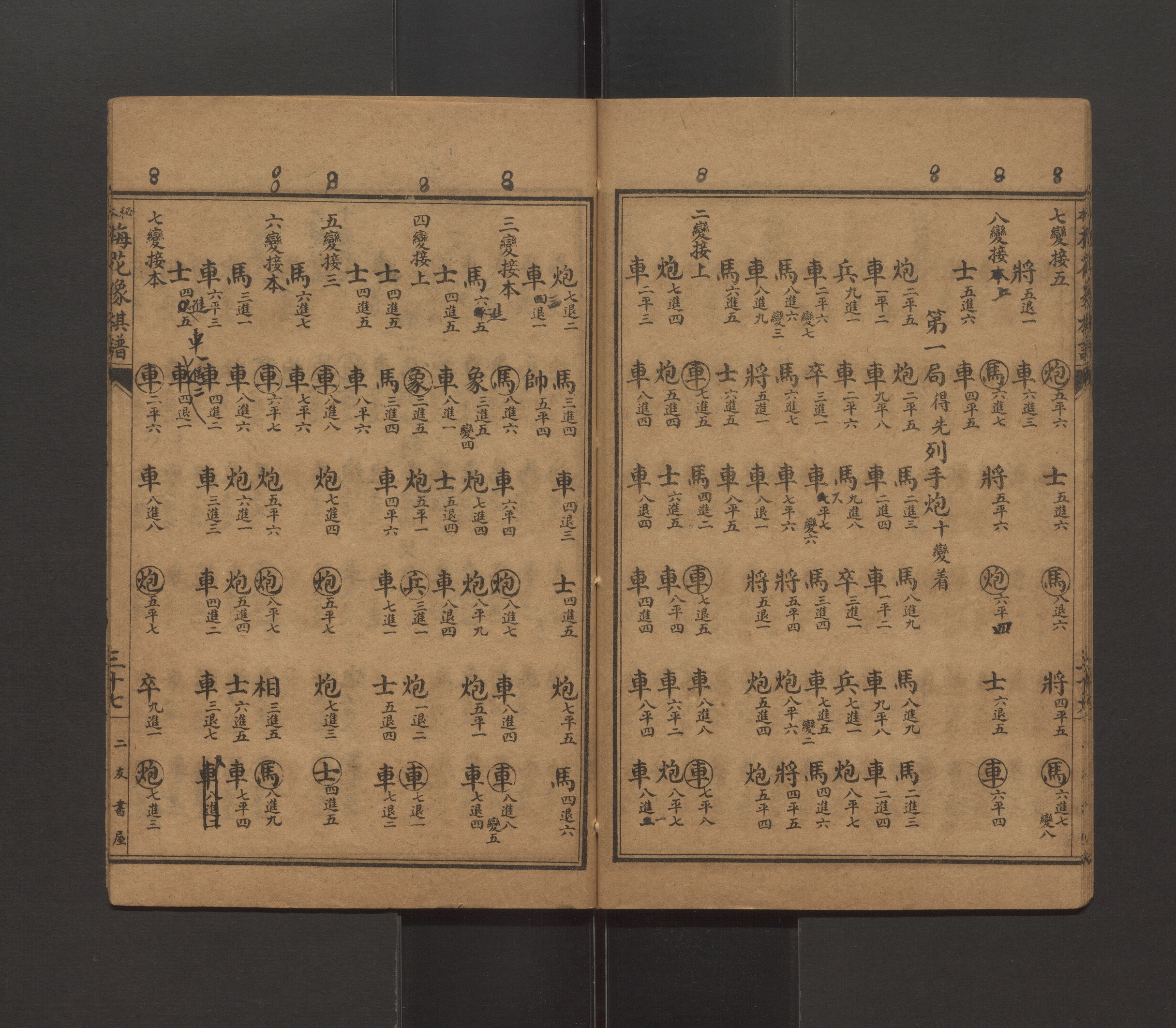
Wang Zaiyue (王再越) devoted the last of the six divisions of his Plum Blossom Manual (《梅花谱》) to five Opposite-direction Cannons studies. In the first, Black lets Red's chariot reach the river, then brings the other chariot to its own riverbank. The 1917 Shanghai printing shows how to read its variations. The main line starts below the vertical heading on the right. Smaller branch markers in the score refer the reader to columns headed “second variation continues from above” or “third variation continues from the main line.”[28][29] Lü Simian (吕思勉), who edited another printing, raised a question about this kind of instruction. The winning side's attack might be ingenious, he wrote, while the losing side could still have defended better. In 2025 the Shanghai Xiangqi Memory project paired the 1917 page images with replayable scores.[30][29][31]
Plum Blossom Manual, division VI, study 1. The opposing chariots reach their riverbanks at different moments.
Loading xiangqi example…
From the edge horse to the delayed countercannon
Yang Guanlin against Zhang Zenghua, 1956
At the first national championship in 1956, eventual champion Yang Guanlin met Zhang Zenghua (张增华) in the preliminary competition. Zhang chose the large variation. Yang sent both horses inward and developed the left chariot first. His left cannon then crossed the river with 5. C8+4 and stopped Black's right chariot from coming out. Red was ahead in development on both wings when the right chariot came across onto the sixth file, alongside Black's palace.[32][33][34][3]
The opening advantage took a different form as pieces came off. Red exchanged horses and used both cannons to control the center. Late in the game Red's rear cannon slid to file 8. Over the next three moves the horse used that cannon's support to drive the attack home, ending the score at 23. H7+9. The two published scores put some earlier horse, pawn and chariot moves in different orders. They agree on the position after Black's ninth move and on the finish. The replay follows game 75 of Xiangqi Quick Wins (《象棋快杀速胜法》).[34][3]
Yang Guanlin–Zhang Zenghua, 1956 national championship. Complete score from Xiangqi Quick Wins, game 75.
Loading xiangqi example…
Tu Jingming and Ge Weipu describe relatively few appearances of the old opening in national competition in the 1950s and 1960s. Its revival took a different form. Black brought out a horse and chariot first, reserving the choice of the second cannon's destination. In the preface to his specialist study, Zhao Qingge dates the renewed interest to the mid-1970s and describes experiments by Hu Ronghua (胡荣华), Liu Dahua (柳大华) and Li Laiqun (李来群), as well as his own tournament use. Tu's dictionary records more appearances in major events from 1980 onward.[13][35][2][36]
The dates also depend on which part of the opening is meant. Hu remembered seeing Chen Changrong (陈昌荣) use a left-cannon chariot blockade against Hu's teacher He Shunan (何顺安) at Shanghai's Meihua Teahouse (美华茶楼) in 1955. Hu drew on that idea against Yang in 1960, giving up a cannon for three pawns. The later system combines that blockade with a second decision, bringing the other cannon to the center. By December 1984, a book by Taiwan author Jiang Rongfu (姜榮富) already named the immediate and halfway systems side by side in its title. Later manuals treat large, small and blockade systems through the transition to the middlegame.[37][2][38][39][40]
Three ways to delay the cannon
All three defenses can start 1. C2=5 h8+7. Moving the horse protects the central pawn and leaves Black free to choose the formation after seeing more of Red's deployment. The most revealing piece to watch is Black's other cannon, the one on file 8. Advancing it four points restricts Red's chariot. Moving it sideways to the edge frees Black's chariot. Black can also postpone moving it altogether and send the second-file cannon to the center first.[1][41][42][8]
Left-cannon chariot blockade
The usual starting line is 1. C2=5 h8+7 2. H2+3 r9=8 3. R1=2 c8+4 4. P3+1 c2=5. The fourth move explains why Black spent a turn on the blockade. Red's right chariot has a black cannon in front of it, while the second black cannon now bears down on the center. He Zuofeng records the nickname lièpào cháo qián dǎng (列炮朝前挡), a countercannon with a forward block. Red has several ways to challenge it, including bringing the right horse to the river, sending the left cannon against a horse and developing the left horse either inward or to the edge.[7][43][44][8]
In the double-headed snake (两头蛇), Red pushes both the third- and seventh-file pawns. This opens routes for both horses and restricts the opposing ones. Red can bring the left chariot across the river to put pressure on Black's right horse. Black in turn can bring the right chariot to the river and across to the left to join the attack on Red's other wing. Wang Jialiang and Zhang Zhiqiang emphasize that Black's two horses may still be cramped when this attack starts. Black relies on the chariots to make time for them. One of the published examples from the 2005 Qiyou Cup shows both seventh-file pawns advancing as play spreads across the board.[43][44][45][35][46]
The blockade first, the countercannon second. Wang Jialiang and Yang Dian’s two-pawn line with Red’s left edge horse.
Loading xiangqi example…
A different way to handle the blockade is to develop the left horse to the edge. In the line on the board, Red plays 5. H8+9 and only then pushes the seventh-file pawn. Black takes the blockading cannon off the file with 6...c8=7, inviting a chariot trade, and Red later retreats the central cannon a point to guard the central pawn. In a 2013 cup game, Xie Jing (谢靖) used the edge horse to steer Li Laiqun away from familiar preparation. Li answered by moving the blockading cannon all the way to the opposite edge, 6...c8=1.[6][47] The edge horse has practical drawbacks, too. Fu Baosheng's analysis of Jiang Wenqi (江文琪) against Lian Shite (连诗特) shows Black allowing an elephant to fall to seize the file beside the palace. Black won in 21 moves.[48]
Three-step Tiger transition
The Three-step Tiger (三步虎) takes its name from the three moves that bring the chariot into play. Black brings the left horse inward, moves the left chariot onto file 8 and shifts the left cannon to file 9. The chariot now looks along the opened file. Red often advances a flank pawn before developing the right chariot. Black can then choose a Screen Horses formation, or bring the opposite cannon into the center and enter the cannon duel. Wang Jialiang and Yang Dian give a line in which Red responds by moving the left cannon to the edge as well, freeing the other chariot. In Cao Quanzhong's treatment, Red can instead send the left cannon across the river to interfere with Black's development.[42][49][7][50]
Red has a direct answer to a black chariot that comes out early. At the women's national championship in Pan'an on 11 October 2012, Shi Fenglan (时凤兰) moved her left cannon to the edge against Zhao Yin (赵寅). Zhao brought her chariot just over the river with 5...r8+5. Shi immediately pushed the central pawn, 6. P5+1. Zhao answered 6...c2=5. Shi now filed her left chariot and sent it across the river on move eight. Zhao withdrew hers one point. Shi won in 25 moves.[51][7][8]
Shi Fenglan–Zhao Yin, Pan’an, 11 October 2012. The first eight moves of the Three-step Tiger transition.
Loading xiangqi example…
Ge Weipu compares three ways for Red to use the next turn in a related Tiger position. An early advisor move gives Black time to occupy the river exit. Advancing the chariot to straddle the river was, he wrote, a proposal still awaiting a practical test. Taking the chariot a point farther gives Red a chance to offer an exchange and reduce Black's attacking force. Which riverbank the chariot occupies can matter as much as which file it chose.[52]
The countercannon without a prior blockade
Black can develop the left horse and chariot, then play c2=5 while the cannon on file 8 is still at home. One route is 1. C2=5 h8+7 2. H2+3 r9=8 3. R1=2 p7+1 4. H8+7 c2=5. The black pawn has opened a route for its horse. If Red now sends the chariot across, 5. R2+6, Black can raise the other chariot two points to protect the right horse and discourage a cannon exchange on that wing.[41][8]
The seventh-pawn route from Wu Qisheng and colleagues’ Halfway Opposite-direction Cannons, game 16.
Loading xiangqi example…
The countercannon can arrive as early as move two. In Shang Wei's study 1. C2=5 h8+7 2. P3+1 c2=5, Red leaves the right chariot at home and Black later brings the left chariot across the board. By move nine the black chariot can attack either a horse or a cannon. In Shang's analysis, advancing two points to attack the cannon gives Black the initiative. The tempting six-point advance to attack the horse lets Red offer it for a dangerous attack.[53]
A Wuyang Cup game between Xu Yinchuan (许银川) and Hu Ronghua shows what happens if Red accepts the early chariot exchange. Hu had scored only half a point in the first three rounds and wanted an unbalanced game. He centered his cannon on move three. Xu traded chariots on move five, developed the left horse and chariot, then advanced the left cannon with 8. C8+4. That last move both limited Black's remaining chariot and threatened the pawn behind it. Xu won the central pawn and eventually the game.[54][14]
Xu Yinchuan–Hu Ronghua, Wuyang Cup. Opening excerpt, with the chariot exchange on move five.
Loading xiangqi example…
In 2013 Xu took the other side of the opening against Jiang Chuan (蒋川) in the national championship at Shishi. The two players advanced their left cannons over the river and aimed them at the opposing back-rank elephants. Xu accepted an elephant and a pawn. When Jiang's horse jumped forward, Xu moved his central cannon sideways to help defend. The tournament report records a further practical consideration. Under that event's rule on an early repetition, it was Jiang, playing Red, who had to vary before move 25. Xu won.[55]
Classification and frequency
The ECCO catalogue distinguishes the direct first move from three groups of delayed replies. Its codes follow qualifying moves and their order. A left-cannon blockade without a qualifying switch to the central cannon has its own entry, B07. The classification recognizes a full left–right reflection of the board.[8][11]
| Code | Route | What distinguishes it |
|---|---|---|
| D50 | Immediate Opposite-direction Cannons | Black answers the first-move Central Cannon with the cannon from the opposite wing. |
| D30–D36 | Left-cannon blockade, then countercannon | Black plays c8+4 before c2=5. D30 covers positions without the qualifying Red third-pawn advance. The remaining entries distinguish Red's third pawn and the subsequent horse, cannon or second pawn choice.
|
| D40–D43 | Left Three-step Tiger, then countercannon | Black has played c8=9. D41 identifies the Red central pawn against a river-straddling chariot, D42 the Red left filed chariot and D43 the two advanced flank pawns.
|
| D51–D55 | Other deferred countercannons | Black develops the left horse before c2=5. Apart from the residual D51, the entries distinguish Red's right filed chariot, its over-river advance, the left filed chariot and both filed chariots.
|

In a 21 November 2026 snapshot of the LiXiangQi Masters opening book, derived from Dongping's master-game collection, 69,613 of 141,548 distinct game scores began with the Central Cannon. In 611 of those games Black replied immediately with the opposite cannon, about 0.88% of the Central Cannon games. Each of the 611 was also catalogued as D50. The three delayed groups contained 1,730 blockade games, 824 Three-step Tiger games and 1,439 other deferred games. Together the four routes account for 4,604 games, or 6.61% of the Central Cannon games. Of those 4,604, about seven in eight came through a delayed route. The dated scores in the full collection span 1917–2026.[9][8]
The smaller reference set printed in ECCO's own catalogue also distinguishes the two measures. It gives 12 examples for D50, 192 for the blockade, 94 for the Tiger and 109 for the remaining deferred entries. Those figures describe the games used in compiling the catalogue.[8]
A similar position from a Pawn Opening
An opposite-direction cannon position can also arise after Red opens with a pawn. On 24 June 1994 Yan Wenqing played 1. P7+1 against Xu Yinchuan. Black moved a cannon behind the black third-file pawn, Red moved the left cannon to the center and Black replied from the opposite wing. The sequence was 1...c2=3 2. C8=5 c8=5. Xu won. This game has the central confrontation studied in the cannon manuals, but its opening belongs to ECCO's Pawn Opening class, E12 after reflection. A search for D50 alone would miss it.[54][8][5]
Yan Wenqing–Xu Yinchuan, 24 June 1994. Opposite-direction Cannons reached through a Pawn Opening.
Loading xiangqi example…
A different pawn-first route appeared the following decade. At the 2013 men's national championship, Meng Chen (孟辰) began with a seventh-file pawn against Zhao Jincheng (赵金成). Black answered with a horse and brought a cannon to the center only on move five. Red then used the left cannon to blockade Black's right chariot. The tournament anthology describes the resulting formation as Central Cannon with a lifted chariot against an edge cannon that has switched to Opposite-direction Cannons. The game is indexed in the anthology under Pawn Opening against a horse.[56][43]
References
- ↑ a b c d e f Jim Png Hau Cheng, Lexicon of Xiangqi (Chinese Chess) Terms in English, 2017, ISBN 9789574347070, pp. 147–148 and 401–404, entries on deferred, major and minor Opposite Direction Cannons. Edition record.
- ↑ a b c d e f g h i Tu Jingming (屠景明), 中国象棋词典, Shanghai Lexicographical Publishing House, 1986, 1987 printing, pp. 67–68 and 88, “列手炮”, “大列手炮”, “小列手炮”, “半途列炮” and “左炮封车”. Bibliographic record of the later edition.
- ↑ a b c d Huang Shaolong (黄少龙), Duan Yali (段雅丽) and Du Bin (杜彬), 列炮局, Economic Management Press, 2014, ISBN 9787509633144, preface and games 38–41, pp. 40–45. Edition record.
- ↑ a b Introduction to Chinese Chess (Xiangqi) for International Chess Players, 2015, chs. 2 and 6 and exercises 7–8 in ch. 18, pp. 7, 21 and 91–92. World Xiangqi Federation copy.
- ↑ a b c d Jin Qichang, 象棋布局宝典, Beijing Sport University Press, 2010, pp. 3–4 and section on Pawn Opening, pp. 269 ff.
- ↑ a b c d e f Wang Jialiang (王嘉良) and Yang Dian (杨典), 列手炮新编, chs. 1–3. Opening and terminology, inward horse, pressure on the horse, chariot exchange, two-pawn blockade.
- ↑ a b c d He Zuofeng (何左峰), 新世纪顺炮列炮, People's Sports Publishing House, 2006, pp. 209, 212, 237 and 248. Edition record.
- ↑ a b c d e f g h i j k l m Xiangqi Encyclopedia (象棋百科全书网), 中国象棋开局编号, 2004 edition, Class D, D30–D55, Class B, B07 and Class E, E12.
- ↑ a b c Dongping Xiangqi (东萍象棋网), master-game collection, as represented in the LiXiangQi Masters opening book. Distinct eligible game scores, snapshot of 21 November 2026.
- ↑ Jin Qichang (金启昌), Xu Jialiang (徐家亮) and Liu Haiting (刘海亭), 斗炮局, People's Sports Publishing House, 1992, preface pp. 1–2.
- ↑ a b Xiangqi Encyclopedia, 中国象棋开局编号——常见问题解答, December 2007, questions 1, 5 and 6.
- ↑ Yang Guanlin (杨官璘), 弈林新编, “列手炮(一)”, opening study, first five moves.
- ↑ a b Tu Jingming and Ge Weipu, 象棋布局大全(炮类):中炮对屏风马与列手炮局, Shurong Chess Press, 1994, part II, pp. 313–315 and 329. Edition record.
- ↑ a b c Qiu Zhiyuan (邱志源) and Zhu Quanguan (朱泉官), 小列手炮, People's Sports Publishing House, 1990, preface and pp. 1–3. Library record.
- ↑ Yan Wenqing and Zhang Qiang, 象棋特级大师讲布局·骗着与对策, Jiuzhou Press, 2017, ISBN 9787510853951, ch. 3, game 35, “弃象陷车”, digital pp. 211–215. Edition and chapter contents.
- ↑ 象棋布局陷阱100局, game 16, “小列手炮弃象陷車局”, principal score and final note.
- ↑ a b Weiceng (未曾), 事林广记, Shuge (书格), 22 December 2019, edition descriptions and Xiyuan Jingshe facsimile.
- ↑ a b National Palace Museum, Taipei, 碁人弈事, exhibition label for 新編纂圖增類群書類要事林廣記, 2025, items 故善004371 and 故善004372.
- ↑ a b c Ji Benhan (季本涵), 长三角象棋活动史论纲, 2019, pp. 6 and 9–11, on 事林广记, “白饶先”, and the Ming manuals.
- ↑ a b Chen Yuanjing (陈元靓), compiler, 事林广记 (Shilin guangji), chess section, “白饶先” scores. Zhishun scores reproduced in Cheng Mingsong, 中国象棋谱大全, vol. 1, pp. 2–3. Collection record. Compare the piece-rule text in another edition.
- ↑ a b Cheng Mingsong (程明松), ed., 中国象棋谱大全, vol. 1, Shurong Chess Press, 1997, 2003 printing, ISBN 7805485291, editorial introduction and normalized scores, pp. 1–3, 63. Library record of the revised collection.
- ↑ Xu Zhi (徐芝), compiler, and Chen Xueli (陈学礼), reviser, 适情雅趣, 1570, vol. 9, games 16–18 and vol. 10, games 4–7.
- ↑ Zhang Ru'an (张如安), “晚明通俗日用类书中的象棋史料”, 2019, pp. 8–10.
- ↑ Zhu Jinzhen (朱晋桢), 橘中秘, preface dated 1632, opening verses and primary text and first-player large Opposite-direction Cannons study.
- ↑ 自出洞来无敌手, anonymous manual, “出” group, first game and second game.
- ↑ Zhang Lianfang (张连芳), ed., 自出洞来无敌手:中国象棋古谱新编, Jincheng Press, 2000, ISBN 7800842843, editorial preface, contents and appendix. Edition and contents.
- ↑ Yao Kuan (姚宽), 西溪丛语, upper volume, Min Xiucai's account of the chess-playing Daoist at Baoxin.
- ↑ a b Wang Zaiyue (王再越), 秘本梅花象棋譜, Shanghai, 1917 printing, division VI, first study and ten lines. Facsimile and annotated score.
- ↑ a b c Shanghai Chess Institute (上海棋院), notice on the digitization of 象棋梅花谱, 象棋记忆 project, 2025.
- ↑ Lü Simian (吕思勉), editorial preface to 象棋梅花譜, Wenming Shuju, 1926, preface p. 3, National Library of China copy.
- ↑ Xinhua (新华社), “四部经典古谱在‘象棋记忆’平台上线展示”, 5 March 2025, report on the four editions and features of the digital collection.
- ↑ “杨官璘对付‘大列手炮’的绝招”, annotated reconstruction, 5 November 2017, opening and move 5.
- ↑ Shenzhen Qiguo Xiangqi Museum (棋国象棋博物馆), “中国象棋名手——杨官璘”, 16 February 2023, paragraphs on the 1956 national tournament.
- ↑ a b 象棋快杀速胜法, ch. 2, game 75, Yang Guanlin–Zhang Zenghua, annotations to moves 4, 9, 11, 17, 20 and 23.
- ↑ a b Zhao Qingge (赵庆阁), 列炮新编, Shurong Chess Press, ISBN 7805484104, author's preface dated July 1992 and ch. 1, pp. 1–4. Publication named in a profile of the author.
- ↑ Fang Shiqing (方士庆) and Li Peng (李鹏), 象棋布局构思, Beijing Sport University Press, 2nd ed., ISBN 9787810512299, pp. 1–2. Bibliographic record of the earlier edition.
- ↑ Hu Ronghua (胡荣华), 胡荣华口述历史, account of the 1955 teahouse game and his 1960 game against Yang, published by Tide News, 2024.
- ↑ Taiwan National Central Library (國家圖書館), bibliographic listing, ISBN 9789575614379, Jiang Rongfu (姜榮富), 列炮與半途列炮專集, first ed., December 1984.
- ↑ Zhu Baowei (朱宝位) and Liu Haiting, 列手炮, Anhui Science and Technology Press, 2015, ISBN 9787533766658, publisher's description of the five chapters.
- ↑ Yang Dian and Liu Jinqi, 斗炮布局秘籍, Chengdu Times Press, 2012, ISBN 9787546406008, introduction and contents, part V and appendix.
- ↑ a b Wu Qisheng (吴启生) and colleagues, 半途列炮, Jiangxi Science and Technology Press, 2nd ed., ISBN 9787539012216, preface and games 1 and 16, pp. 1–3, 65–67. Edition record.
- ↑ a b Jin Qichang, Qisheng (启生) and Fanxun (凡逊), 中炮对三步虎, People's Sports Publishing House, 2009, ISBN 9787500935148, preface dated June 2008 and chapter divisions. Edition record.
- ↑ a b c Yan Wenqing (阎文清) and Zhang Qiang (张强), 象棋特级大师讲布局·定式与战理, Jiuzhou Press, 2017, games 82, 94 and 153, digital pp. 333–334, 378–379 and 605–608.
- ↑ a b Cai Weilin (蔡伟林) and Qiu Zhiyuan, 中炮对左炮封车转列炮局, People's Sports Publishing House, 1988, preface and ch. 1, game 1, p. 1. Bibliography, entry under this title.
- ↑ Wang Jialiang and Zhang Zhiqiang (张志强), 现代象棋布局精华, People's Sports Publishing House, 2002, ISBN 7500923309, ch. 5, pp. 88–90. Edition record.
- ↑ Yang Dian and Wang Jing (王静), 象棋斗炮类布局战术, Fujian Science and Technology Press, ISBN 9787533532482, ch. 5, pp. 350–353 and 371–372, fig. 138. Edition record.
- ↑ Chen Qiming (陈启明), Liu Jinqi (刘锦祺) and Dong Bo (董波), 2013全国象棋杯赛精彩对局解析, Liaoning Science and Technology Press, game 87, Xie Jing–Li Laiqun, digital pp. 591–592. Edition record.
- ↑ Fu Baosheng (傅宝胜), 实战象棋开局, Anhui Science and Technology Press, 2008, ISBN 9787533741884, pp. 222, 373–375. Edition record.
- ↑ Wang Jialiang and Yang Dian, 中炮对三步虎转列炮, ch. 1, Red shifts the cannon to the edge against Black's third pawn, notes to moves 3–7.
- ↑ Cao Quanzhong (曹全忠), opening column in Qiyi (《棋艺》), 2015, no. 8, “中炮进三兵对左三步虎(2)”, moves 3–5.
- ↑ Jin Song (金松), Qi Fang (齐放) and Shi Xiaofeng (石晓峰), 2012全国象棋个人赛精彩对局解析, Liaoning Science and Technology Press, 2013, ISBN 9787538180107, Shi Fenglan–Zhao Yin and Wang Ruixiang–Zhao Jincheng, digital pp. 675–676 and 1379–1380 and opening note on p. 135. Library edition.
- ↑ Ge Weipu (葛维蒲), 象棋布局细解, Liaoning Science and Technology Press, games 118–119, pp. 284–288. Edition record.
- ↑ Shang Wei (尚威), 象棋布局圈套, Shanghai Culture Press, 2nd ed., 2004, game 100, pp. 276–277.
- ↑ a b 许银川百局精选, game 21, Xu Yinchuan–Hu Ronghua, Wuyang Cup, comments 6, 9, 15, 26 and 79, and Yan Wenqing–Xu Yinchuan, 24 June 1994, comments 20–22, 51 and 100.
- ↑ “象棋个人赛次轮许银川力克蒋川 赵鑫鑫王天一胜”, Sina Sports, report from Shishi, 8 November 2013.
- ↑ Chen Qiming, Liu Jinqi and Sun Fulong (孙富龙), 2013全国象棋个人赛精彩对局解析, Liaoning Science and Technology Press, 2014, game 103, Meng Chen–Zhao Jincheng, digital pp. 451–452. Chinese digital edition.