History of xiangqi

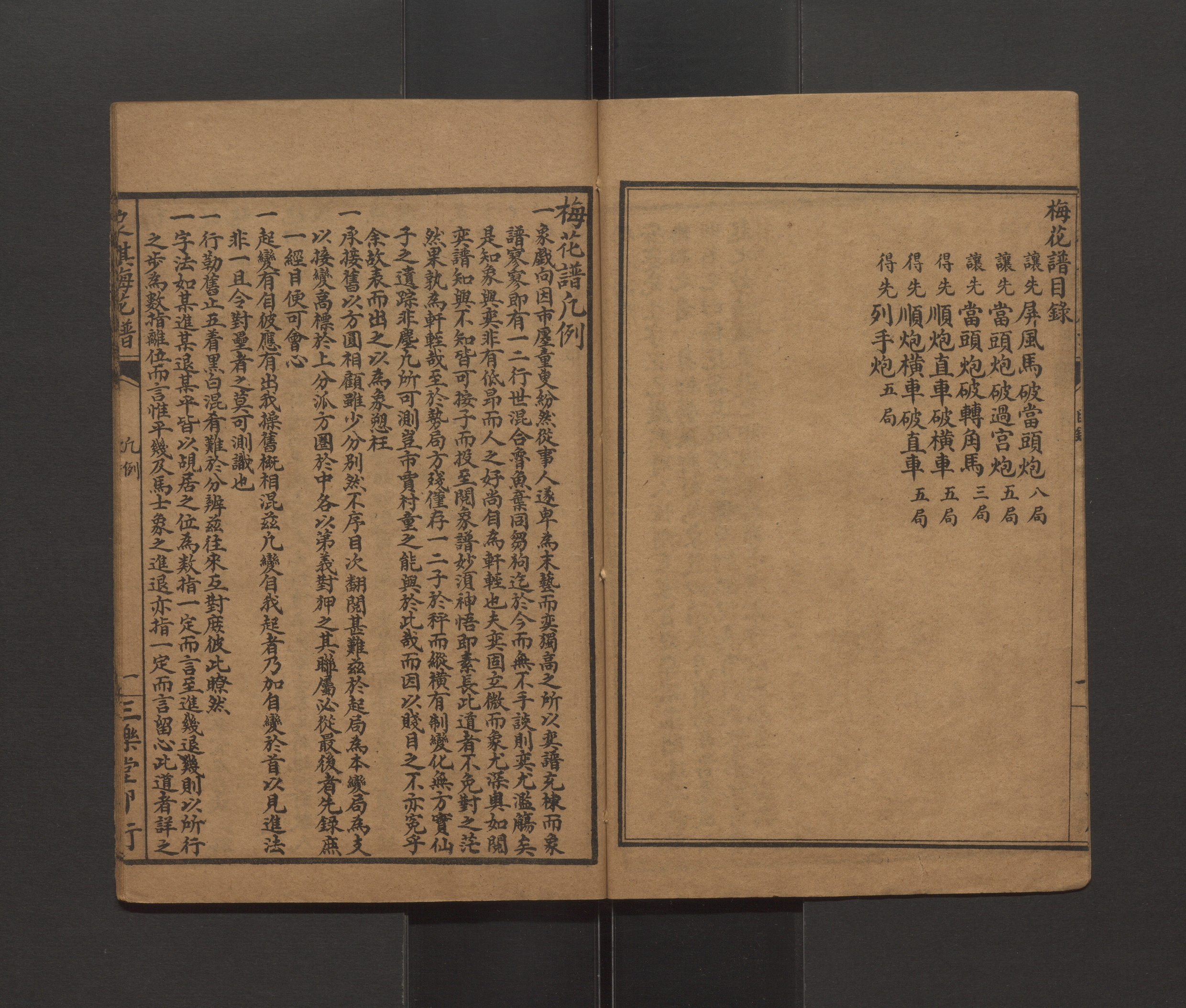
Xiangqi (象棋), or Chinese chess, is a game for two players, each commanding an army with a general to defend. The game is recognizable in the archaeological and literary record of the Song dynasty (960–1279).[2][3] Excavators have recovered complete sets of thirty-two pieces.[3][4] A Song poet describes two armies facing each other across a river and cautions against wasting the long-range cannon.[5] By the early fourteenth century a printed encyclopedia preserved games that can still be played through on a modern board.[6][7]
The term xiangqi is older than any surviving description of the familiar board. The Han commentator Wang Yi read it in a poem from the Warring States tradition as a reference to ivory gaming pieces.[8][9] A sixth-century emperor taught his court a game of symbols. A ninth-century storyteller imagined a battle in which horses moved obliquely and chariots drove straight ahead.[10][11][12] How these games were related to one another and to Indian chaturanga remains disputed. The surviving evidence establishes neither a single inventor nor a route of transmission.[13][14][15]
Excavators found wooden xiangqi pieces aboard a Southern Song ship in Quanzhou harbour.[16] Ming printers published mating problems and opening attacks. Qing players copied studies by hand, and in early twentieth-century Guangzhou a shoe mender made his living challenging passers-by to solve them.[17][18][19] Newspapers, public matches and national championships brought individual players to wider audiences.[20][21] Singapore hosted the first world championship in 1990, and Vietnam won its first men’s individual world title at standard time control in 2025.[22][23]
Before the familiar board
Ivory pieces and the name xiangqi

In “Summoning the Soul” (招魂), a poem in the Songs of Chu (楚辭), the speaker entices a wandering soul home with food, music, dancers and games. The line that later readers singled out puts xiangqi (象棊 in this text) alongside liubo (六簙). Players take sides and call out as the game turns in their favour. The Han commentator Wang Yi (王逸) understood the guests to be playing liubo with throwing rods and pieces made of ivory. Here xiang describes the material.[9] The poem describes the guests’ excitement and gives no moves by which the pieces could be identified.[8][26][13]
A tomb near Changsha gives that reading a physical counterpart. The inventory and contents of Mawangdui tomb 3 include a lacquered liubo board and six dark and six light ivory counters. Studies of early gaming equipment describe versions of bo in which a throw of rods determined how a player could move. A second early text, Liu Xiang’s (劉向) Garden of Stories (說苑), has a musician remind Lord Mengchang of his pleasure in playing xiangqi and watching dancers. Liu presented his collection in the first century BCE. Its speaker belongs to an earlier age, and the story records none of the game’s rules.[25][9][27][13]
The emperor’s game and the armies of the Tang
One early event can be dated closely. In the fifth lunar month of 569, Emperor Wu of the Northern Zhou completed a work called the Classic of Symbols (象經, Xiangjing) and summoned his officials to hear it explained. In his preface Wang Bao (王褒) enumerated twelve subjects, among them the heavens and earth, sun and moon, seasons, trigrams, civil and military stations, and standards of conduct. Yu Xin (庾信), writing a rhapsody for the occasion, pictured the sun, moon and colours of the four directions on the board. Here another meaning of xiang, an image or symbol, fits the language of the participants.[10][11][28][13]
Even a later imperial court had difficulty putting the work into practice. The New Book of Tang relates that Emperor Taizong could make little of it. An older official, Cai Yungong (蔡允恭), had once known something of the game but had forgotten much of it. The scholar Lü Cai (呂才) returned with a diagram which Cai recognized. Neither the diagram nor a complete set of playable rules accompanies the biography. Reading Wang’s preface alongside Yu’s rhapsody, Ji Benhan (季本涵) has proposed how movements might have been derived from the trigrams. The moves are a modern reconstruction.[29][13][30]
The armies in Niu Sengru’s (牛僧孺) story of Cen Shun (岑順) behave more like chessmen. A young scholar staying in a house hears drums by night and watches two armies form up. A commander gives the horse an oblique course and the chariot a straight one. A foot soldier advances a short distance. When Cen’s relatives investigate, they find an old tomb with a game board and metal figures. The tale sets this encounter in 762. It was written in the ninth century, and the excavation takes place inside the story. A contemporary poetic witness is Bai Juyi (白居易), who pictured a soldier bearing down on a chariot in xiangxi (象戲) in a poem about a games enthusiast.[12][31][13]
Where did chess come from?
Writers looking for an inventor drew on different traditions. Chao Buzhi (晁補之) invoked the Yellow Emperor and his animal battle array. A Yuan Buddhist chronicler associated an older celestial game with the culture hero Shennong and credited Niu with substituting military pieces. The modern scholar Hu Shi (胡適) used that chronicle to propose a revision in 839, possibly after a game had reached China from India or Persia. The chronicle was written centuries after Niu, whose own tale gives no such account of his work.[32][33][34][12]
H. J. R. Murray compared the pieces themselves. Working inward from a back corner, he found chariots, horses, elephants and counsellors in corresponding positions in Indian chess and xiangqi. He argued for descent from Indian chaturanga.[14][35] Seventh-century India also supplies a literary clue. Bāṇa praised the peace of King Harsha’s reign by saying that armies learned their formations only on the aṣṭāpada, a board of sixty-four squares. Michael Mark read this as an allusion to chess in light of the game’s spread beyond India. Bāṇa gave no rules or account of its travels.[15]
Joseph Needham proposed a journey in the other direction. He suggested that Emperor Wu’s celestial game grew out of divination and reached India, where its pieces became two armies. Mark accepted the link between Wu’s game and divination but found no corresponding evidence tying the Indian war game to that practice.[36][15] An essay published by the Jining Museum traces a different Chinese ancestry through liubo, sai (塞), Wu’s game and the military game of the Tang. Its author acknowledged the gaps in excavated equipment between those stages.[37] Other East Asian games share some features with xiangqi. Korean janggi has intersections and cannons. In Japanese shogi pieces occupy squares, and a player can return a captured piece to the board on their own side.[38][13]
The game in Song China
Several games on the same shelf
In the eleventh century, xiangxi could still mean quite different games. Chao Buzhi remembered watching people set out pieces as a boy. The game he subsequently described had two armies and thirty-two men, familiar numbers to a modern player, but its board had eleven lines in each direction. Chao found it cramped. For his Expanded Game of Symbols (廣象戲) he proposed nineteen lines each way and ninety-eight pieces. The bibliographer Ma Duanlin (馬端臨) also listed diagrams by Yin Zhu (尹洙) and a seven-state game associated with Sima Guang (司馬光).[32][39]
Sima’s rules turn the Warring States into a game for a tableful of guests. Seven players could each conduct a state of seventeen pieces. The yellow piece for the Zhou sovereign stood alone at the centre, immune from attack. There were rules for alliances when fewer guests played, and a diplomat who could neither take nor be taken. One rule would be immediately familiar to a xiangqi player. A cannon could capture along a line only with exactly one piece between it and its target. This particular cannon rule thus appears in a game with seven armies as well as in the later two-player tradition.[40][41]
What survives of the two-player game

Cao Xun (曹勳) recounted an omen concerning Zhao Gou (趙構), the Prince of Kang, who became Emperor Gaozong in 1127. His mother, Lady Wei, marked a general for her son and cast the pieces onto a board. The marked piece alone landed in the nine-point palace, a sign that the prince would take the throne.[44][20] Cao told the story twice. His account of captivity places it on the journey north. His inscription for a painted cycle of twelve auspicious signs sets it outside the fallen capital. The casting is the seventh scene.[42][45][43]
The paintings and inscriptions took shape after Gaozong’s abdication, decades after the events they depict. Yu Yunguo dates the cycle to 1171–74 and reads it as publicity for the restored dynasty. Luo Chaohua questions whether the emperor commissioned it, observing that no order for the work has been found. The scene shows how a xiangqi player’s familiar palace could make an accession story legible to a later audience.[42][46]
Liu Kezhuang (劉克莊), in a Southern Song poem addressed to a fellow player, describes an ordinary contest. He sets two camps of thirty-two pieces in all on opposite sides of a great river, warns against firing the long-range cannon in vain and teases his friend about giving away the first move and asking for a rematch.[5]
The surviving pieces vary in material, lettering and even the titles assigned to each side. A ceramic set, copper-alloy pieces from two inland sites and wooden pieces from a seagoing ship preserve different parts of that history.[3][47][48][4]
| Place and find | What the pieces preserve |
|---|---|
| Luoyang, Henan. Ceramic set excavated in 1997. | A complete Northern Song set of sixteen pieces to a side. The dark and light discs have incised lettering. Both commanding pieces bear jiang (將, general) and the soldiers of both armies bear zu (卒).[47] |
| Jiangyou, Sichuan, and Diaoyucheng, Chongqing. Copper-alloy pieces. | A Song find at Jiangyou in 1983 contained all thirty-two pieces, including, for each side, a general, five soldiers, and two each of the advisors, elephants, horses, chariots and cannons. At Diaoyucheng archaeologists identified a horse, cannon and soldier from one site and a smaller general at another. The cannon carries the stone radical in pao (砲), a spelling also used of stone-throwing artillery.[26][4] |
| Houzhu harbour, Quanzhou, Fujian. Wooden pieces from a Southern Song seagoing ship excavated in 1974. | Twenty pieces survived. Three styles of lettering indicate at least three sets aboard. A dark piece bears shuai (帥, marshal), a title found on the red general today. The red pieces include jiang. Five of the ship’s pieces were exhibited in Singapore in 2012.[16][48][2] |
The river and the people who played
The river acquired a historical geography. The Northern Song thinker Cheng Hao (程顥) wrote of soldiers crossing a river, a general in the centre and, at the close, the rivalry of Liu and Xiang. These were Liu Bang (劉邦), founder of the Han dynasty, and Xiang Yu (項羽) of Chu. In their war the two agreed in 203 BCE to divide territory at the Honggou canal near Xingyang, Han to the west and Chu to the east. The familiar inscription Chu he, Han jie (楚河漢界, “Chu River, Han Boundary”) evokes that division. Cheng’s poem shows the association in a Song player’s imagination. It does not tell us when the four characters began to be printed on boards. The 2020 Chinese competition rules explicitly prescribe them.[49][50][51][2]
In the Southern Song capital of Lin’an, present-day Hangzhou, both the marketplace and the court supported the game. Zhou Mi’s (周密) recollections of the capital list boards and pieces among the small trades, and name xiangqi among goods that included kites, hunting arrows and dice. His roster of players available for court service preserves personal names as well as kinds of play. It identifies a woman called Shen Gugu (沈姑姑) as a xiangqi player and also marks Lady Shangguan (上官夫人) with the character for the game.[52][53]
The earliest surviving playable scores

Books devoted to xiangqi were known by the Southern Song. In his catalogue of books, Chen Zhensun (陳振孫) listed a one-volume Xiangqi shenji ji (象棋神機集) under the name of Ye Maoqing (葉茂卿). The entry preserves its title and extent. For moves that a player can set out on a board, the early surviving witness is a different work, a household encyclopedia.[56][6][7]
Chen Yuanjing (陳元靚) compiled Shilin guangji (事林廣記) in the Southern Song. It set games alongside such subjects as astronomy, geography, food and etiquette. Its original printing has been lost. Later publishers added and removed material. One surviving Yuan text teaches the pieces through rhyme. The general goes one step within the nine-palace, the advisor goes diagonally within it, the chariot runs along a rank or file, and the cannon requires an intervening piece to capture. Other entries give pieces point values, list named positions and offer maxims for play.[6][41][20]
The Xiyuan Jingshe (西園精舍) printing of the Zhishun era, 1330–1333, gives two openings and an endgame. The latter is “Double Dragons Out to Sea” (二龍出海勢). Its woodcut shows the divided river, nine files, ten ranks and crossed palace lines. The National Palace Museum in Taipei holds another printing of the encyclopedia from the same era, issued by a different publisher. Its leaves measure only about 17.3 by 10.5 centimetres. Its recreation entries covered both xiangqi and go.[6][54][55][57]
The two opening games begin with both players putting a cannon on the centre file. From the centre file a cannon can threaten the opposing central pawn, using its own pawn as the screen. One answers from the same side of the board, the other from the opposite side. The old score numbers the files from one player’s side for both armies. Modern notation counts each player’s files from that player’s right. The old text also calls the sides White and Black. In the nine-move Same Direction Cannons study below the first player’s chariot crosses the river and changes files repeatedly. The score stops with the opposing horse giving check on move nine. Cheng Mingsong’s edition says the second player wins a chariot from this position. The modern transcription shows the first player as Red. The first move, C2=5, takes the cannon from the second file across to the fifth. The reply, c8=5, brings the opposing cannon to the same file.[20][7][55]
Same Direction Cannons in Shilin guangji, 1330–1333
Loading xiangqi example…
The Ming manuals and the people behind them
The earliest Ming manuals have uneven histories. Baibian xiangqi pu (百變象棋譜, “A Hundred Transformations”) is associated with a printing of 1522. Yang Baiwei (楊柏偉), who studied the old editions, distinguished that date from the surviving impressions taken from Ming blocks during the Qing. The work transmits seventy positions. The author and publication date of Mengru shenji (夢入神機, “Divine Ingenuity in a Dream”) are harder to establish. Its surviving fragments show how easily the record could have vanished.[58][59][60]
On 26 August 1949, in the market town of Duliu near Tianjin, Zheng Guojun (鄭國鈞) and his cousin Li Baolin (李寶林) rescued pages a merchant was using to wrap goods. They recovered 285 diagrams. Each surviving half-page showed a position, its title and a hint, but no sequence of moves. Zheng set aside 126 diagrams that also appeared in Shiqing yaqu (適情雅趣, “Elegant Pastime”). He sent the remaining 159 to Lin Youru (林幼如), editor of a xiangqi monthly in Fuzhou. Lin recognized fifteen further duplicates, leaving 144 positions. A modern edition with reconstructed play appeared in 1983, followed by a book in 1985.[60][59]
A poem gives a glimpse of where such material circulated before it was bound in books. In 1554 Liu Hui (劉繪) addressed a long xiangqi poem to Cao Qi (曹起) of Guangping. Cao travelled for play and made his living at games for stakes. The account associates him with the scholar and dramatist Li Kaixian (李開先), who passed on three hundred endgame positions to him.[61]
In 1570 Xu Zhi (徐芝) of Nanjing and his reviser Chen Xueli (陳學禮) brought out Elegant Pastime in ten juan, or book divisions. A reader could set up one of more than five hundred positions, attempt the win, turn to its solution, or play through studies beginning with two full armies. The first six divisions give the diagrams, the seventh and eighth their solutions, and the last two full-game material from the Eighteen Variations of the Golden Roc (金鵬十八變). The printing preserved enough of that material for players four centuries later to recognize diagrams among Zheng’s fragments.[17][20][55][60]

Opening analysis also circulated outside specialist books. The 1596 Wanshu cuibao (萬書萃寶) and the 1597 Five Carts of Brocade (五車拔錦) printed xiangqi material among the practical knowledge offered to their readers. The latter includes a study with the two horses deployed to defend the centre, the formation now called Screen Horses. Here the horses’ side has the first move. The later association of this opening with a famous Qing manual can obscure its place in Ming print.[63][62][64]
In 1632, Zhu Jinzhen (朱晉楨) dated the preface to Secrets Inside the Orange (橘中秘). The title recalls another story transmitted under Niu Sengru’s name. Two enormous oranges are opened to reveal a pair of old men playing inside each fruit. Zhu’s secrets are practical ones. The manual groups full-game examples by who moves first and by handicaps, including the concession of one or two horses. It also contains 140 endgame positions. In his editorial rules Zhu acknowledges that some weak replies were chosen to bring out a good continuation. An annotated victory could serve as a lesson even when the opponent had a better defence.[65][66][20]
The thirteen-move horse sacrifice opens Zhu’s full-game studies. In another Same Direction Cannons opening, the first player lifts a chariot off the back rank, sends it deep into the opposing camp and allows the other side to take a horse with 6... c2+7. The attack brings both chariots and both cannons into play before 13. C8=5 gives checkmate. The entire model game fits on a short printed score.[66][55]
The thirteen-move horse sacrifice, 1632
Loading xiangqi example…
Qing manuscripts, openings and composed endings

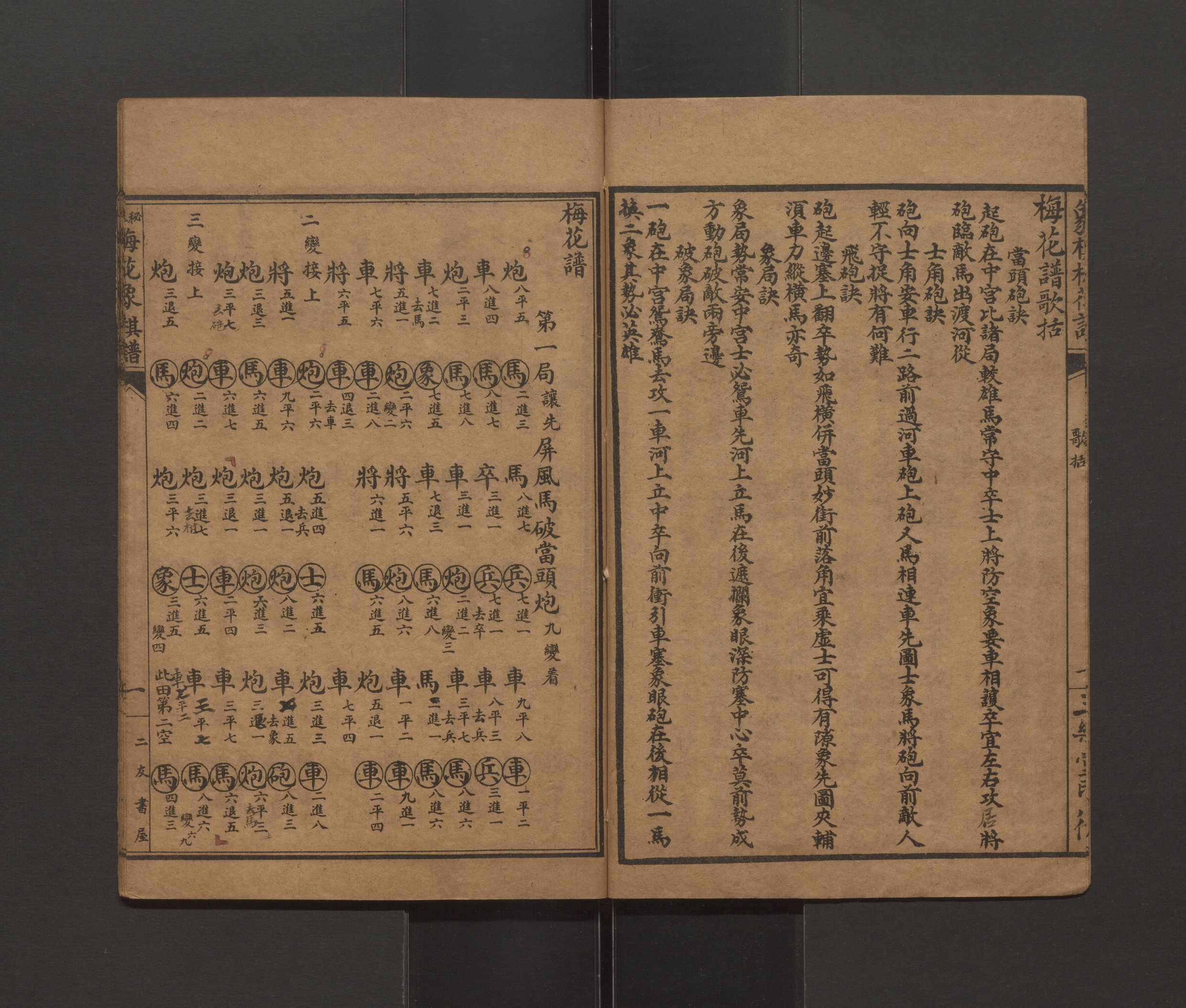
The Plum Blossom Manual (梅花譜) is attributed to Wang Zaiyue (王再越), whom its preface places in the Kangxi reign (1662–1722). Its best-known sequence reverses the perspective of Zhu’s attacking lessons. In eight studies the second player answers the Central Cannon with Screen Horses and plays for a counterattack. Wang also studied the cannon side of other openings. The surviving 1917 printing contains thirty-one studies in six divisions. Players had copied the book by hand, sometimes encoding moves with the characters of verses. The copies left later editors with competing readings of individual moves.[64][67][20]
In the first study the cannon side sends a chariot to the riverbank to take a pawn. The defender uses the time to bring a horse toward the palace and activate a chariot. The main line runs to 19... r4-3, when the responding player captures the opposing chariot.[64] The historian Lü Simian (呂思勉), who collated an edition, questioned whether the author had given the losing side its strongest defence.[67]
Screen Horses in the first Plum Blossom Manual study
Loading xiangqi example…

A folding board in the National Palace Museum, Taipei, preserves another side of Qing play. One face carries a gold-painted grid and river. On the reverse is a painting on silk of birds, flowers and a pond, signed by the Jesuit court painter Giuseppe Castiglione (郎世寧) and inscribed with a verse by Liang Shizheng (梁詩正). The board fits above a box of thirty-two jade pieces, half white with red lettering and half green with gold.[68]
The endgame developed a literature of its own. A practical ending asks, for example, whether the remaining pieces can force a win. A composed position, or paiju (排局), can begin with a sequence of apparent winning chances before it resolves into a familiar ending or a draw. Taolüe yuanji (韜略元機), published in 1707, already gave considerable space to draws. In the Jiaqing reign, Xue Bing (薛丙) published Xinwu canbian (心武殘編) in 1800. A Hundred Games (百局象棋譜) followed in 1801 and Bamboo Fragrance Studio (竹香齋象戲譜) in 1804, with an expanded edition in 1817. A reader comparing two collections could find the same position under another name, with an extra defence or a correction many moves into the solution.[69][58]
In 1853 Han Yingbi (韓應陛) described finding a printed copy that Xue had annotated in the margins and between lines, together with manuscripts and slips of paper. Some moves had been copied into the book, some crossed out, others left loose. Han preserved the alternatives and marked where they came from.[18] Another large collection, Chen Wenqian’s (陳文乾) Yuanshen haikuo (淵深海闊, “Deep as an Abyss, Wide as the Sea”), remained in manuscript after its completion in 1808. In 1933 Qian Mengwu (錢夢吾) put up a hundred silver yuan to borrow the book overnight. With help he copied more than a hundred positions. Qian published selections in newspapers. Three decades later Liu Guobin (劉國斌) obtained the complete manuscript by putting up a wristwatch as security. His annotated edition with Zhu Baowei (朱寶位) brought all 371 studies into print in 1988.[58][70]
Collections associated with Wu Shaolong (吳紹龍) and with players surnamed Shi and Yang preserve encounters from the Qianlong and Jiaqing periods.[58] In May 1687 Shen Fuzong (沈福宗), a visitor from Nanjing, wrote to the Oxford scholar Thomas Hyde to identify the characters che (車, chariot) and ma (馬, horse). Hyde questioned him further. His Latin book De ludis orientalibus, published in Oxford in 1694, brought an account of Chinese chess to European readers.[71][72]

In Canton in 1793, Pan Zhenguan (潘珍官) brought Eyles Irwin a board and pieces and taught him the game. Irwin called the cannon a “rocket-boy” and explained to the Royal Irish Academy how removing the intervening piece could save a man under attack. Pan also supplied a Chinese account that credited the Han general Han Xin (韓信) with inventing the game for homesick soldiers in winter quarters. The letter preserves a lesson given in Canton and a legend told there. Scholars have been unable to identify the earlier work from which Pan said he took the story.[73][15] A century later W. H. Wilkinson drew on Zhu’s Secrets Inside the Orange for his English-language Manual of Chinese Chess, printed in Shanghai in 1893.[74][14]
From street challenges to regional championships
A problem stall in Guangzhou
In early twentieth-century Guangzhou, a player could earn a living at the edge of a street or in the garden of a teahouse. Feng Jingru (馮敬如), originally a shoe mender, set out problems including “Seven Stars Gather” (七星聚會) for challengers. He would also play a full game. In the garden of the Pianpian teahouse, the proprietor erected a shelter for players. When the first shelters filled up, more were built alongside them. Feng became one of the regular attractions. In 1930 he and Li Qingquan (李慶全) represented the south in a drawn contest with players from eastern China in Hong Kong.[19][69]
“Seven Stars Gather” opens A Hundred Games. Each side begins with seven pieces. Red has two chariots and a cannon, while four black soldiers have crossed the river, three of them already inside Red’s palace. Red opens by giving up the cannon. By the end of move six in the replay, both sides have a chariot and two pawns. Black also has an elephant. The Qing collection treated the position as a draw and gave twenty-five lines of play. The replay follows one twenty-seven-move line. At 5. R2=5, Red even offers a chariot to a soldier, clearing a path for the red general to advance out of immediate danger.[75][76]
Seven Stars Gather, a drawn line from A Hundred Games
Loading xiangqi example…
Print, clubs and touring players

In Shanghai, Xie Xiaxun (謝俠遜) worked on the Shishi xinbao (時事新報) from 1916 and edited newspaper xiangqi columns. He used his contacts with players and collectors to obtain and compare manuscripts and publish old works together in his Xiangqi pu daquan (象棋譜大全). His memoir describes the search for copies of the Plum Blossom Manual. In November 1926 an advertisement in Xueheng offered four volumes for three yuan and listed their contents, including the Plum Blossom Manual. A book that had once passed between players in manuscript could now be ordered from a commercial publisher.[78][79][77][20]
Copies of Xie’s collection reached Lanzhou in northwestern China. A Gansu biography records that when a visitor brought the book to Peng Shusheng (彭述聖), Peng pointed out errors. In 1932 he and Wang Hesheng (王和生) opened a xiangqi study room in Lanzhou’s City God Temple, where newcomers could learn from local players.[80]

The Singapore Xiangqi General Association dates its founding to 1934. A photograph from Xie’s 1935 tour shows the local Chinese chess association welcoming him beneath a dated banner.[82][81] Xie travelled again during the war against Japan. In Hong Kong, Singapore, Malaya and elsewhere, he played benefit matches and appealed to overseas Chinese communities for support.[78]
Taiwan, Hong Kong and Vietnam
In Taiwan under Japanese rule, the newspaper Taiwan xinminbao (臺灣新民報), the Central Bookstore and the associations around Lin Hsien-tang (林獻堂) helped sustain an all-island competition. There was a tournament each year from 1933 to 1936. Organizers invited mainland player Lin Yixian (林奕仙) to visit. When Lin Hsien-tang left Taiwan in 1937, the series lost the person who had brought these circles together. Across the South China Sea, a northern championship was held in Hanoi in 1932 and a southern one in Saigon in 1933. Vietnam’s first nationwide championship followed much later, at Đà Nẵng in 1992.[83][84]
In Hong Kong, Li Zhihai (李志海) made a point of reaching people beyond the playing room. He broadcast on Rediffusion and wrote for Sing Tao Daily. The association he helped register in 1952 initially had a little over twenty members. Its bulletin, first issued on 1 April, sent match scores, new openings and practical endings to members and correspondents overseas. For the 1954 Hong Kong–Macao invitational, the Lin Heung Teahouse opened three floors. Li remembered all the seats taken early and spectators leaning against the stair rails to watch. In 1956 visitors from Taiwan played in a public exhibition on four large boards.[85]
National competition in China
Rules for a common tournament
Competitive play called for rules on time limits and repeated checks or attacks. For a Shanghai city tournament in 1950, Tu Jingming (屠景明) compiled regulations that addressed such disputes and allowed two minutes per move, with three five-minute extensions at the player’s discretion.[86] In 1956 the state sports authorities recognized xiangqi as an official sport and issued national competition rules. Thirty players met in Beijing that December under rules requiring them to use clocks and record their moves. Guangzhou’s Yang Guanlin (楊官璘) finished first and Harbin’s Wang Jialiang (王嘉良) second. The Chinese Xiangqi Association was founded in November 1962.[86][21][87]
The 1956 code gave Black the first move. The national rules changed to Red first in 1980. They also evolved in matters spectators could barely see. Sealed moves could once be used to adjourn play. The 1999 revision abolished them and required the player to move a piece and press the clock with the same hand. The rulebook specifies a board of ninety intersections with two palaces and sixteen pieces of seven kinds in each army.[86][2]
Players and spectators
In Beijing in 1960, the Shanghai schoolboy Hu Ronghua (胡榮華) defeated Yang on his first appearance at the national championship. Hu had studied Yang’s games against Wang Jialiang. According to a contemporary account, he advanced a pawn to deny Yang a favourite cannon position, then allowed a cannon to be taken to tie down the opposing wing. He went on to win the title. Hu and Xu Tianli (徐天利) later annotated the game. The replay follows the Dongping tournament score through 76... r1=4. The digital transcription of Hu and Xu’s annotation reaches the same finish on move 78. It includes a four-ply repetition by a horse and chariot in the middle of the game. Yang has the first move and Hu the second, displayed in today’s colours.[88][89][90][86]
Yang Guanlin–Hu Ronghua, Beijing, 1960
Loading xiangqi example…
Hu won each of the ten editions held from 1960 through 1979, sharing first place with Yang in 1962. After the Cultural Revolution began in 1966, national competition and xiangqi periodicals stopped. People continued to play in the streets, sometimes with political slogans printed on the board or box. The national individual event resumed in Chengdu in 1974. Hu’s fourteenth and last title came in 2000, at age fifty-five.[91][92][93][94]
In 1970s Guangzhou, a city competition at Zhuji Road Primary School led the coach Chen Songshun (陳松順) to open a playing room there. Among the players he noticed was eight-year-old Huang Yuying (黃玉瑩). She, Huang Zijun (黃子君) and Ma Jing (馬靜), pupils at three different schools, joined the city’s youth training class.[95] At the 1979 National Games, women contested their own individual title for the first time. Eight players made the final field and played seven rounds. Huang Zijun won. When national team competition for women began in 1982, she and Huang Yuying played for Guangdong.[96]
Public tournaments retained something of the teahouse. At the Five Rams Cup (五羊杯), founded in January 1981, former national champions played on a stage in Guangzhou’s Cultural Park while people below worked out the moves together. The event reached its twenty-ninth edition in 2009. Writers also brought the experience of following a player into print. Hu recalled his friendship with the martial-arts novelist and xiangqi writer Liang Yusheng (梁羽生). In A Cheng’s (阿城) 1984 novella The King of Chess (棋王), Wang Yisheng (王一生), a youth sent to the countryside during the Cultural Revolution, learns from an old man who collects waste paper. On the train taking the young people away, Wang is already looking for someone to play.[97][98][99][100]
A national team league offered another kind of season. Shanghai won the first top-flight league in 2003.[101] Ten teams qualified for the inaugural women’s top league in 2013–14. Its rules let a player sign for a club while keeping her provincial registration for the national championships.[102] In 2008 China also placed xiangqi on its national list of intangible cultural heritage, in the category of traditional sports, amusements and acrobatics.[103]
In September 2024 the Chinese Xiangqi Association announced lifetime bans for Wang Tianyi (王天一) and Wang Yuefei (王躍飛) over the manipulation of games.[104] In January 2025 the association disciplined a further 41 people. Three, including Zhao Xinxin (趙鑫鑫), received lifetime bans, 34 received suspensions and four received reprimands.[105] In April 2026 it announced further sanctions, including lifetime bans for Hong Zhi, Xie Jing (謝靖) and Xu Chao (徐超) in competitions and activities organized or authorized by the association and its members.[106]
An international game

In Vietnam the game is cờ tướng, the “game of generals”. At the Chùa Vua festival in Hanoi, play is associated with Đế Thích, revered there as a divine master of the game. In one form spectators watch moves relayed from a small board to a large one using pieces on sticks. In cờ người, or human chess, thirty-two people take the places of the pieces and enact the contestants’ moves. For the Lunar New Year festival in 2019, sixty-four players registered and matches were timed. Village celebration and tournament practice could share the same ground.[108][109]
Singapore hosted a Southeast Asian championship in 1968 and helped establish the Asian Xiangqi Federation in 1978. International organizers faced a question about the equipment itself. Would picture symbols make the game easier to learn for people who did not read Chinese? In Bangkok in 1981 the Asian federation approved a set drawing on designs by Singapore’s Mao Ruifa (毛瑞發). After debate, an April 1982 communiqué withdrew the adoption and kept the character pieces for official competition. The pictorial designs retained a role in teaching. In Europe, players who had arrived from China and Vietnam helped establish clubs and tournaments. France’s Taing Hao Yen won the first European championship in 1984. In Berlin in 1987, Hu Ronghua and the German chess grandmaster Robert Hübner met over both a xiangqi board and an international chessboard.[82][110][111]
The first world championship took place in Singapore in 1990. China’s Lü Qin (呂欽) won the men’s individual title, ahead of Hu Ronghua and Chinese Taipei’s Wu Kuei-lin (吳貴臨).[22] Singapore’s Teo Sim Hua (張心歡) and China’s Huang Yuying each won five rounds and drew one in the women’s event. Teo took the title on total game points.[112][113] The tournament preceded the establishment of the World Xiangqi Federation in Beijing in 1993.[82][114] Clubs also built a North American circuit. The North American federation’s constitution lists Canadian and United States member organizations and provides for a North American Cup in even years and a Masters Cup in odd years.[115]
In 2009 China’s sports administration shortened the official Chinese name of the sport from Zhongguo xiangqi (中國象棋) to xiangqi (象棋) and adopted Xiangqi as its English name.[116] Xiangqi entered the Asian Games in Guangzhou in 2010. Hong Zhi (洪智) and Tang Dan (唐丹) won the individual gold medals.[117][118]
In 2017 the World Xiangqi Federation agreed to draw up a common rulebook based on the fourth revision of the Asian rules. Its bilingual edition credited Hong Kong’s Li Zhihai for his work on the rules and Png Hau Cheng for the English translation. The 2018 Asian championship in Shanghai was the first official tournament to use it.[114][119]
When xiangqi returned to the Asian Games at Hangzhou in 2023, mixed teams of two men and one woman competed as well, and China beat Vietnam in the final.[117][118] At the 2025 world championships in Shanghai, Lại Lý Huynh of Vietnam defeated China’s Yin Sheng (尹昇) playing second in the standard-time final. It was Vietnam’s first men’s individual world title at that time control. Tang Dan won her fourth women’s world title.[120][23] In November 2026 Singapore hosted the World Open, World Youth and World Rapid championships together, drawing 247 players representing seventeen associations across the three events.[121]
Computers, books and the street board

Computers changed who could supply an opponent and who could check a published solution. Early programs included Jiangzu (將族) and ELP (Elephant) in Taiwan. Online services such as QQ Games and Tiantian Xiangqi (天天象棋) subsequently let people play at a distance. In 2006 grandmaster Xu Yinchuan (許銀川) met the program Qitian Dasheng (棋天大聖) on Inspur hardware in Beijing. Both games were drawn. The computer offered the first draw and Xu the second.[123][124]
Endgame databases brought a new method to a question that Xue Bing and his readers had pursued by hand. For a given small set of pieces, a program can start with the positions where play ends and work backwards to determine which positions win, lose or draw. In 2019 Li Xusheng (李旭昇) reported positions requiring more than 450 moves for a win against best resistance, well beyond the move limits used in competition. A database could establish what a material advantage was worth even where a player could never demonstrate the win within tournament rules.[125][69]
Digital analysis also found its way back into print. For their 2012 edition of Chen Wenqian’s two-hundred-year-old Yuanshen haikuo, Wang Shoucheng (王首成) and Bai Hongkuan (白宏寬) describe checking variations with software and comparing suggestions from other players. A single study, “Five Tigers Descend the Mountain” (五虎下川), was discussed for more than a year in an online endgame column. Wang and Bai incorporated the results into a printed edition, continuing a discussion that had begun in handwritten copies.[70]
References
- ↑ Gary Lee Todd, photograph of Song-dynasty xiangqi pieces, Luoyang Museum (2008). File description, date and licensing. Photograph and licence.
- ↑ a b c d Chinese Xiangqi Association, Chinese Xiangqi Competition Rules (象棋競賽規則), 2020 edition. Articles 1–3, grid, river inscription, piece names and movement. Official rules.
- ↑ a b c Zhao Kai (趙凱), “新中国成立以来出土象棋探析”, 黄河·黄土·黄种人 (2022), no. 3. Section 1 and table 1 introduction. Read the source.
- ↑ a b c Chongqing Daily, interview with archaeologist Zhao Zhenjiang (趙振江), “宋代象棋是什么样?钓鱼城出土了4枚” (25 December 2024). Fanjiayan and Dacaofang sites, pieces, spellings and comparison with Jiangyou. Read the source.
- ↑ a b Liu Kezhuang (劉克莊), “A xiangqi poem for Ye Qianzhong” (象弈一首呈葉潛仲). Opening deployment, “三十二子”, distant cannon, concession of first move and rematch. Read the source.
- ↑ a b c d Weiceng (未曾), Shuge, facsimiles and edition descriptions of Shilin guangji. Yuan Zhishun Xiyuan jingshe edition, and 1492 edition. Edition descriptions and facsimiles.
- ↑ a b c Cheng Mingsong (程明松), ed., Zhongguo xiangqi pu daquan (中國象棋譜大全), Shurong Qiyi, 1997, 2003 printing. pp. 1–3, Yuan introduction and both scores. Link identifies the 2006 reprint. Edition record for the reprint.
- ↑ a b Songs of Chu (楚辭), “Summoning the Soul” (招魂). Stanza inviting the soul back to a feast, after the dancers and before the bells. Original text.
- ↑ a b c Huang Ruxuan (黃儒宣), “左冢棋局及博塞遊戲相關問題探究”, Bulletin of the Institute of History and Philology 93.2 (2022). pp. 273–274, 301–302 (Wang Yi’s gloss and the tomb inventory) and the discussion of casting implements. Full text.
- ↑ a b Linghu Defen (令狐德棻) and others, Book of Zhou (周書). Juan 5, annals of Emperor Wu, Tianhe 4, fifth month. Original text.
- ↑ a b Wang Bao (王褒), preface to the Xiangjing (象經序), preserved in Yiwen leiju (藝文類聚). Juan 74, 象戲, the twelve subjects. Original text.
- ↑ a b c Niu Sengru (牛僧孺), “Cen Shun” (岑順), from Xuanguai lu (玄怪錄), preserved in Taiping guangji (太平廣記). Juan 369, the battle order, excavation in the story, and final dating. Original text.
- ↑ a b c d e f g Peter Banaschak, “Facts on the Origin of Chinese Chess (Xiangqi 象棋)”, based on a paper delivered at the 1997 IGK symposium. Sections on Chu ci, Shuo yuan, the brocade and the conclusions. Full text.
- ↑ a b c H. J. R. Murray, A History of Chess, Oxford University Press, 1913. Chapter VII, “Chess in China, Corea, and Japan”, opening discussion of shared pieces and cultural contact, and p. 125 on Wilkinson’s manual. Full text.
- ↑ a b c d Michael Mark, “The Beginnings of Chess”, in Irving Finkel, ed., Ancient Board Games in Perspective (British Museum Press, 2007). Pp. 139–40, 146–47 and 153–55, on Bāṇa’s allusion, the Han Xin story and divination. Read the source.
- ↑ a b Quanzhou Maritime Museum, presentation on the Southern Song ship, CCTV, 16 May 2025. Houzhu harbour ship, excavation and onboard finds. Read the source.
- ↑ a b Xu Zhi (徐芝), compiler, and Chen Xueli (陳學禮), reviser, Shiqing yaqu (適情雅趣), 1570. Preface, opening verse and first full-game study in Cheng Mingsong, ed., Zhongguo xiangqi pu daquan, pp. 28–33. Edition record for the anthology.
- ↑ a b Han Yingbi (韓應陛), preface to the revised Xinwu canbian (重訂心武殘編序), 1853. Account of Xue Bing’s annotated print and loose handwritten slips. Original text.
- ↑ a b Shenzhen Qiguo Xiangqi Museum, biography of Feng Jingru (馮敬如). Biography, passages on street stalls, the Pianpian teahouse and the 1930 Hong Kong match. Read the source.
- ↑ a b c d e f g h i j Ji Benhan (季本涵), “长三角象棋活动史论纲” (2019). Chs. 1–4, particularly the 1127 omen, Yuan recensions, Ming printing and manuscript transmission. Full text.
- ↑ a b People’s Daily (人民日報), national xiangqi championship final report, 28 December 1956. Beijing competition, closing paragraph naming first six. Read the source.
- ↑ a b World Xiangqi Federation, past world championship results, 1990–2022. First edition, Singapore 1990, individual men, women and team columns. Official standings.
- ↑ a b Vietnam News Agency, “Vietnam wins its first standard individual title at the world xiangqi championship”, 2025. Shanghai final and place in Vietnamese competition history. Read the source.
- ↑ David Schroeter (drs2biz), A Set of Liubo Chess, Hunan Museum, photograph taken 17 August 2006. Photographer’s Flickr record of the Hunan Museum exhibit and Wikimedia Commons licence review. Photograph and licence.
- ↑ a b Wang Chuning (王楚寧), “大英博物館藏六博俑新探”, Fudan University Center for Research on Chinese Excavated Classics and Paleography. Section on Han gaming equipment, Mawangdui tomb 3 and Fenghuangshan tomb 8. Read the source.
- ↑ a b Academy of Chinese Studies, “故宮內的非一般中國象棋”. Sections on early references, Northern Zhou and Song bronze sets. Read the source.
- ↑ Liu Xiang (劉向), Shuo yuan (說苑). Juan 11, “Good persuasion” (善說), Yongmen Zizhou and Lord Mengchang. Original text.
- ↑ Yu Xin (庾信), “Rhapsody on the Symbol Game” (象戲賦), preserved in Yiwen leiju. Juan 74, 象戲, the rhapsody immediately following Wang’s preface. Original text.
- ↑ Ouyang Xiu (歐陽修) and others, New Book of Tang (新唐書). Juan 107, biography of Lü Cai (呂才). Original text.
- ↑ Ji Benhan (季本涵), “A new investigation into the origins of xiangqi” (象棋探源新論), Hangzhou international chess culture symposium, 2014. Part I, readings of Wang Bao and Yu Xin, and Part II, Northern Song forms. Full text.
- ↑ Bai Juyi (白居易), “Twenty Poems on the Depth of Spring” (和春深二十首). Poem on the house of a games player, lines on pitch-pot and xiangxi. Original text.
- ↑ a b Chao Buzhi (晁補之), preface to Guang xiangxi tu (廣象戲圖), quoted in Ma Duanlin’s Wenxian tongkao (文獻通考). Juan 229, 廣象戲圖. Original text.
- ↑ Shenzhen Qiguo Xiangqi Museum, “象棋的历史起源” (2021). Origins traditions, items 1–4. Read the source.
- ↑ Hu Shi (胡適), “考作象棋的年代”. Opening and argument from Nianchang’s Buddhist chronicle. Original text.
- ↑ Jim Png Hau Cheng (方浩鑒), “探讨穆瑞于1913年《棋史》中,针对象棋的描述”. pp. 2–4, on H. J. R. Murray and shared pieces. Full text.
- ↑ Joseph Needham, “Thoughts on the Origin of Chess” (1962). Opening three paragraphs on Emperor Wu’s game, divination and India. Read the source.
- ↑ “Collecting and studying early xiangqi equipment” (中國古代象棋具收藏與欣賞), Jining Museum, 28 April 2021. Opening discussion of the proposed liubo–sai–xiangxi succession and limits of archaeological evidence. Read the source.
- ↑ Zhang Chaoying (張超英), “日本将棋史著作所见中国象棋相关述录” (2020). Comparison with Korean and Japanese games and the Kōfukuji finds. Full text.
- ↑ Ma Duanlin (馬端臨), Wenxian tongkao (文獻通考). Juan 229, entries 象棋 and 溫公七國象棋, reproducing earlier catalogue comments. Original text.
- ↑ Sima Guang (司馬光), Rules of Seven States Xiangxi, in Shuofu (說郛). Juan 102, 七國象戲, rules and piece descriptions. Original text.
- ↑ a b Chen Yuanjing (陳元靚), Shilin guangji (事林廣記). 象棋子法, mnemonic verse and 棋九十分. Original text.
- ↑ a b c Yu Yunguo (虞雲國), “‘中兴圣主’与他的《中兴瑞应图赞》”, The Paper, August 2019. Part I, opening and Tianjin detail. Part II, discussion of the seventh scene and Cao Xun’s two accounts. Read the source. Part II, the two accounts.
- ↑ a b Yu Hui (余輝), “Li Tang and landscape painting after Li Tang”, National Palace Museum Research Quarterly 30.4. Discussion of early Southern Song legitimating images and note 19. Read the source.
- ↑ Cao Xun (曹勳), Beishou jianwen lu (北狩見聞錄). Account of the 1127 captivity, Lady Wei and the Prince of Kang, also quoted by Ji Benhan, section 1. Full text.
- ↑ National Palace Museum, Taipei, Auspicious Omens (瑞應圖), collection record. Object catalogue, descriptions of 2009 and 2012. The catalogue numbers the casting of the pieces as episode seven. Museum catalogue.
- ↑ Luo Chaohua (羅超華), “《中兴瑞应图》的流传及其相关问题新考”, Journal of Nanjing University of the Arts (Fine Arts & Design), 2022, no. 4. Introduction, date after Gaozong’s abdication and disputed patronage. Read the source.
- ↑ a b China Media Group, Luoyang Museum feature, 29 March 2025. “在宋代象棋里找不同”, section on the 1997 excavation. Read the source.
- ↑ a b Du Nanfa (杜南發), “Ancient chess pieces” (古棋之象), Lianhe Zaobao, 11 July 2020. Quanzhou ship pieces and the 2012 Singapore exhibition. Read the source.
- ↑ Liu Bin (劉斌), “中国古代象棋诗词述略” (2019). Discussion of Cheng Hao’s 象戲 and Zhu Gaochi’s 詠象棋. Full text.
- ↑ Sima Qian (司馬遷), Records of the Grand Historian (史記). Annals of Xiang Yu (項羽本紀), treaty at the Honggou. Full text.
- ↑ Renmin Wenzhai (人民文摘), “楚河汉界”, February 2014. The board inscription and the Honggou near Xingyang. Read the source.
- ↑ Zhou Mi, Wulin jiushi (武林舊事). “Small trades peculiar to the capital” (小經紀他處所無者), list of goods. Original text.
- ↑ Zhou Mi (周密), Wulin jiushi (武林舊事). Roster headed 棋待詔, including 沈姑姑, Siku text, appended roster. Original text.
- ↑ a b Chen Yuanjing, Shilin guangji, Yuan printing, Zhonghua Shuju facsimile, 1963. “Two Dragons Out to Sea” (二龍出海勢), board and adjoining text. Woodcut facsimile.
- ↑ a b c d e Jim Png Hau Cheng, A Lexicon of Xiangqi (Chinese Chess) Terms in English, 2017. “Elegant Pastime Manual”, p. 191, “Encyclopedia of Everything”, p. 204, and “Same Direction Cannons”, pp. 460–473. Edition record.
- ↑ Chen Zhensun (陳振孫), Zhizhai shulu jieti (直齋書錄解題). Juan 14, entry for Xiangqi shenji ji (象棋神機集). Read the source.
- ↑ National Palace Museum, Taipei, Ancient Go Culture exhibition. “益智遊戲生態圈”, entry on Shilin guangji, Jian’an Chunzhuang printing in the Zhishun era. Exhibition catalogue.
- ↑ a b c d Yang Baiwei (杨柏伟), “棋起起落落数百秋”, Hangzhou chess culture conference essay. Opening paragraphs on Ming and Qing publishing. Read the source.
- ↑ a b Dongping Xiangqi, historical manual catalogue (象棋古譜介紹). Entries on Mengru shenji, Baibian xiangqi pu and related early titles. Read the source.
- ↑ a b c Jin Qichang (金啟昌), Zhang Zhimin (張志民) and Shu Yi (蜀弈), Mengru shenji xinbian (夢入神機新編), Chengdu Shidai, 2002. Introduction, p. 1, recovery of the Duliu fragments, ISBN 9787805487380. Edition record.
- ↑ Zhang Ru’an (張如安), “On Liu Hui’s Ming xiangqi poem for Cao Qi” (明代劉繪《象棋歌贈廣平曹起》詩考述), 2020. Dating and biographical reconstruction of Cao Qi, Wu Tang and Li Kaixian. Full text.
- ↑ a b Xu Sanyou (徐三友), corrector, Five Carts of Brocade (五車拔錦), 1597 woodblock edition. Juan 12, 棋譜門, scan 10, Library of Congress Chinese Rare Book Collection. Woodblock facsimile.
- ↑ a b Zhang Ru’an, “Xiangqi sources in the everyday encyclopedias of the late Ming” (晚明通俗日用類書中的象棋史料), 2019. Opening catalogue and comparison of the full games. Full text.
- ↑ a b c d Wang Zaiyue (王再越), Plum Blossom Manual (梅花譜), 1917 printing, Xiangqi Memory collection. Xiangqi Memory, book 12, chapter 969, verse and opening of study 1. Contents and editorial rules. Verse and first study.
- ↑ Niu Sengru, “The men of Ba and Qiong” (巴邛人), Xuanguai lu. Juan 3, four old men inside two oranges. Original text.
- ↑ a b Zhu Jinzhen (朱晉楨), Secrets Inside the Orange (橘中秘), 1632. Self-preface and editorial rules, particularly rule 8, full-game book, first study, endgame books. Read the source.
- ↑ a b c Lü Simian (呂思勉), editorial notes to Wang Zaiyue, Xiangqi meihua pu (象棋梅花譜), Wenming Shuju. Two preliminary notes, pp. 1–5, National Library of China copy. Full text.
- ↑ a b National Palace Museum, Taipei, “Jade Chinese chess pieces” (玉象棋), Qing dynasty. Object 故玉006246N000000000, description, inscriptions, dimensions and photographs. Museum catalogue.
- ↑ a b c Wu Qiangsheng (伍强胜), “近现代象棋排局名家录” (2022). Sections on classical studies, Taolüe yuanji, Xinwu canbian and Baiju. Full text.
- ↑ a b Wang Shoucheng (王首成) and Bai Hongkuan (白宏寬), Yuanshen haikuo xiangqi pu (淵深海闊象棋譜), Henan Science and Technology Press, 2012. Chen Wenqian’s preface, p. 3, and the editors’ introduction, pp. 4–5, ISBN 9787534958311. Edition record.
- ↑ William Poole, “The Letters of Shen Fuzong to Thomas Hyde, 1687–88”, Electronic British Library Journal, 2015, article 9. Letter of 25 May 1687, Chinese, Latin and translation, pp. 14–15. Read the source.
- ↑ Jim Png Hau Cheng (方浩鑒), “Early Western literature on Chinese chess (seventeenth to late nineteenth century)” (早期西方文學對於中國象棋的文獻探討), 2017. Sections on Shen Fuzong, Thomas Hyde and De ludis orientalibus (Oxford, 1694). Full text.
- ↑ a b Eyles Irwin, “An Account of the Game of Chess, as played by the Chinese”, Transactions of the Royal Irish Academy, vol. 5. Letter dated Canton, 14 March 1793. Letter, Chinese appendix supplied by Pan Zhenguan, directions for play and inset 2 (the board). Read the source.
- ↑ W. H. Wilkinson, A Manual of Chinese Chess (Shanghai, North-China Herald Office, 1893). Digitized edition record. For the manual’s use of Secrets Inside the Orange, see Murray, p. 125. Edition record.
- ↑ Bai Hongkuan (白宏寬) and Zhou Ping (周平), Baiju xiangqi pu xiangjie (《百局象棋譜》詳解), Chengdu Times Press, 2015, ISBN 9787546413471. Study 89, diagram on p. 144, principal line and notes. Edition record.
- ↑ A Hundred Games (百局象棋譜), “Seven Stars Gather” (七星聚會), digital game-score transcription. Starting diagram and the 27-move drawn line. Diagram and moves.
- ↑ a b Zhonghua Shuju, advertisement for Xiangqi pu daquan (象棋譜大全初集), Xueheng, no. 59, November 1926. Advertising leaf 1271, National Library of China facsimile. Advertisement facsimile.
- ↑ a b Wenzhou Local Chronicles Office, biography of Xie Xiaxun, 2015. Southern travels and benefit games during the war. Read the source.
- ↑ Xie Xiaxun (謝俠遜), “Forty years of xiangqi” (四十年來舞象回憶錄), Nanyang xiangqi zhuanji, no. 9, Zhonghua Shuju. pp. 260–263, on obtaining and collating copies for publication. Scanned volume.
- ↑ Gansu Provincial Research Institute of Culture and History, “Peng Shusheng” (彭述圣), December 2024. Biographical entries on reviewing Xie’s collection and the 1932 Lanzhou study room. Read the source.
- ↑ a b Xie Xiaxun (謝俠遜), Nanyang xiangqi zhuanji (南洋象棋專集), vol. 1 (Shanghai, Zhonghua Shuju, 1937). National Library of China copy. “Impressions of a southern tour” (南遊印象), plate 4, upper photograph and dated banner. View the plate.
- ↑ a b c Singapore Xiangqi General Association, institutional history, World Xiangqi Federation. Founding paragraph and items 1–2, Southeast Asian and world tournaments. Read the source.
- ↑ Chen Pao-tai (陳寶泰), The Promotion, Competition and Social Activity of Chinese Chess and Go in Taiwan, 1930–1951, National Chengchi University, 2021. Abstract and chapter 2, especially sections 2–3. Read the source.
- ↑ Vietnam Xiangqi Federation, member history, Asian Xiangqi Federation. Regional tournaments of 1932–33 and national editions of 1992–93. Full text.
- ↑ Li Zhihai (李志海), history of the Hong Kong Chinese Chess Association, Asian Xiangqi Federation. Opening pages, 1930s–1956. Full text.
- ↑ a b c d Liu Jijun (劉繼軍) and Cai Weilin (蔡偉林), “中国《象棋竞赛规则》与时俱进的发展概况” (2019). Shanghai 1950, national rules 1956, revisions 1987/1999. Full text.
- ↑ Chinese Xiangqi Association, profile for the Asian Xiangqi Federation. Opening, membership and objectives. Full text.
- ↑ Zhao Yan (趙彥), “The new bud of the xiangqi world, Hu Ronghua”, People’s Daily, 8 January 1961. p. 6, training in Shanghai and victory over Yang Guanlin in Beijing. Contemporary report.
- ↑ Hu Ronghua and Xu Tianli (徐天利), Sixty Masterpieces of Hu Ronghua (胡榮華傑作六十局), People’s Sports Publishing House, 1986. Yang Guanlin–Hu Ronghua, Beijing, 1960, opening annotations and concluding line in the digital transcription. Annotated game.
- ↑ Dongping Xiangqi Archive, game 16106, Yang Guanlin–Hu Ronghua, Beijing 1960. National individual championship, round 3, 152 half-moves. Tournament score.
- ↑ Guangdong Xiangqi, national individual championship results, 1956–2014, published 4 November 2014. Men’s table, rows 1960–1980 and 2000. Read the source.
- ↑ Xinhua, report on the national xiangqi championship, People’s Daily, 3 December 1962. p. 2, results of the individual championship. Contemporary report.
- ↑ Ding Xiaofeng (丁曉峰) and Wang Ye (王曄), “紅旗一舉明千里,象戲薪傳遍寰瀛”, 2022. Regional case study of Anhui and account of the interruption during the Cultural Revolution. Full text.
- ↑ Xinhua, “Hu Ronghua wins his fourteenth national championship”, Beijing dispatch, 17 November 2000, via Sina. Closing round and final standings. Contemporary report.
- ↑ Huanan shenlong Chen Songshun (華南神龍陳松順), section 14, “培育新秀,功不可没”, reproduced by Guangdong Xiangqi, 2014. Account of the school playing room and the municipal youth class in Guangzhou in the 1970s. Read the source.
- ↑ “An appreciation of Huang Zijun’s classic middlegames” (全國冠軍黃子君經典中局賞析), Qiyi (棋藝), 2015. Player biography and second-round score from the 1979 National Games. Read the source.
- ↑ General Administration of Sport of China, “全国象棋冠军邀请赛开启新征程”. Guangzhou Cultural Park and history of the Wuyang Cup. Read the source.
- ↑ Hu Ronghua, oral history, Shanghai Bookstore Press, 2023, excerpted by the Shanghai Research Institute of Culture and History, 7 July 2025. “我与梁羽生等文人棋手的交往”, account of newspaper coverage and literary friendships. Read the source.
- ↑ A Cheng (阿城), The King of Chess (棋王), Shanghai Literature (上海文學), no. 7, 1984. Original publication, table of contents and chapters of the novella. Read the source.
- ↑ David Der-wei Wang (王德威), “世俗的技藝——閒話阿城與小說”, Shouhuo, reproduced by the China Writers Association, 6 July 2018. Opening paragraphs on The King of Chess. Read the source.
- ↑ People’s Daily, “上海队夺得首届全国象棋联赛冠军”, 30 December 2003. p. 8, report of the final round and relegation. Read the source.
- ↑ General Administration of Sport of China, “The women’s top league”, 2 December 2013. Inauguration in Gaomi and player transfer policy. Read the source.
- ↑ China Intangible Cultural Heritage Digital Museum, national register entry “Xiangqi” (象棋). Project 791, identifier VI-19, date and cultural category. Read the source.
- ↑ Chinese Xiangqi Association, disciplinary announcement, 19 September 2024, reproduced by CCTV. Association findings and sanctions concerning Wang Tianyi and Wang Yuefei. Read the source.
- ↑ General Administration of Sport of China, “全国棋牌领域赛风赛纪警示教育会举行”, January 2025. Report of the 12 January meeting, investigation and association disciplinary decisions. Read the source.
- ↑ General Administration of Sport of China, “Chinese Xiangqi Association announces sanctions”, April 2026. Announcement of 13 April, sanctions and jurisdiction. Read the source.
- ↑ DHN, photograph of Vietnamese xiangqi, Orange County, California, 28 January 2006. Photographer’s description, date and licence, Wikimedia Commons. Photograph and licence.
- ↑ Vietnam Sports Administration, “Thi đấu Cờ người – nét văn hóa độc đáo tại Lễ hội Chùa Vua”, 2019. Chùa Vua festival, Hanoi, interviews and account of the human chess final. Read the source.
- ↑ Vietnam National Authority of Tourism, “Cờ người”. Festival rules and the roles of the thirty-two human pieces. Read the source.
- ↑ Yan Mujiang (言穆江) and Chen Yiqiu (陳弈秋), study of pictorial xiangqi pieces (2019). 1981 Bangkok decision and 18 April 1982 clarification. Full text.
- ↑ Pu Fangyao (濮方堯), “Development of xiangqi in Europe” (象棋在歐洲的發展), World Xiangqi Federation. pp. 4–5, first European championship and Berlin dual exhibition. Full text.
- ↑ Li Yongming (李永明), Xinhua dispatch from Singapore, 6 April 1990, People’s Daily, 8 April 1990, p. 4. Closing report, final paragraph on the women’s scores. Read the source.
- ↑ World Xiangqi Federation, “1990 World Xiangqi Championships Game Records”. First edition, Singapore, 1–6 April. Summary of champions and game records. Read the source.
- ↑ a b World Xiangqi Federation, preface to the World Xiangqi Rules. Decision of 15 November 2017, Asian rules, acknowledgements and bilingual publication. Read the source.
- ↑ North American Xiangqi Federation, constitution, 2018 text. Articles 1–4, member cities and regular competitions. Full text.
- ↑ General Administration of Sport of China, decision 体竞字〔2009〕31号, signed 23 February 2009. Decision approving the change in the sport’s official Chinese name and its English designation. Read the source.
- ↑ a b General Administration of Sport of China, Asian Games national training squad report. Guangzhou events, Hangzhou mixed-team player composition. Read the source.
- ↑ a b Xue Jian (薛劍), Sichuan Online, report from Hangzhou, 1 October 2023. Mixed team final and comparison with the 2010 Asian Games. Read the source.
- ↑ China Sports Daily, “《世界象棋规则》首次在正式比赛中使用”, 29 October 2018. Report from the twentieth Asian championship, Shanghai. Read the source.
- ↑ Board and Card Games Administrative Center, General Administration of Sport of China, Shanghai World Championship closing report (2025). 27 September, standard individual and team events. Read the source.
- ↑ Asian Mind Sports Association, closing report on the World Xiangqi Tournament Series, 16 November 2026. Dates, counts and three separate events in Singapore. Read the source.
- ↑ Zhizhou Deng, photograph of street xiangqi, Guangzhou, 31 January 2020. Photographer’s Flickr record, CC BY 2.0. Photographer’s record.
- ↑ Su Cheng (苏成), study of xiangqi software and artificial intelligence, Hangzhou conference (2022). Section on software history, pre-2006 and 2006–2016. Full text.
- ↑ He Yong (何勇), report on Xu Yinchuan’s match with the Inspur computer, People’s Daily Online, 15 August 2006, reproduced by Sina. Account of the morning and afternoon games and interviews after the match. Read the source.
- ↑ Li Xusheng (李旭昇), “Using xiangqi endgame databases in analysis and composition” (象棋殘局庫在殘局理論研究與排局創作中的應用), 2019. Introduction and sections 1–2, retrograde analysis, move limits and examples. Full text.